

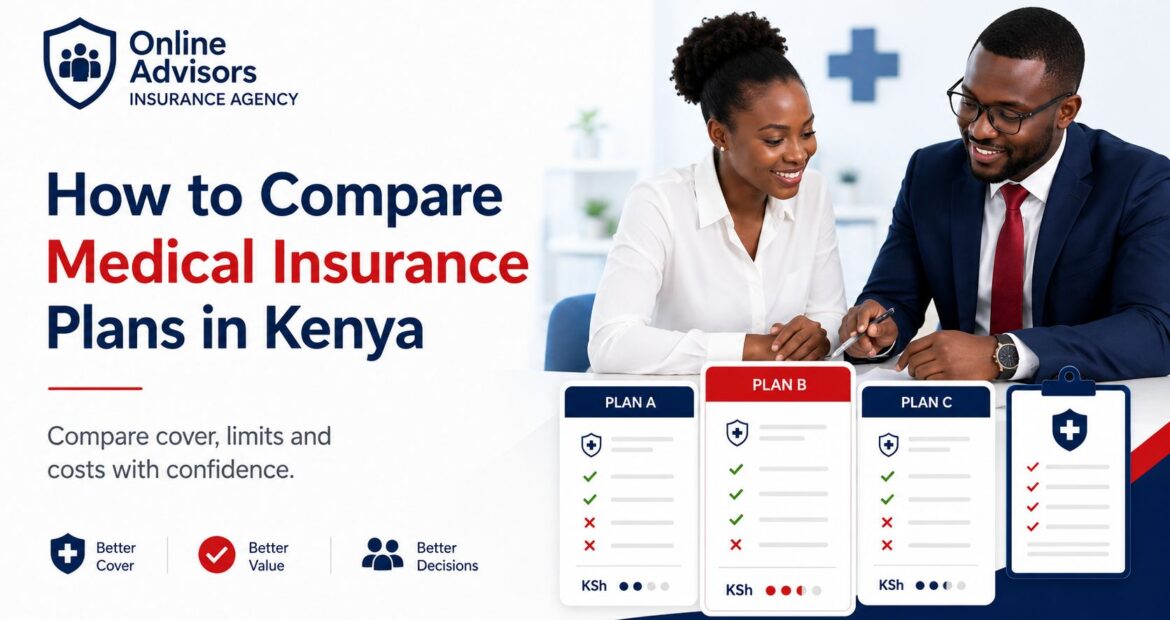
Choosing medical insurance in Kenya can be difficult because two plans with similar premiums can provide very different levels of protection.
One plan may offer a high inpatient limit but a restricted hospital network. Another may provide outpatient, maternity, dental and optical benefits but impose longer waiting periods. A third may look expensive until you realise that it provides stronger chronic-illness benefits, lower co-payments or wider access to hospitals.
The best way to compare health insurance is therefore not to ask only:
“Which plan is cheapest?”
Instead, ask:
“Which medical insurance plan provides the most suitable protection for my healthcare needs at a premium I can sustainably afford?”
Current Kenyan products demonstrate how widely benefits can differ. Jubilee’s J-Care currently provides inpatient options of up to KES 10 million and allows optional outpatient, maternity, dental and optical benefits, while Britam’s Milele range offers several levels of medical cover with different inpatient, outpatient, maternity, dental and optical structures.
This guide explains how to compare medical insurance plans in Kenya before choosing cover for yourself or your family.
1. Compare the Type of Medical Cover First
Before comparing premiums, confirm that the quotations are actually offering similar types of insurance.
Medical plans can broadly include:
- Inpatient-only cover
- Inpatient plus outpatient
- Comprehensive medical insurance
- Senior medical insurance
- Child-only cover
- International medical insurance
- Group or corporate medical insurance
An inpatient-only policy should not be compared directly with a comprehensive policy as though they provide the same protection.
For example, Jubilee’s CoverBora is currently structured primarily as an affordable inpatient plan with cover up to KES 500,000, while J-Care provides much broader benefit options and inpatient limits reaching KES 10 million.
Start by making sure you are comparing like with like.
2. Compare the Inpatient Limit
The inpatient limit is the maximum amount available for eligible hospitalisation expenses during the applicable policy period, subject to the benefit schedule and policy terms.
You may encounter limits such as:
- KES 250,000
- KES 500,000
- KES 1 million
- KES 2 million
- KES 5 million
- KES 10 million
A higher limit usually provides stronger protection against major hospital bills, but it may also increase the premium.
Jubilee’s current J-Care product, for example, offers inpatient protection up to KES 10 million, while lower-cost products in the market may provide substantially smaller limits.
Do not automatically choose the highest available limit. Choose a level that makes sense for your preferred hospitals, financial position and risk exposure.
3. Look Beyond the Headline Inpatient Limit
A common mistake is assuming that a KES 5 million inpatient policy provides KES 5 million for every medical condition.
Medical policies can contain sublimits.
There may be separate limits for:
- Hospital room and board
- ICU
- Chronic illnesses
- Pre-existing conditions
- Cancer treatment
- Maternity
- Psychiatric treatment
- Dental
- Optical
Britam’s Milele plans, for example, use separate benefit structures and sublimits for areas such as outpatient, dental, optical, maternity and chronic or pre-existing conditions depending on the selected plan.
Always request the detailed benefit schedule, not just the headline limit.
4. Compare Outpatient Cover
Outpatient cover handles eligible treatment that does not require hospital admission.
Depending on the plan, this may include:
- Doctor consultations
- Laboratory tests
- Prescription medicine
- Specialist visits
- Diagnostic imaging
- Minor procedures
- Physiotherapy
Outpatient limits can vary significantly.
A family with young children or a person managing a chronic condition may use outpatient services frequently, making this benefit particularly valuable.
If you rarely visit hospitals for routine treatment, you may instead choose stronger inpatient protection and self-fund ordinary outpatient expenses.
The correct balance depends on how your household actually uses healthcare.
5. Check the Hospital Network
One of the most important questions to ask before purchasing medical insurance is:
“Which hospitals can I use?”
Insurers generally work with networks of approved hospitals, clinics and other medical providers.
Britam provides an online hospital locator for customers, while Jubilee maintains provider panels for its health-insurance products.
Before buying, check whether your preferred hospitals are included near:
- Your home
- Your workplace
- Your children’s school
- Other areas where your family spends significant time
A cheap policy may offer poor practical value if the hospitals you actually want to use are outside the applicable network.
6. Compare Waiting Periods
Waiting periods determine when particular medical benefits become available after the policy starts.
They may apply to:
- General illnesses
- Maternity
- Chronic illnesses
- Pre-existing conditions
- Certain surgeries
- Other specified treatment
Do not assume that all insurers use identical waiting periods.
For example, Britam’s Milele Platinum documentation currently states no waiting period for accidental hospitalisation while outpatient care, dental, optical and acute inpatient care can have an initial 30-day period under that plan.
If two policies cost almost the same but one makes an important benefit available considerably earlier, that can materially affect value.
7. Compare Pre-Existing Condition Terms
If you or a family member already has a medical condition, this can become one of the most important areas in the entire comparison.
Ask:
- Is the condition covered?
- What waiting period applies?
- Is there a separate sublimit?
- Is medication covered?
- Are specialist consultations included?
- Does the policy require medical underwriting?
Some products explicitly provide cover for pre-existing conditions after specified waiting periods. Jubilee’s CoverBora, for example, currently states that pre-existing conditions become covered after 12 months.
Do not settle for the vague statement:
“Pre-existing conditions are covered.”
Ask exactly when, how, and up to what limit.
8. Compare Chronic Illness Benefits
A chronic condition can generate ongoing costs through medication, laboratory tests, consultations and specialist care.
Examples include:
- Diabetes
- Hypertension
- Asthma
- Certain heart conditions
When comparing plans, establish whether chronic treatment is handled under:
- Outpatient cover
- Inpatient cover
- A separate chronic-illness benefit
- A special sublimit
Jubilee’s current J-Care product specifically includes chronic-condition treatment among its benefits, while Britam’s corporate medical cover also lists chronic, recurring and pre-existing conditions within its medical benefit structure.
For someone already managing a chronic illness, this may be more important than having a large optical or dental benefit.
9. Compare Maternity Carefully
If you are planning to have children, do not simply ask whether maternity is included.
Compare:
Maternity limit
How much is available?
Waiting period
How long must you be insured before the benefit becomes available?
Normal delivery and Caesarean section
Are both covered and under what limits?
Pregnancy complications
How are they handled?
Newborn cover
When and how must the child be added?
Jubilee’s current J-Care plans include maternity as an optional benefit, while Britam’s Milele plans also provide maternity benefits at different limits depending on the selected plan.
If maternity is important to you, compare it as a separate benefit rather than relying on the overall inpatient limit.
10. Compare Dental and Optical Benefits
Dental and optical benefits are often useful but usually carry separate annual limits.
Dental may include eligible:
- Consultations
- Extractions
- Fillings
- Scaling
- Other specified procedures
Optical may include:
- Eye examinations
- Frames
- Prescription lenses
Britam’s current Milele Silver plan, for example, includes dental and optical benefits subject to its applicable limits, while Jubilee J-Care offers dental and optical as optional benefits.
Do not assume that a high inpatient limit means generous dental and optical limits.
11. Check Co-Payments
A co-payment is an amount you may need to contribute when receiving certain medical services.
Suppose:
Consultation cost:
KES 3,500
Applicable co-pay:
KES 500
You contribute KES 500 while the insurer handles the eligible balance according to the policy terms.
When comparing plans, ask:
- Does a co-pay apply?
- How much is it?
- Does it apply at every hospital?
- Are certain hospitals subject to higher co-pays?
- Does it apply to specialist visits?
A policy with a low annual premium can become less attractive if your family makes frequent visits and pays substantial co-payments throughout the year.
12. Compare Prescription Medicine Benefits
For many families, medicine accounts for a large share of outpatient medical spending.
Ask whether the policy covers:
- Prescription drugs
- Chronic medication
- Approved pharmacies
- Drug delivery
- Limits on particular medication
Jubilee’s current J-Care product includes drug delivery among its listed value-added services, while Britam Milele promotes pharmacy-based access for qualifying minor ailments under its Pharmacy First arrangement.
This can be particularly important for households that require medication every month.
13. Compare Cancer and Major Illness Benefits
A major medical insurance policy should be evaluated partly on how it protects against financially severe illnesses.
Ask specifically about:
- Cancer
- Chemotherapy
- Radiotherapy
- Dialysis
- ICU
- Major surgery
- HIV-related treatment
- Organ-related treatment
Jubilee’s J-Care currently lists cancer, HIV, chronic and congenital conditions among the areas covered within its product structure.
Do not assume that every serious condition automatically has access to the entire inpatient limit.
Check for benefit-specific sublimits.
14. Compare Emergency Evacuation
Emergency evacuation can become important where appropriate medical facilities are not available nearby.
Ask whether the plan provides:
- Road ambulance
- Emergency transfer
- Air evacuation
- Overseas emergency evacuation
- Repatriation
International plans generally provide broader geographic benefits. Jubilee’s Care and Health international plan, for example, currently includes worldwide emergency medical evacuation and repatriation.
A family that travels frequently may value this much more than one that receives almost all treatment within Nairobi.
15. Compare Geographical Coverage
Some plans focus on healthcare within Kenya.
Others provide:
- East African treatment
- Regional cover
- Overseas referral
- Worldwide medical treatment
Broader geographical coverage generally costs more.
Do not pay for international benefits merely because they sound impressive if your family is unlikely to use them.
But if you travel frequently, have family members studying abroad or want access to overseas treatment, wider geographical cover may be important.
16. Check Maximum Entry and Renewal Ages
Age can affect eligibility and premium.
This becomes particularly important when insuring parents.
Some insurers have separate senior health products. Jubilee’s J-Senior is currently designed for people aged 65 and above and includes inpatient and outpatient protection, while Britam’s Milele Senior currently accepts customers from age 55 and above.
Ask:
- What is the maximum joining age?
- Is there a maximum renewal age?
- Can parents join the ordinary family plan?
- Do they require a dedicated senior policy?
17. Compare Child Benefits
Families should check how children are treated under each policy.
Important areas include:
- Maximum dependant age
- Vaccinations
- Paediatric care
- Newborn cover
- Congenital conditions
- Emergency treatment
Some insurers also provide child-specific products. Britam’s Milele Junior, for example, was designed as a child-only medical product including inpatient, outpatient, dental and optical benefits.
This can be useful where parents already have medical insurance through an employer but need separate cover for a child.
18. Examine the Claims and Pre-Authorisation Process
A medical insurance policy is most valuable when you need treatment.
Ask:
- Is pre-authorisation required for admission?
- How are outpatient visits handled?
- Is there a digital card?
- How are reimbursement claims submitted?
- How quickly are approvals processed?
- Is customer support available outside normal office hours?
Britam currently promotes its Milele range as requiring no approvals for outpatient visits under its stated arrangement, illustrating how administrative processes can differ between plans.
Ease of use matters, especially during a medical emergency.
19. Compare the Premium Last — Not First
Premium matters, but it should be evaluated after you understand the cover.
Imagine three hypothetical policies:
| Feature | Plan A | Plan B | Plan C |
|---|---|---|---|
| Annual Premium | KES 40,000 | KES 75,000 | KES 110,000 |
| Inpatient | KES 500K | KES 2M | KES 5M |
| Outpatient | No | KES 100K | KES 200K |
| Maternity | No | Optional | Included |
| Dental | No | KES 10K | KES 20K |
| Optical | No | KES 10K | KES 20K |
| Chronic Cover | Limited | Included | Higher Limit |
| Hospital Network | Basic | Wider | Wider |
Plan A is cheapest.
But that does not make it automatically best.
Plan C provides the broadest benefits, but that does not mean every family needs it.
The best value might actually be Plan B.
Your job is to identify the point where:
Protection + affordability + healthcare needs meet.
20. Check Whether the Premium Is Sustainable
Health insurance is normally renewed annually.
Do not choose a policy that puts so much pressure on your household budget that you are likely to cancel it next year.
Medical insurance becomes more useful when you can maintain continuous cover.
When comparing plans, ask yourself:
Can I comfortably pay this premium every year?
A slightly more modest plan that you can maintain consistently may be better than a premium plan you can only afford temporarily.
21. Check What Happens at Renewal
Ask:
- Does premium increase with age?
- Will benefits change?
- Are completed waiting periods preserved?
- Will I need fresh medical underwriting?
- What happens after a major claim?
- What happens if there is a break in cover?
This is especially important where you already have pre-existing or chronic conditions.
Do not evaluate the policy as though you will only use it for twelve months.
22. Verify That the Insurer and Intermediary Are Licensed
Before purchasing health insurance, establish exactly who is underwriting your policy.
Kenya’s Insurance Regulatory Authority currently maintains a 2026 licensed-entities registry and publishes lists of licensed insurers and Medical Insurance Providers. Its Medical Insurance Provider list was updated as recently as 31 May 2026.
This is particularly important when dealing with insurance offers through:
- Social media
- Unfamiliar websites
- Unknown intermediaries
Never transfer money simply because someone has sent you an attractive medical insurance poster.
Confirm the insurer and intermediary first.
A Simple Medical Insurance Comparison Checklist
Use this when collecting quotations:
| What to Compare | Plan A | Plan B | Plan C |
|---|---|---|---|
| Annual Premium | |||
| Inpatient Limit | |||
| Outpatient Limit | |||
| Room Limit | |||
| ICU | |||
| Maternity | |||
| Maternity Waiting Period | |||
| Dental | |||
| Optical | |||
| Chronic Illness | |||
| Pre-existing Conditions | |||
| Cancer | |||
| Prescription Medicine | |||
| Hospital Network | |||
| Co-pay | |||
| Emergency Evacuation | |||
| Overseas Treatment | |||
| General Waiting Period | |||
| Major Exclusions | |||
| Maximum Entry Age |
Completing this table will give you a much clearer picture than simply comparing three premium figures.
Five Questions That Quickly Reveal Whether a Plan Is Good Value
If you do not want to analyse dozens of pages immediately, begin with these five questions:
1. What is the inpatient limit?
This shows the basic level of protection against major hospital bills.
2. Which hospitals can I use?
This establishes whether the policy is practical for your family.
3. What waiting periods apply?
This determines when important benefits actually become available.
4. How are pre-existing and chronic conditions handled?
This can be critical for households already managing medical conditions.
5. What will I still pay myself?
Check co-payments, exclusions and benefit sublimits.
If two plans still look similar after answering these questions, then compare the premium.
Common Mistakes When Comparing Health Insurance Plans
Choosing the Cheapest Plan Automatically
Cheap cover can be appropriate, but only when the benefits suit your needs.
Comparing Only Inpatient Limits
A KES 5 million policy with poor sublimits may not necessarily be better than a well-structured KES 2 million plan.
Ignoring the Hospital Network
Verify the hospitals you actually intend to use.
Ignoring Waiting Periods
A benefit that is unavailable for 12 months may not meet an immediate healthcare need.
Hiding Existing Medical Conditions
Provide accurate information where disclosure is required.
Forgetting Co-Payments
Frequent small payments can significantly increase your actual annual healthcare cost.
Buying More Cover Than You Can Maintain
Long-term affordability matters.
Should You Compare Medical Insurance Yourself or Use an Insurance Agency?
You can contact insurers individually.
However, every insurer may present its quotation differently.
One may emphasise inpatient limits.
Another may emphasise maternity.
Another may quote optional outpatient benefits separately.
An insurance agency can help standardise the comparison and explain:
- Premium differences
- Benefit limits
- Hospital networks
- Waiting periods
- Pre-existing-condition terms
- Co-payments
- Exclusions
This can make it easier to compare several insurers on the same basis.
Frequently Asked Questions
How do I compare medical insurance plans in Kenya?
Compare more than premium. Examine inpatient and outpatient limits, hospital networks, waiting periods, maternity, chronic and pre-existing-condition terms, co-payments, exclusions and claims procedures.
Which medical insurance company is best in Kenya?
There is no single insurer that is automatically best for every customer.
The most suitable option depends on your age, family size, medical needs, preferred hospitals, benefit requirements and budget.
Is a higher inpatient limit always better?
Not necessarily.
A higher limit provides more potential protection, but check benefit sublimits, exclusions and hospital access as well.
Should I choose inpatient-only medical insurance?
It can be suitable where your main goal is protection against major hospital bills and you are comfortable self-funding routine outpatient treatment.
Jubilee’s CoverBora is one current example of an inpatient-focused product.
Should I get outpatient cover?
Outpatient cover can be useful for families that frequently use doctors, medication, laboratory tests or specialist services.
The decision depends on expected usage and the additional premium.
How do I know whether a health insurer is licensed?
Use the Insurance Regulatory Authority’s current licensed-entity resources. IRA currently publishes its 2026 registry along with lists of licensed insurers and Medical Insurance Providers.
The Bottom Line
When comparing medical insurance plans in Kenya, do not compare price alone.
Compare:
Inpatient limit
Outpatient limit
Hospital network
Waiting periods
Maternity
Pre-existing conditions
Chronic illnesses
Cancer benefits
Dental
Optical
Co-payments
Medicine
Emergency evacuation
Exclusions
Claims process
Premium
The cheapest policy may provide excellent value for one family and inadequate protection for another.
Similarly, the most expensive policy is not automatically the best.
The right medical insurance plan is the one that provides meaningful protection against the medical expenses that matter most to you while remaining affordable enough to maintain over time.
Compare Medical Insurance Plans With Online Advisors
At Online Advisors Insurance Agency Ltd, we help individuals and families compare available medical insurance options from reputable insurers in Kenya.
Rather than comparing premium alone, we can help you review:
- Inpatient and outpatient limits
- Hospital networks
- Waiting periods
- Maternity
- Pre-existing conditions
- Chronic illness cover
- Dental and optical
- Co-payments
- Major exclusions
Request Health Insurance Quotes
Tel: 0723 645 810
Website: www.onsure.co.ke
Office: Vision Plaza, 1st Floor, Office 2, Mombasa Road, Nairobi
Compare the benefits. Compare the limits. Compare the terms. Then compare the price.
Important Disclaimer
This article provides general educational information and does not constitute medical advice, a quotation or a recommendation of a particular insurer. Medical insurance benefits, premiums, waiting periods, hospital networks, eligibility criteria and exclusions vary between insurers and may change. Always obtain current quotations and review the applicable benefit schedule and policy wording before purchasing cover.