


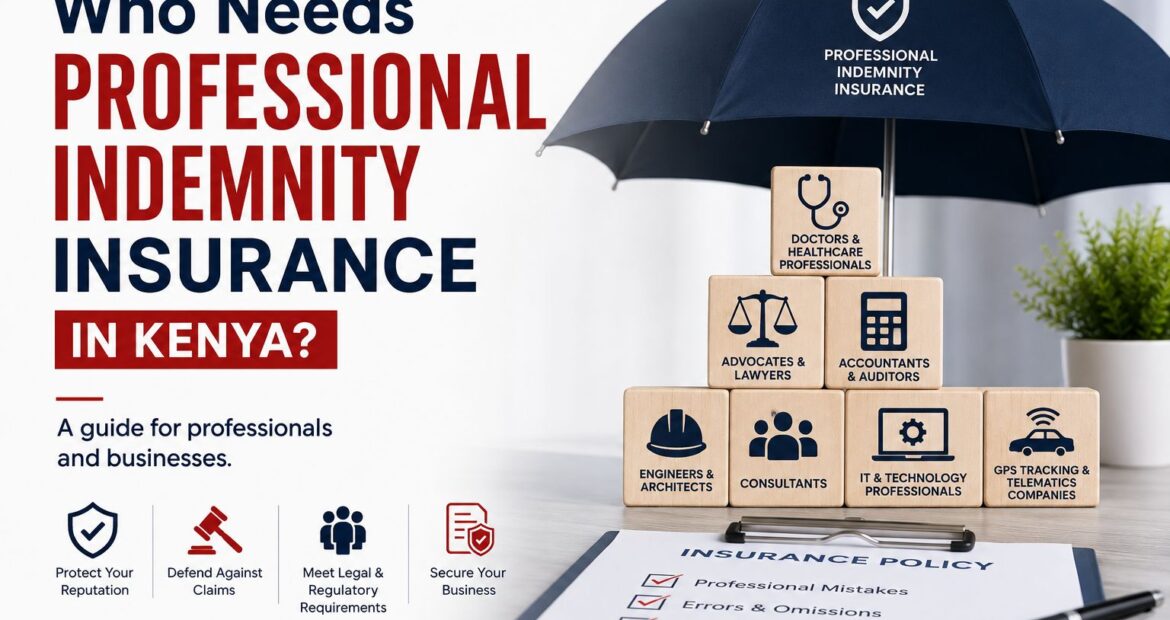
If you provide professional advice, make specialist recommendations, prepare reports, diagnose clients, certify work or deliver a service that another person relies on, an error in your work could potentially lead to a financial claim.
That is why Professional Indemnity Insurance, commonly known as PI Insurance, is important for many Kenyan professionals.
Professional indemnity insurance is designed to help protect professionals and professional firms against qualifying claims arising from alleged negligence, errors, omissions or failures in the delivery of professional services.
But who actually needs professional indemnity insurance in Kenya?
The answer falls into two broad categories:
Professionals who may be required by law, regulation, licensing rules or contracts to maintain PI insurance, and professionals who purchase it voluntarily because their work creates significant professional liability exposure.
Kenya currently has explicit professional-indemnity requirements for several regulated activities. For example, medical and dental practitioners must maintain professional indemnity cover for annual licensing, advocates are subject to the Advocates (Professional Indemnity) Regulations, and insurance brokers must maintain PI insurance meeting regulatory requirements.
This guide explains the professionals who should consider professional indemnity insurance in Kenya and why the cover matters.
What Is Professional Indemnity Insurance?
Professional indemnity insurance protects against certain liabilities arising from professional services.
Suppose you advise a client, prepare a report or perform specialised work and the client later alleges that:
- You made a professional mistake
- Important information was omitted
- Your advice was negligent
- You failed to perform a professional obligation
- Your work caused the client financial loss
The client may demand compensation or take legal action.
A professional indemnity policy can potentially respond to qualifying claims and associated legal defence costs, subject to the policy’s limits, exclusions and conditions.
For a detailed explanation of how the cover works, read our guide:
Professional Indemnity Insurance in Kenya Explained: What It Covers and How It Works
Who Should Consider Professional Indemnity Insurance?
A useful test is:
Could a client suffer a financial, professional or other measurable loss because of an error in the service I provide?
If the answer is yes, you may have professional liability exposure.
The following professions deserve particular attention.
1. Doctors and Medical Practitioners
Doctors are among the clearest examples of professionals exposed to professional-negligence claims.
A patient could allege that a practitioner:
- Made an incorrect diagnosis
- Failed to diagnose a condition
- Provided inappropriate treatment
- Made an error during a procedure
- Failed to provide sufficient professional care
- Failed to properly communicate medical risks
Medical practitioners therefore face potentially significant liability exposures.
In Kenya, this is not merely optional risk management for practitioners regulated by the Kenya Medical Practitioners and Dentists Council.
KMPDC’s 2026 renewal notice states that practitioners must take professional indemnity cover each year and that valid PI cover is a mandatory requirement for annual licensing.
For doctors, professional indemnity insurance is therefore both a regulatory consideration and an important financial protection mechanism.
2. Dentists and Community Oral Health Practitioners
Dental practitioners can also face allegations arising from professional treatment.
These could involve:
- Dental procedures
- Surgery
- Misdiagnosis
- Treatment complications
- Professional errors
- Failure to meet expected standards of care
KMPDC’s current licensing framework covers medical, dental and community oral health practitioners and requires valid professional indemnity cover for annual licence renewal.
Dental practices should therefore review both:
Individual practitioner PI insurance
and, where appropriate:
Professional liability protection for the healthcare facility itself.
3. Hospitals, Clinics and Other Health Institutions
Professional liability does not stop with individual practitioners.
Healthcare institutions can also face claims arising from the professional services delivered within their facilities.
Examples include allegations involving:
- Clinical negligence
- Treatment errors
- Institutional failures
- Staff-related professional liability
- Patient management
- Medical procedures
KMPDC’s 2026 renewal requirements state that valid professional indemnity cover is mandatory for the annual licensing of health institutions.
This means a clinic or medical centre should not assume that the doctor’s personal PI policy automatically replaces the institution’s own liability requirements.
The facility and the individual practitioner can have distinct exposures.
4. Clinical Officers
Clinical officers also face professional liability risks arising from diagnosis, treatment and other clinical services.
Kenya’s Clinical Officers (Training, Registration and Licensing) Act specifically provides that every clinical officer must take professional indemnity cover each year.
Professional indemnity should therefore form part of the annual professional risk-management and licensing considerations for practising clinical officers.
5. Nurses and Other Healthcare Professionals
Nurses provide direct patient care and can potentially face allegations relating to professional duties, clinical decisions, medication, patient monitoring and other areas of practice.
However, licensing and insurance requirements are not necessarily identical across every healthcare profession.
A nurse should therefore confirm the current PI requirements applicable through their employer, professional regulator or contracting institution rather than assuming that the rules applying to doctors or clinical officers automatically apply in exactly the same way.
Even where professional indemnity is not individually mandated in a particular working arrangement, healthcare professionals should understand whether they are protected under:
- An employer’s liability arrangement
- An institutional professional-indemnity policy
- An individual professional-indemnity policy
This becomes particularly important for nurses practising independently or providing professional services outside ordinary employment.
6. Advocates and Law Firms
Lawyers provide advice and representation that can have significant financial and legal consequences for clients.
Professional liability claims against advocates could arise from allegations such as:
- Missing an important filing deadline
- Failing to properly advise a client
- Mishandling professional responsibilities
- Errors in legal documentation
- Failure to act according to instructions
- Breach of professional duty
Kenya’s Advocates (Professional Indemnity) Regulations state that professional indemnity cover is intended to compensate clients for qualifying loss or damage arising from civil liability or breach of trust by an advocate or the advocate’s employees. The regulations also link compliance with professional-indemnity requirements to the issuance of practising certificates for advocates to whom they apply.
For practising advocates, PI insurance is therefore an essential professional requirement.
7. Accountants
Accountants regularly handle information that affects important financial decisions.
Their work can involve:
- Preparing financial statements
- Tax calculations
- Financial reporting
- Management accounts
- Advisory work
- Financial analysis
- Compliance work
An accounting error can potentially cause a client financial loss, tax exposure or regulatory difficulties.
Professional indemnity insurance can help protect practising accountants against qualifying allegations relating to professional services.
ICPAK’s practising and membership guidance includes professional indemnity insurance among requirements relevant to professional practice, and its licensing guidance has required practising accountants to submit appropriate PI cover.
8. Auditors
Auditors face particularly significant professional liability exposure because third parties and organisations may rely on audit opinions and reports.
Potential allegations could involve:
- Failure to identify material misstatements
- Inadequate audit procedures
- Errors in reporting
- Professional negligence
- Failure to identify relevant risks
The financial consequences of an audit-related claim can be significant, especially where the client is a large organisation.
For this reason, audit practices should maintain an appropriate level of professional indemnity insurance that reflects the size and nature of their engagements.
ICPAK’s guidance requires professional-indemnity protection appropriate to the risk assumed by practising accountants.
9. Insurance Brokers
Insurance brokers advise clients on risk and insurance placement.
Errors can have serious financial consequences.
For example, a broker could face allegations that they:
- Failed to arrange requested cover
- Provided incorrect advice
- Failed to renew insurance
- Misrepresented policy terms
- Failed to communicate an important exclusion
Kenya’s Insurance Regulatory Authority currently requires insurance brokers to maintain professional indemnity insurance with a minimum limit of KES 10 million as part of broker licensing requirements.
IRA’s 2026 licensing requirements also continue to address PI insurance requirements for insurance brokers and Medical Insurance Providers.
10. Insurance and Risk Consultants
Professionals advising clients about:
- Insurance programmes
- Enterprise risk management
- Claims
- Insurance placement
- Compliance
- Risk-control measures
can also create professional liability exposure.
Imagine a consultant advises a company that a particular risk is adequately insured.
A loss occurs and the company discovers a major gap in cover.
If the client alleges that the consultant’s professional advice caused the uninsured loss, the consultant could face a claim.
Professional indemnity can therefore be important even where the consultant is not operating as an insurance broker.
11. Engineers
Engineers provide technical expertise upon which expensive projects rely.
Professional liability exposures can arise from:
- Design errors
- Incorrect specifications
- Calculation errors
- Inadequate technical advice
- Certification errors
- Failure to identify a technical problem
Imagine an engineering consultancy designs part of a commercial development.
A design error is discovered after construction begins and significant corrective work is required.
The project owner could allege that the professional error caused millions of shillings in additional costs.
Professional indemnity insurance can help protect engineering firms against qualifying claims of this nature.
Major project contracts may also specify minimum PI limits as a condition of appointment.
12. Architects
Architects can face claims involving:
- Design errors
- Incorrect specifications
- Professional oversight
- Building-design problems
- Certification
- Failure to comply with professional obligations
Because errors can affect expensive construction projects, the potential financial exposure can be substantial.
Architectural firms should therefore evaluate their PI limit based on the size and value of the projects they undertake rather than simply choosing the cheapest available cover.
13. Quantity Surveyors
Quantity surveyors provide professional advice relating to project costs, valuations, quantities and contracts.
Claims could arise from alleged:
- Costing errors
- Incorrect estimates
- Measurement mistakes
- Professional negligence
- Contract-administration errors
A major error in a large construction project can result in significant financial consequences.
Professional indemnity can therefore be an important risk-management tool for quantity-surveying firms.
14. Management Consultants
Consultants are paid specifically for their expertise.
Their clients make strategic decisions based partly on their recommendations.
Consulting work may involve:
- Business strategy
- Operations
- Human resources
- Finance
- Technology
- Risk
- Management systems
If a client alleges that negligent professional advice caused financial damage, the consultant may need to defend the claim.
This makes PI insurance relevant to both large consulting firms and independent consultants.
15. Financial Consultants and Advisers
Professionals providing financial analysis or advice may be exposed to claims if a client alleges that negligent advice caused financial loss.
Examples could involve:
- Financial modelling
- Investment-related analysis
- Business valuations
- Financial projections
- Financing recommendations
- Transaction advisory work
The precise regulatory and insurance requirements depend on the type of financial service being provided.
However, anyone providing professional financial advice should assess whether their services create an errors-and-omissions exposure.
16. IT Consultants and Technology Companies
Professional indemnity is increasingly relevant to technology businesses.
Technology professionals may provide:
- Software development
- IT consulting
- System implementation
- Cybersecurity consulting
- Database management
- Cloud services
- System integration
- Technical support
Consider a software company that installs a system for a client.
An alleged configuration error causes the client’s business system to fail for several days.
The client claims millions of shillings in lost revenue.
That may create a professional-liability exposure.
Technology companies should consider whether they require:
Professional Indemnity / Technology Errors & Omissions
alongside:
Cyber Insurance.
The two covers address different but potentially overlapping risks.
17. GPS Tracking and Telematics Companies
GPS tracking companies provide technology services upon which vehicle owners, lenders, fleet operators and insurers may rely.
Potential professional-liability scenarios could include allegations that:
- Tracking information was incorrect
- A system failed to send an expected alert
- A monitoring service was not performed according to contract
- A system configuration error affected service
- Professional services were provided incorrectly
This does not mean that every vehicle theft or tracking-system failure automatically creates liability.
The actual legal position depends on the contract, circumstances and duty undertaken by the service provider.
However, GPS tracking and telematics companies should carefully assess their professional-services exposure, particularly where they enter contracts promising monitoring, reporting, fleet management or other specialist services.
PI or technology errors-and-omissions insurance can therefore be worth considering alongside cyber, public liability and other business covers.
18. Surveyors and Valuers
Clients, lenders and insurers frequently rely on professional valuations.
An allegedly incorrect valuation could potentially cause financial loss.
For example, a lender could rely on a valuation when making a financing decision.
If the value is later alleged to have been negligently overstated, a professional dispute could follow.
Surveyors and valuers should therefore consider professional indemnity insurance appropriate to the size of the valuations and assignments they undertake.
19. Real Estate and Property Consultants
Professionals providing specialised property advice can face liability where clients rely on:
- Property valuations
- Development advice
- Due diligence
- Property-management advice
- Professional reports
The risk increases where the professional is responsible for making technical or advisory judgements rather than simply facilitating a transaction.
20. Recruitment and Human Resource Consultants
HR and recruitment consultants may also provide professional advice that influences important business decisions.
Depending on the nature of the services, claims could potentially arise from:
- Negligent professional advice
- Incorrect candidate information
- Failures in professional screening
- Errors in consultancy work
Whether PI insurance is appropriate depends on the precise services provided and the contractual obligations assumed.
21. Business Advisers and Startup Consultants
Professionals who advise entrepreneurs and businesses on:
- Strategy
- Financial planning
- Operations
- Investor readiness
- Business restructuring
- Governance
should also consider professional-liability exposure.
Simply giving business advice does not mean that every failed business decision becomes the adviser’s responsibility.
However, if a client alleges that a professional adviser acted negligently and caused a measurable financial loss, a liability claim may follow.
22. Freelancers and Independent Professionals
A common misconception is that professional indemnity insurance is only for large firms.
It is not.
An independent professional may actually be financially more vulnerable to a claim because they do not have the balance sheet, legal department or financial reserves of a large company.
Freelancers who provide:
- Consulting
- Design
- Technology
- Accounting
- Professional advice
- Specialist reports
- Project management
should assess whether a client could reasonably claim financial loss arising from their professional work.
Professional Indemnity May Be Required by Your Client Even When the Law Does Not Require It
This is an important distinction.
Professional indemnity insurance can be:
Legally or regulatorily required
or:
Contractually required.
Suppose a company appoints a consultant to work on a major project.
The contract may state:
The consultant must maintain professional indemnity insurance of not less than KES 20 million.
The consultant must then maintain that limit to satisfy the contract even if there is no general law requiring every consultant in that industry to carry PI insurance.
PI requirements commonly appear in professional-service contracts, procurement requirements and consultancy engagements.
An ICPAK 2026 consultancy tender, for example, required professional-liability insurance covering the full amount of the contract.
Always read the insurance section of a client contract before signing it.
Which Professionals Need PI Insurance Most?
Professional indemnity deserves especially serious consideration where your work involves:
Giving Professional Advice
The client relies on your judgement.
Designing or Specifying Something
An error could lead to costly corrective work.
Preparing Professional Reports
Third parties may rely on the report.
Diagnosing or Treating People
Errors can result in significant claims.
Handling Client Money or Important Transactions
Mistakes can cause financial loss.
Certifying Work
The client relies on your professional confirmation.
Working on High-Value Contracts
Even a small error can create a large financial claim.
Being Required by a Regulator
The cover may be necessary for your professional licence.
Being Required by a Client
The contract may specify a minimum PI limit.
If several of these apply to your work, PI insurance should be seriously considered.
How Much Professional Indemnity Cover Do You Need?
There is no universal amount.
One consultant may require:
KES 5 million
while another may require:
KES 100 million
or more.
Consider:
- Regulatory minimums
- Largest client contract
- Potential maximum financial loss
- Number of clients
- Annual turnover
- Nature of professional services
- Client requirements
- Legal defence costs
- Previous claims
Insurance brokers provide a useful example of a regulated minimum: IRA currently requires a professional-indemnity limit of at least KES 10 million for broker licensing.
Other professions may have different requirements.
What Happens if You Do Not Have Professional Indemnity Insurance?
If a client successfully brings a professional-liability claim and no applicable insurance exists, the professional or firm may need to finance:
- Lawyers
- Expert witnesses
- Court costs
- Settlements
- Damages
from their own resources.
Even an unsuccessful claim can be expensive to defend.
For a small professional firm, a major dispute can threaten:
- Cash flow
- Business assets
- Reputation
- Ability to continue operating
Insurance therefore helps transfer part of this financial exposure to the insurer according to the policy terms.
Professional Indemnity Does Not Replace Good Professional Practice
Having PI insurance should never be treated as permission to become careless.
Strong risk management remains essential.
Professionals should maintain:
- Clear contracts
- Written client instructions
- Proper records
- Documented advice
- Quality-control procedures
- Complaint procedures
- Professional standards
- Staff training
- Proper client communication
Good documentation is particularly important.
If a client alleges that you failed to give particular advice, written records can become essential evidence when defending the claim.
How Do You Know Whether You Need Professional Indemnity Insurance?
Ask yourself these seven questions:
- Do clients pay me for professional knowledge or expertise?
- Do clients rely on my advice when making important decisions?
- Could an error in my work cause a client financial loss?
- Do I prepare reports, designs, valuations or certifications?
- Does my regulator require professional indemnity?
- Do my client contracts require professional indemnity?
- Could I afford to personally finance a substantial professional-negligence claim?
If you answer yes to one or more of these questions, you should investigate professional indemnity insurance.
Questions to Ask Before Buying Professional Indemnity Insurance
When requesting a quotation, ask:
What professional activities are covered?
Make sure the business description reflects what you actually do.
What is the limit of indemnity?
Determine the maximum amount available.
Is the limit any one claim or aggregate?
Understand how multiple claims affect the policy.
What excess applies?
Know your financial contribution.
What is the retroactive date?
This is especially important for previous professional work.
Are legal defence costs inside the limit?
This can materially affect available protection.
What geographical limits apply?
Important if you work with international clients.
What exclusions apply?
Understand what the policy does not cover.
Is the policy claims-made?
Understand when claims must be made and notified.
Who May Not Need Professional Indemnity Insurance?
Not every business necessarily requires PI cover.
A business whose operations do not involve professional advice or specialist services may have more important exposures covered by:
- Public liability
- Product liability
- Property insurance
- WIBA
- Motor insurance
- Cyber insurance
- Goods-in-transit insurance
For example, a retailer selling ordinary consumer products may generally have a different risk profile from an engineering consultant.
The correct insurance depends on what the business actually does.
Frequently Asked Questions
Who needs professional indemnity insurance in Kenya?
Professionals who provide advice, treatment, designs, reports, audits, certifications or specialist services should consider PI insurance. Some regulated professions and activities also have specific professional-indemnity requirements.
Is professional indemnity compulsory for doctors in Kenya?
KMPDC’s 2026 renewal notice states that medical, dental and community oral health practitioners must maintain valid professional indemnity cover as a mandatory requirement for annual licensing.
Do advocates need professional indemnity insurance?
Yes, advocates to whom Kenya’s Professional Indemnity Regulations apply must comply with the relevant requirements for issuance of their practising certificates.
Do insurance brokers need professional indemnity insurance?
Yes. IRA currently requires insurance brokers to maintain a PI policy with a minimum limit of KES 10 million as part of licensing requirements.
Do accountants need professional indemnity insurance?
Professional indemnity is particularly relevant to practising accountants and audit firms. ICPAK guidance includes PI insurance among requirements associated with professional practice and licensing.
Do consultants need professional indemnity insurance?
It may not be legally compulsory for every consultant, but it can be important where clients rely on professional advice and could suffer financial loss from an alleged error.
Clients can also make PI insurance a contractual requirement for consultancy assignments.
Do GPS tracking companies need professional indemnity insurance?
There is no general rule that every GPS tracking company must carry PI insurance simply because it provides tracking services. However, companies providing professional monitoring, reporting, telematics or technology services should assess whether service failures or professional errors could create liability and whether PI or technology errors-and-omissions insurance is appropriate.
The Bottom Line
Professional indemnity insurance is particularly important for people whose knowledge, judgement, advice or professional services can cause another person financial loss if something goes wrong.
In Kenya, this includes professionals such as:
Doctors
Dentists
Clinical officers
Advocates
Accountants
Auditors
Insurance brokers
Consultants
Engineers
Architects
Technology professionals
GPS tracking and telematics service providers
Valuers and surveyors
and many other professional-service businesses.
For some, PI insurance is a licensing requirement.
For others, it may be required by a client contract.
And for many professionals, it is simply sensible risk management.
The question should therefore not only be:
“Am I legally required to have PI insurance?”
Also ask:
“What could happen financially if a client alleges that my professional work caused them a loss?”
If the answer could threaten your business or personal finances, professional indemnity insurance deserves serious consideration.
Get a Professional Indemnity Insurance Quote in Kenya
At Online Advisors Insurance Agency Ltd, we help professionals and businesses compare professional indemnity insurance options from reputable insurance companies in Kenya.
We can assist professionals including:
- Doctors and medical practitioners
- Advocates and law firms
- Accountants and auditors
- Consultants
- Technology businesses
- GPS tracking and telematics companies
- Other professional service providers
We can help you compare:
- Limits of indemnity
- Premiums
- Excesses
- Retroactive dates
- Claims-made conditions
- Legal defence protection
- Important exclusions
Request a Professional Indemnity Insurance Quote
Tel: 0723 645 810
Website: www.onsure.co.ke
Office: Vision Plaza, 1st Floor, Office 2, Mombasa Road, Nairobi
Your clients rely on your expertise. Protect yourself when professional work is challenged.
Important Disclaimer
This article provides general educational information and does not constitute legal advice or confirmation that every profession listed has a statutory requirement to maintain professional indemnity insurance. Regulatory and licensing requirements vary by profession and may change. Professionals should confirm current requirements with the relevant regulator or professional body and review the applicable insurance quotation and policy wording before purchasing cover.