


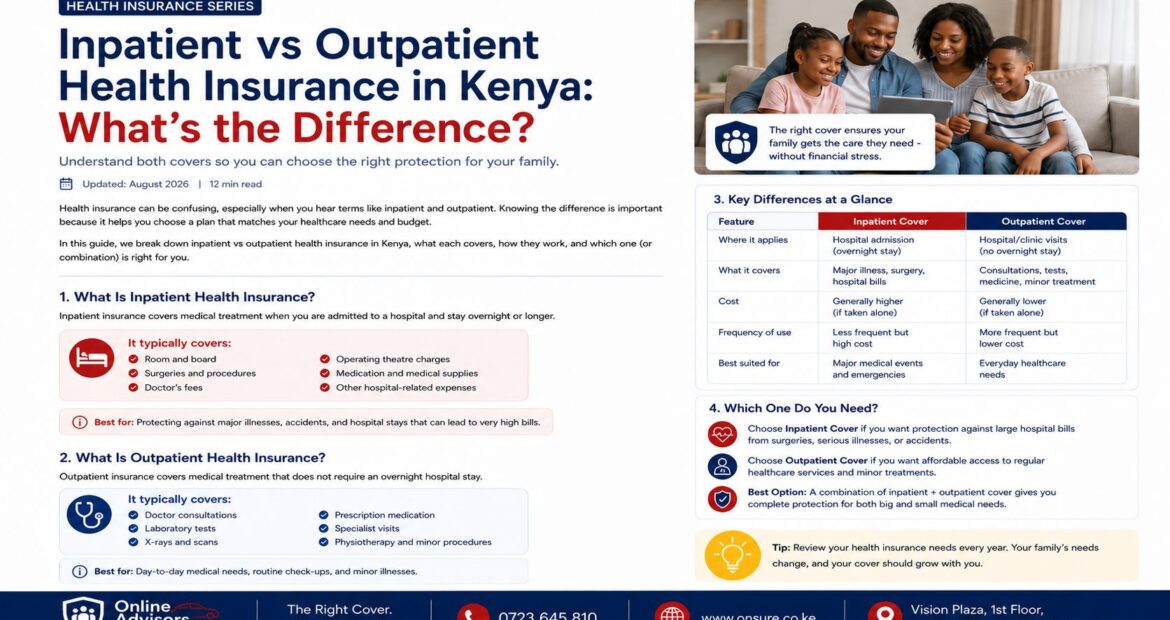
When comparing health insurance in Kenya, two terms appear repeatedly:
Inpatient cover and outpatient cover.
They sound similar, but they protect against very different types of medical expenses.
The simplest distinction is this:
Inpatient cover applies when you are admitted to hospital, while outpatient cover generally applies when you receive medical treatment without being admitted.
For example, if you visit a clinic for a consultation, receive medication and go home the same day, the treatment would normally fall under the outpatient section of a medical insurance plan.
If you undergo surgery and are admitted to hospital for several days, the eligible expenses would generally fall under the inpatient benefit.
Many Kenyan medical insurance products combine the two. Jubilee’s current J-Care Johari, for example, bundles inpatient and outpatient cover, while Britam’s Bima Ya Mwananchi also provides inpatient and outpatient options for individuals and families.
Understanding the difference is important because choosing the wrong balance of benefits can leave your family paying significant medical expenses from your own pocket.
This guide explains inpatient and outpatient health insurance in Kenya, what each typically covers, how their limits work, and which benefit you should prioritise when choosing a medical insurance plan.
What Is Inpatient Health Insurance?
Inpatient health insurance provides protection for eligible medical expenses when an insured person is formally admitted to hospital for treatment.
A hospital admission may be required because of:
- Surgery
- Serious illness
- Accident injuries
- Complications requiring monitoring
- Intensive care
- Treatment that cannot safely be provided on an outpatient basis
Inpatient insurance is often considered the foundation of private medical insurance because hospital admissions can produce very large and unexpected bills.
Current Kenyan medical products can provide significantly different inpatient limits. Jubilee’s J-Care, for example, currently offers inpatient cover of up to KES 10 million, depending on the plan selected.
What Does Inpatient Health Insurance Usually Cover?
The exact benefits differ between insurers, but inpatient insurance can include eligible expenses such as:
- Hospital accommodation
- Doctor’s fees
- Specialist fees
- Surgery
- Theatre charges
- Nursing care
- Diagnostic tests
- Prescription medicines used during admission
- ICU treatment
- Hospital procedures
- Accident-related hospitalisation
Additional benefits may apply depending on the product.
Always check the insurer’s actual benefit schedule and policy wording rather than assuming every inpatient plan provides identical protection.
Example of an Inpatient Claim
Suppose your child develops appendicitis.
After examination, the doctor determines that emergency surgery is required.
The child is admitted to hospital for three nights.
The eligible medical costs might include:
Hospital room: KES 45,000
Surgery and theatre: KES 180,000
Surgeon’s fees: KES 70,000
Tests and scans: KES 30,000
Medication: KES 20,000
Total medical bill:
KES 345,000
If your family has an inpatient medical policy with an adequate limit, the insurer may settle eligible expenses according to the terms and limits of the policy.
Without inpatient insurance, the family may need to finance the entire bill itself.
This is why inpatient cover is particularly important for protecting household savings against large medical costs.
What Is Outpatient Health Insurance?
Outpatient health insurance covers eligible medical treatment where you visit a healthcare provider but are not admitted to hospital.
You may visit a doctor, receive treatment and return home on the same day.
Typical outpatient visits include:
- Doctor consultations
- Treatment for common illnesses
- Laboratory tests
- Prescription medicine
- X-rays
- Specialist consultations
- Routine medical reviews
Outpatient benefits are designed primarily for the day-to-day healthcare expenses families experience more frequently.
Jubilee currently offers an outpatient-focused product, Cover Nafuu, which provides unlimited outpatient visits at a selected clinic from KES 4,000 per year, demonstrating that outpatient protection can also exist independently of a broader inpatient plan.
What Does Outpatient Health Insurance Usually Cover?
Depending on the insurer, eligible outpatient benefits may include:
- General practitioner consultations
- Specialist consultations
- Prescription medicine
- Laboratory tests
- X-rays
- Diagnostic imaging
- Minor procedures
- Physiotherapy
- Routine health checks
- Chronic disease monitoring
Some products also include:
- Vaccinations
- Wellness benefits
- Mental-health consultations
- Telemedicine
- Drug delivery
Jubilee’s J-Care currently includes features such as annual check-ups, vaccinations, telemedicine and drug delivery within its broader medical offering.
The exact benefit depends on the plan.
Example of an Outpatient Claim
Suppose your child develops a high fever.
You visit a hospital.
The costs are:
Consultation: KES 2,500
Laboratory tests: KES 3,000
Medication: KES 2,500
Total:
KES 8,000
The child is treated and goes home.
Because there was no admission, this would ordinarily be considered an outpatient medical expense, subject to your policy.
If the family only has inpatient insurance, it may need to pay the KES 8,000 itself.
If outpatient cover is included and the treatment qualifies, the insurer may pay the eligible costs subject to the policy limit and any applicable co-payment.
Inpatient vs Outpatient Health Insurance: Quick Comparison
| Feature | Inpatient | Outpatient |
|---|---|---|
| Hospital admission required | Usually yes | Usually no |
| Major surgery | Usually covered subject to policy | Generally not the primary benefit |
| Hospital accommodation | Yes, subject to limits | No |
| ICU treatment | Usually under inpatient | No |
| Routine doctor visits | Usually no | Yes |
| Prescription medicine | During admission | Usually yes, subject to limit |
| Laboratory tests | During admission | Usually yes |
| Specialist consultations | During admission or policy terms | Often covered |
| Frequency of use | Less frequent | More frequent |
| Potential cost per event | Usually higher | Usually lower |
| Main purpose | Protect against major hospital costs | Manage routine healthcare costs |
This distinction helps explain why inpatient insurance normally carries much higher overall financial limits than outpatient insurance.
Which Is More Important: Inpatient or Outpatient Cover?
If you have a limited insurance budget, inpatient cover should usually receive serious priority because hospital admissions can create very large bills.
Imagine two medical expenses.
Outpatient event
Consultation + medicine:
KES 5,000
Inpatient event
Surgery + four nights in hospital:
KES 600,000
A household may be able to absorb several KES 5,000 medical visits from income or savings.
A sudden KES 600,000 hospital bill may be much more difficult.
That is the basic financial reasoning behind using insurance primarily to protect against large, unpredictable losses.
However, this does not mean outpatient insurance is unimportant.
Families with regular medical usage can spend significant amounts on outpatient treatment over the course of a year.
When Is Outpatient Cover Particularly Valuable?
Outpatient insurance can be valuable where your family:
- Has young children
- Frequently visits doctors
- Requires regular prescription medicine
- Has chronic medical conditions
- Frequently needs laboratory tests
- Uses specialists regularly
- Wants predictable healthcare expenses
Consider a family that visits a clinic twice every month.
If average consultation, testing and medication expenses are:
KES 5,000 per visit
Twenty-four visits in one year could cost:
KES 120,000
In such a case, an appropriate outpatient benefit could provide significant financial value.
Can You Buy Inpatient Insurance Without Outpatient Cover?
Yes, depending on the insurer and product.
Some medical plans provide inpatient-only options.
This can be useful for individuals and families who want protection against major hospitalisation but prefer to pay routine healthcare costs themselves.
Jubilee’s CoverBora is a current example of an inpatient-focused medical product, with family-friendly pricing starting from KES 11,200 per year.
However, other products package inpatient and outpatient together.
For example, Jubilee’s J-Care Johari currently combines inpatient and outpatient cover and states that the two are bundled under that product.
Can You Buy Outpatient Cover Without Inpatient Insurance?
Some products allow this.
Jubilee’s Cover Nafuu is a current example of outpatient-focused protection, offering access to outpatient visits at a selected clinic.
However, purchasing outpatient-only cover leaves you exposed to the potentially much larger costs associated with hospital admission.
If your budget allows, consider whether you need protection against both routine healthcare expenses and major hospitalisation.
What Is an Inpatient Limit?
The inpatient limit is the maximum amount the insurer will pay for eligible inpatient medical expenses during the applicable policy period, subject to the policy terms.
For example:
Inpatient limit: KES 1,000,000
If your eligible hospital expenses during the year reach:
KES 700,000
you may still have:
KES 300,000
of the overall inpatient limit remaining, subject to any sublimits or policy conditions.
However, health insurance limits are not always as simple as one headline number.
There may also be smaller limits for:
- Hospital room
- ICU
- Chronic conditions
- Cancer
- Organ treatment
- Psychiatric care
- Other specialised treatment
Always check the detailed benefit schedule.
What Is an Outpatient Limit?
The outpatient limit is the maximum available amount for eligible outpatient expenses during the policy period.
For example:
Outpatient limit: KES 100,000 per year
Eligible outpatient expenses may include:
- Consultations
- Medicine
- Tests
- Specialist visits
Once the limit is exhausted, the family generally needs to finance additional outpatient expenses itself until the next policy period, unless another applicable benefit exists.
Why Are Outpatient Limits Usually Lower Than Inpatient Limits?
Because the financial nature of the risks is different.
Outpatient claims are generally:
More frequent but smaller.
Inpatient claims are generally:
Less frequent but potentially much larger.
An outpatient consultation might cost several thousand shillings.
A serious inpatient claim involving surgery or ICU can cost hundreds of thousands or even millions of shillings.
This is why a policy might provide:
KES 100,000 outpatient
while providing:
KES 2 million inpatient.
The two limits address different levels of financial risk.
What Is a Co-Payment?
A co-payment, or co-pay, is an amount the insured person may need to contribute when accessing certain medical services.
For example:
Hospital consultation:
KES 3,000
Applicable co-pay:
KES 500
The patient pays:
KES 500
and the insurer handles the eligible balance according to the policy terms.
Co-payments are particularly common in outpatient medical insurance arrangements.
When comparing policies, ask:
- Is there a co-pay?
- How much is it?
- Does it apply at every facility?
- Are some hospitals subject to higher co-payments?
- Does it apply to specialist visits?
A policy with a low annual premium but significant co-payments may cost your family more in actual use.
Does Outpatient Cover Include Medicine?
It often can, but never assume this.
Ask whether your policy covers:
- Prescription medicine
- Chronic medication
- Approved pharmacies
- Limits on certain medicines
- Drug delivery
Britam’s Milele range currently includes Pharmacy First, which allows qualifying members to access medication for selected minor ailments from participating pharmacies without first visiting a hospital.
Medication arrangements differ significantly between insurers.
What Happens if an Outpatient Visit Turns Into a Hospital Admission?
This is an important practical situation.
Suppose you visit an outpatient clinic with severe abdominal pain.
The doctor conducts tests and decides that you need immediate surgery.
Your treatment may move from:
Outpatient
to:
Inpatient.
The insurer’s benefit allocation will depend on its rules and the structure of the claim.
The initial consultation and tests may be handled differently from the subsequent hospital admission.
Your insurer or medical provider should advise how the claim will be allocated.
Does Inpatient Cover Include Maternity?
Not automatically.
Maternity is frequently treated as a separate benefit.
A medical plan can have:
KES 2 million inpatient cover
but only:
KES 100,000 maternity cover.
Maternity may also have its own waiting period.
Therefore, couples planning to have children should compare maternity separately rather than assuming it falls fully within the main inpatient limit.
Does Outpatient Cover Include Dental and Optical?
Not necessarily.
Dental and optical are commonly separate benefits or optional add-ons.
For example, Jubilee’s current J-Care provides optional outpatient, maternity, dental and optical benefits rather than treating every benefit as automatically included within the basic inpatient cover.
Always check:
Dental limit
and:
Optical limit
separately.
What About Chronic Illnesses?
Chronic conditions can create both inpatient and outpatient expenses.
For example, a person with diabetes may need:
Outpatient
- Regular doctor reviews
- Blood tests
- Medication
- Monitoring
but may occasionally require:
Inpatient
- Hospital admission following complications
Therefore, households managing chronic illness should examine both sections of the policy.
Jubilee’s current J-Care includes chronic-condition care, while Jubilee’s Cover Nafuu outpatient product also states that chronic illness support is included.
Check the actual chronic-condition sublimits and waiting periods.
What About Cancer Treatment?
Cancer treatment can involve both outpatient and inpatient services.
For example:
- Specialist consultations
- Diagnostic tests
- Chemotherapy
- Radiotherapy
- Surgery
- Hospital admission
Different medical plans allocate these costs differently.
Jubilee’s J-Care currently identifies cancer treatment among its covered medical areas.
When comparing policies, ask whether cancer treatment:
- Has a separate limit
- Falls within inpatient
- Has outpatient components
- Requires pre-authorisation
- Has a waiting period
What Is Pre-Authorisation?
Some medical procedures require insurer approval before treatment proceeds.
This is commonly called:
Pre-authorisation.
It may apply to:
- Hospital admission
- Surgery
- Expensive diagnostic procedures
- Specialist treatment
- Certain medications
The process allows the insurer to confirm that:
- The member is covered
- The benefit is available
- The treatment meets policy requirements
- The hospital is authorised
For routine outpatient services, some products have simplified procedures. Britam’s current Milele range, for example, states that outpatient visits do not require approvals under its stated arrangement.
Should a Family Have Both Inpatient and Outpatient Insurance?
For many households, having both provides more complete protection.
Inpatient insurance protects against:
Large, less frequent medical expenses.
Outpatient insurance helps manage:
Smaller, more frequent healthcare costs.
A family with both benefits may therefore have protection across a much wider range of medical needs.
However, affordability matters.
You should choose a policy that your household can sustainably renew.
Example: Family With Inpatient Only
Consider a family with:
KES 1 million inpatient cover
but:
No outpatient cover.
During the year:
Outpatient visits: KES 60,000
Hospital admission: KES 350,000
The family may need to pay:
KES 60,000
of routine outpatient expenses itself.
But the eligible KES 350,000 hospital admission may fall within the inpatient insurance, subject to policy terms.
This arrangement can still provide strong protection against catastrophic medical costs.
Example: Family With Inpatient + Outpatient
Another family has:
Inpatient: KES 2 million
Outpatient: KES 100,000
During the year:
Outpatient expenses: KES 70,000
Hospital admission: KES 400,000
Both sets of eligible costs may fall within their respective policy benefits.
This provides broader financial protection but usually comes with a higher premium.
Which Option Is Better for a Young Family?
Families with young children often use outpatient services relatively frequently for:
- Fever
- Respiratory illnesses
- Infections
- Vaccinations
- General consultations
- Minor injuries
For this reason, outpatient cover can be particularly useful.
However, the family should still consider adequate inpatient protection in case a child requires:
- Surgery
- Hospital admission
- Serious infection treatment
- Accident treatment
A balanced family medical plan may therefore provide both.
What About a Healthy Single Adult?
A healthy adult who rarely visits doctors might decide to prioritise:
Strong inpatient cover
while self-funding ordinary outpatient expenses.
This can reduce the insurance premium while still protecting against severe financial shocks.
The right decision depends on:
- Savings
- Income
- Health status
- Age
- Medical usage
- Risk tolerance
What About a Family Managing Chronic Conditions?
A household with regular medical needs should pay particular attention to outpatient benefits.
For example:
- Monthly medication
- Frequent laboratory tests
- Specialist reviews
can become expensive over a year.
Check:
- Outpatient limit
- Chronic illness sublimit
- Medicine benefit
- Specialist benefit
- Co-payment
- Waiting periods
A cheap inpatient-focused policy may not adequately address these routine costs.
How to Compare Inpatient and Outpatient Health Insurance Plans
When requesting quotations, create a table like this:
| Feature | Plan A | Plan B | Plan C |
|---|---|---|---|
| Annual Premium | |||
| Inpatient Limit | |||
| Outpatient Limit | |||
| Room Limit | |||
| ICU | |||
| Co-pay | |||
| Prescription Medicine | |||
| Chronic Illness | |||
| Cancer | |||
| Maternity | |||
| Dental | |||
| Optical | |||
| Hospital Network | |||
| Waiting Period | |||
| Pre-existing Conditions |
This allows you to see whether a higher premium is actually buying more useful protection.
Questions to Ask Before Choosing a Plan
Before buying family medical insurance, ask:
- What is the inpatient limit?
- What is the outpatient limit?
- Is outpatient included or optional?
- What hospital room limit applies?
- What co-payment applies?
- Which hospitals can we use?
- Are prescription medicines covered?
- Are specialist consultations covered?
- How are chronic conditions treated?
- What waiting periods apply?
- Is maternity included?
- Are dental and optical included?
- Are pre-existing conditions covered?
- What major exclusions apply?
- What happens when a benefit limit is exhausted?
These questions will tell you far more than simply asking:
“How much is the premium?”
Common Mistakes to Avoid
Mistake 1: Assuming Inpatient Covers Everything
It does not automatically cover routine outpatient treatment.
Mistake 2: Buying Outpatient Only and Ignoring Hospitalisation Risk
Routine treatment can be manageable.
A serious hospital admission can create a much larger financial burden.
Mistake 3: Looking Only at the Overall Limit
Check the sublimits.
Mistake 4: Ignoring Co-Payments
Frequent co-payments can add up over the year.
Mistake 5: Assuming Every Hospital Accepts Your Medical Card
Check the provider network.
Mistake 6: Ignoring Waiting Periods
Some benefits may not be immediately available.
Mistake 7: Buying More Cover Than You Can Sustain
Medical insurance should be affordable enough to renew consistently.
Inpatient vs Outpatient: Which Should You Choose?
A useful way to decide is:
Choose strong inpatient protection if:
- Your main concern is major hospital bills
- Your insurance budget is limited
- You can comfortably self-fund routine medical visits
- You rarely use outpatient services
Consider inpatient plus outpatient if:
- You have young children
- Your family visits doctors regularly
- Someone requires chronic medication
- You want predictable day-to-day medical expenses
- Your budget can support the additional premium
Neither structure is automatically better.
The correct choice depends on your family’s healthcare needs and financial position.
Verify Your Insurance Provider
Before buying medical insurance, confirm that you are dealing with appropriately licensed insurance-market participants.
The Insurance Regulatory Authority currently maintains 2026 listings for licensed insurers and licensed Medical Insurance Providers in Kenya.
This is especially important when receiving medical insurance offers through:
- Social media
- Online advertisements
- Unfamiliar intermediaries
Always know which insurance company is actually underwriting the policy.
Frequently Asked Questions
What is the difference between inpatient and outpatient insurance in Kenya?
Inpatient insurance generally covers eligible treatment requiring hospital admission, while outpatient insurance generally covers eligible treatment where you visit a healthcare provider and leave without being admitted.
Is inpatient health insurance more important than outpatient insurance?
For households with limited budgets, inpatient cover can be particularly important because hospital admissions can produce large medical bills.
However, families that frequently use routine healthcare services may also benefit significantly from outpatient cover.
Can I get inpatient cover without outpatient cover?
Yes, some Kenyan medical insurance products provide inpatient-focused protection. Jubilee’s CoverBora is one current example.
Can I buy outpatient insurance only?
Some products provide outpatient-focused protection. Jubilee’s current Cover Nafuu is one example.
Does outpatient insurance cover medication?
Some plans do, subject to benefit limits, approved providers and policy terms.
Always check the medicine benefit.
Does inpatient insurance cover maternity?
Not automatically.
Maternity can be a separate benefit with its own limit and waiting period.
Does outpatient cover include dental and optical?
Not necessarily.
Dental and optical are often separate benefits or optional add-ons.
Does medical insurance cover chronic illnesses?
Some plans do, but sublimits, waiting periods and conditions can apply. Jubilee’s J-Care currently includes chronic-condition care within its benefit structure.
The Bottom Line
The difference between inpatient and outpatient health insurance is simple:
Inpatient = hospital admission
Outpatient = treatment without hospital admission
But choosing between them requires more thought.
Inpatient insurance protects your family against potentially large hospital bills.
Outpatient insurance helps manage the smaller but more frequent costs associated with doctor visits, medicine, tests and routine treatment.
For many families, the strongest solution is an appropriate combination of both.
If your budget is limited, prioritise the medical expenses that would create the greatest financial difficulty for your household.
Then compare:
Limits
Premiums
Hospital networks
Co-payments
Waiting periods
Chronic-condition benefits
Maternity
Exclusions
before deciding.
Compare Health Insurance Options in Kenya
At Online Advisors Insurance Agency Ltd, we help individuals and families compare medical insurance options from reputable insurance companies in Kenya.
We can help you understand differences in:
- Inpatient cover
- Outpatient cover
- Family premiums
- Hospital networks
- Co-payments
- Maternity benefits
- Dental and optical
- Chronic-condition benefits
- Waiting periods
- Policy exclusions
Request a Health Insurance Quote
Tel: 0723 645 810
Website: www.onsure.co.ke
Office: Vision Plaza, 1st Floor, Office 2, Mombasa Road, Nairobi
Don’t just buy a medical card. Understand what happens when you visit a clinic — and what happens when you are admitted to hospital.
Important Disclaimer
This article provides general educational information and does not constitute a medical insurance quotation, medical advice or recommendation of a particular insurer. Benefits, premiums, limits, hospital networks, waiting periods, co-payments and exclusions vary between insurers and products and may change over time. Always obtain a current quotation and review the applicable policy wording before purchasing cover.