


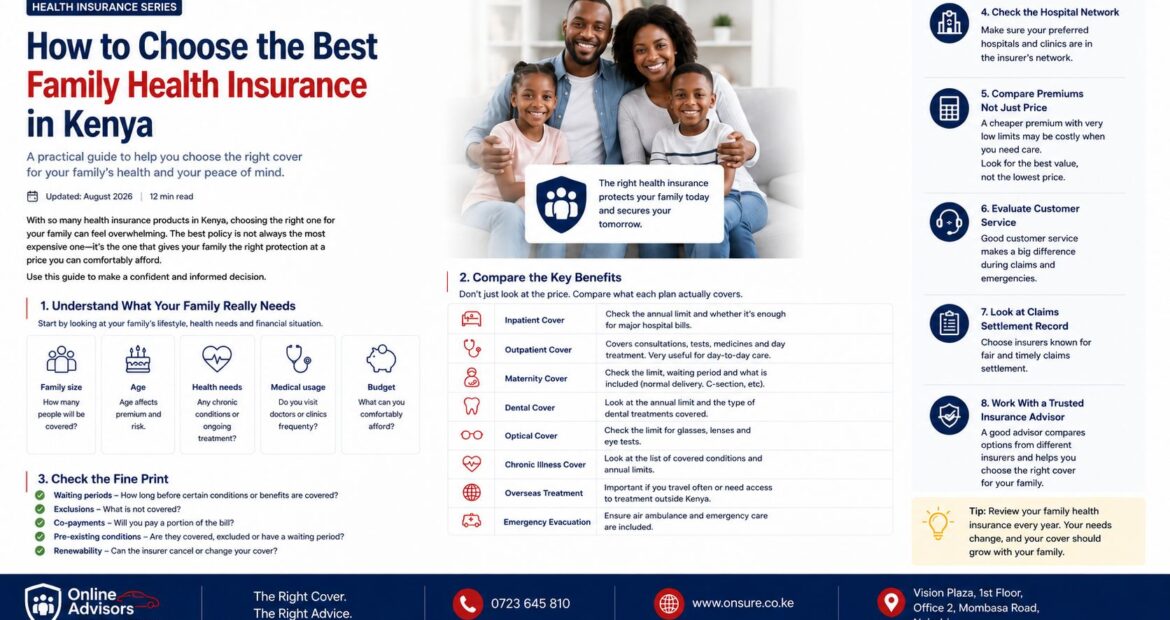
Choosing family health insurance in Kenya can be confusing.
One insurer may offer a lower premium. Another may provide a higher inpatient limit. A third may have stronger outpatient, maternity, dental or optical benefits.
So which one is the best family health insurance in Kenya?
The answer is:
The best family health insurance is the plan that provides the right combination of benefits, hospital access, limits, waiting periods and affordability for your particular family.
There is no single medical insurance policy that is automatically best for every household.
A young couple planning to have children may prioritise maternity cover.
A family with young children may value outpatient treatment and vaccinations.
A household managing diabetes or hypertension may pay closer attention to chronic-condition benefits and medication limits.
Another family may simply want strong inpatient protection against major hospital bills.
Current Kenyan medical products demonstrate these differences. Jubilee’s J-Care currently offers inpatient protection of up to KES 10 million with optional outpatient, maternity, dental and optical benefits, while Britam’s Milele range offers family plans with features including inpatient, outpatient, dental, optical and overseas referral treatment.
This guide explains how to compare family medical insurance plans in Kenya and identify the cover that is most appropriate for your family.
What Is Family Health Insurance?
Family health insurance is a private medical insurance policy that can cover a principal member together with eligible family members.
Depending on the insurer and product, this can include:
- Principal member
- Spouse
- Children
- Other eligible dependants under specified arrangements
Benefits can include:
- Inpatient treatment
- Outpatient treatment
- Maternity
- Dental
- Optical
- Chronic illness care
- Cancer treatment
- Emergency treatment
- Overseas referral
- Wellness benefits
However, the exact benefits, sublimits, exclusions and waiting periods differ from one policy to another.
For example, Jubilee’s J-Care currently offers six coverage levels and optional outpatient, maternity, dental and optical benefits, while Britam’s Milele range provides different plans designed for individuals, families and different stages of life.
Why Choosing Health Insurance Based Only on Price Is a Mistake
Imagine receiving these three hypothetical quotations:
Plan A
Annual premium: KES 35,000
Plan B
Annual premium: KES 75,000
Plan C
Annual premium: KES 120,000
Looking only at price, Plan A appears best.
But suppose the benefits are:
| Feature | Plan A | Plan B | Plan C |
|---|---|---|---|
| Inpatient | KES 500,000 | KES 2 million | KES 5 million |
| Outpatient | None | Included | Included |
| Maternity | None | Optional | Included |
| Dental | None | Included | Included |
| Optical | None | Included | Included |
| Chronic Illness | Limited | Included | Higher limit |
| Overseas Referral | No | Limited | Yes |
Suddenly, comparing premiums alone becomes meaningless.
The correct question is:
What protection am I receiving for the premium?
A cheaper policy may be excellent for a family that wants basic inpatient protection.
A more expensive policy may be worthwhile for a household that needs broader day-to-day medical care.
1. Start With Your Family’s Actual Medical Needs
Before requesting quotations, identify what you need the policy to do.
Consider:
- Number of adults
- Number of children
- Ages of family members
- Existing medical conditions
- Regular medication
- Frequency of outpatient visits
- Pregnancy plans
- Preferred hospitals
- Travel outside Kenya
- Family budget
This prevents you from paying for unnecessary benefits while overlooking important ones.
2. Decide How Much Inpatient Cover You Need
Inpatient insurance protects against eligible hospital expenses where the insured person is admitted.
This is arguably the foundation of most family medical insurance plans because hospital admissions can produce substantial bills.
You may encounter inpatient limits such as:
- KES 250,000
- KES 500,000
- KES 1 million
- KES 2 million
- KES 5 million
- KES 10 million
Jubilee’s current J-Care product provides inpatient options reaching KES 10 million, illustrating how widely limits can vary within one insurer’s product range.
A higher limit generally provides stronger financial protection, but it can also increase the premium.
Ask yourself:
If one family member required major surgery or a prolonged hospital stay, what bill could we realistically absorb ourselves?
Your insurance should ideally protect against the level of medical expense that would seriously disrupt your family’s finances.
3. Decide Whether You Need Outpatient Cover
Outpatient cover can pay for eligible treatment where no hospital admission is required.
Depending on the policy, it can include:
- Doctor consultations
- Specialist consultations
- Laboratory tests
- Prescription medication
- X-rays
- Diagnostic procedures
- Minor treatment
Outpatient cover is particularly useful for families with:
- Young children
- Regular medical appointments
- Chronic medication needs
- Frequent specialist consultations
However, outpatient benefits increase the cost of insurance.
A healthy family with few routine medical expenses may prefer to self-fund ordinary outpatient visits while purchasing stronger inpatient protection.
There is no universally correct option.
4. Check the Hospital Network Before Paying
This is one of the most important checks.
Before buying a medical policy, ask:
Is my preferred hospital on the insurer’s panel?
Do not assume that every health insurance card works at every hospital.
Health insurers maintain networks of approved providers.
Britam currently promotes access to hospitals across its provider network under the Milele health range, while Jubilee markets its family products through an established healthcare network.
Check hospitals near:
- Your home
- Your workplace
- Your children’s school
- Places you travel regularly
Also check any specific facility your family already uses.
A low premium is not particularly useful if the nearest suitable hospital is excluded.
5. Check the Room and Board Limit
An inpatient limit can look impressive while still containing smaller internal limits.
For example:
Overall inpatient limit: KES 2 million
but:
Hospital room limit: KES 10,000 per day
If your preferred hospital charges KES 20,000 per night, you need to understand how the difference will be handled.
Ask specifically about:
- Daily room limit
- ICU limit
- Theatre charges
- Specialist fees
- Surgical limits
Do not rely on the headline inpatient figure alone.
6. Compare Maternity Benefits Carefully
If you are planning to have children, maternity should be one of the first areas you examine.
Depending on the policy, maternity may cover eligible expenses relating to:
- Antenatal care
- Normal delivery
- Caesarean section
- Postnatal care
- Pregnancy complications
- Newborn treatment
Jubilee’s current J-Care family products provide maternity options, including maternity and newborn benefits under applicable plans.
However, three things matter enormously:
Maternity Limit
How much will the insurer pay?
Waiting Period
How long must you remain insured before maternity benefits become available?
Newborn Rules
How quickly must a newborn be added to the policy?
Do not simply ask:
“Does it have maternity?”
Ask:
“What is the maternity limit, waiting period and newborn enrolment requirement?”
7. Understand Waiting Periods
A waiting period is the time after the policy begins during which particular medical conditions or benefits may not yet be covered.
Waiting periods can apply to:
- General illness
- Maternity
- Pre-existing conditions
- Chronic conditions
- Surgery
- Specific procedures
A cheaper policy with longer waiting periods may provide less immediate protection than a slightly more expensive alternative.
Before buying, request a clear schedule of all applicable waiting periods.
8. Ask How Pre-Existing Conditions Are Treated
This is essential where anyone in the family already has a known medical condition.
Examples include:
- Diabetes
- Hypertension
- Asthma
- Heart conditions
- Previous surgery
- Long-term medical conditions
Different insurers may:
- Cover the condition
- Apply a waiting period
- Apply a sublimit
- Require medical underwriting
- Apply special terms
- Exclude it
Britam currently states that its Milele Family plan welcomes pre-existing conditions, while Jubilee’s J-Care lists chronic and congenital conditions among the areas covered within the relevant plan structure. Exact conditions and limits still depend on the applicable policy terms.
Never hide a known medical condition when completing an insurance application.
Accurate disclosure helps avoid problems when a claim occurs.
9. Examine Chronic Illness Benefits
Pre-existing conditions and chronic illness benefits are related but not necessarily identical.
Chronic conditions can require long-term:
- Medication
- Laboratory tests
- Specialist consultations
- Monitoring
- Hospital treatment
If someone in your family regularly manages a chronic condition, ask:
Is chronic treatment covered?
Is there a separate annual limit?
Are prescription medicines included?
Are specialist visits covered?
Does a waiting period apply?
A family with ongoing chronic treatment may find this more important than dental or optical benefits.
10. Compare Cancer and Major Illness Benefits
Medical insurance becomes most valuable when a family faces a large, unexpected medical bill.
Ask specifically about:
- Cancer treatment
- Chemotherapy
- Radiotherapy
- Major surgery
- ICU
- Dialysis
- Organ-related treatment
- Specialist care
Do not assume these expenses automatically fall within the full headline inpatient limit.
Some policies may have specific sublimits or conditions.
Jubilee’s J-Care currently lists cancer and chronic-care benefits among the protection available under the product.
11. Check Dental Cover
Dental benefits may include eligible:
- Consultations
- Extractions
- Fillings
- Root canal treatment
- Scaling
The benefit usually has its own annual limit.
For example:
Inpatient limit: KES 2 million
does not mean:
Dental limit: KES 2 million.
You could have only KES 10,000 or KES 20,000 available for dental treatment, depending on the policy.
Check the actual sublimit.
12. Check Optical Cover
Optical benefits may include:
- Eye consultation
- Eye tests
- Prescription lenses
- Frames
Again, there is normally a separate sublimit.
If several family members wear glasses, optical benefits may be particularly valuable.
Britam currently includes dental and optical features within its Milele Family offering.
13. Understand Co-Payments
Some plans require members to contribute a specified amount when accessing treatment.
For example:
Consultation:
KES 3,000
Co-pay:
KES 500
Insured person pays:
KES 500
The insurance handles the eligible balance according to policy terms.
A policy with a lower premium but frequent co-payments could eventually cost your family more than expected.
Ask:
- Is there an outpatient co-pay?
- Does it apply at every hospital?
- Are some hospitals subject to higher co-payments?
- Does it apply to specialist consultations?
14. Check Whether Medication Is Covered
This is especially important for outpatient insurance.
Ask whether the outpatient benefit includes:
- Prescription medication
- Chronic medicines
- Approved pharmacies
- Drug delivery
- Limits on certain medicines
Jubilee’s current J-Care product includes services such as drug delivery within its broader healthcare offering, while Britam’s Milele plan promotes access to medicine through selected pharmacy arrangements for qualifying minor ailments.
Families with regular medication needs should investigate this carefully.
15. Check the Maximum Entry Age
Medical insurance often has rules regarding the age at which a person can first join.
This is particularly important if you want to insure parents.
Britam currently describes Milele as having solutions extending across different stages of life, and it separately offers a plan for older individuals aged 55 years and above. Jubilee likewise offers a dedicated J-Senior medical product for older customers.
Do not assume an ordinary family policy can automatically include elderly parents.
Ask whether they require separate senior medical insurance.
16. Check Whether Children Are Properly Covered
If you have children, check:
- Minimum joining age
- Maximum dependant age
- Vaccinations
- Paediatric care
- Newborn cover
- Emergency treatment
Jubilee currently confirms that children can be covered under family products such as J-Care, while also offering a separate J-Junior product for eligible children.
Parents should also understand what happens when a child reaches the policy’s maximum dependant age.
17. Consider Mental Health Benefits
Mental-health care is increasingly relevant when comparing comprehensive medical insurance.
Ask whether the policy includes treatment related to:
- Psychiatric care
- Counselling
- Mental-health admission
- Specialist consultation
Jubilee’s current J-Care product includes psychiatric conditions among its listed areas of protection.
Check applicable sublimits and conditions.
18. Consider Emergency Evacuation
A family member may suffer a medical emergency far from an appropriate hospital.
Ask whether the plan includes:
- Road ambulance
- Emergency evacuation
- Air evacuation
- Transfer between hospitals
This can be especially important for families who:
- Travel frequently
- Live outside major urban centres
- Visit rural areas regularly
19. Decide Whether You Need Overseas Treatment
Some plans provide regional or international treatment benefits.
Jubilee’s J-Care currently provides regional coverage and overseas treatment options within specified plan arrangements, while Britam’s Milele Family lists overseas inpatient referral treatment among its benefits.
This can be valuable, but it may also increase the premium.
If your family is comfortable receiving treatment locally, you may prefer to spend your premium on stronger Kenya-based limits.
20. Read the Exclusions
Insurance covers specified risks.
It does not cover every medical expense.
Before paying, ask for the policy wording and understand important exclusions.
Examples can vary by insurer and may relate to:
- Cosmetic procedures
- Experimental treatment
- Non-medically necessary treatment
- Undeclared conditions
- Specified waiting-period conditions
- Certain fertility procedures
- Particular elective treatment
Never assume that because something occurs in a hospital it must automatically be covered.
21. Compare the Annual Premium
Only after understanding the benefits should you compare price.
Suppose:
Plan A
Annual premium: KES 50,000
Plan B
Annual premium: KES 75,000
Plan C
Annual premium: KES 100,000
Ask:
Why is Plan B KES 25,000 more expensive?
Perhaps it includes:
- Outpatient
- Higher inpatient limit
- Maternity
- Lower co-pay
- Stronger chronic illness benefits
That additional KES 25,000 may therefore represent excellent value.
Or it may contain benefits your family does not need.
That is why insurance comparisons should be based on benefit versus cost, not cost alone.
22. Make Sure the Premium Is Sustainable
Health insurance is not particularly useful if you can only afford it for one year.
Consider whether you could realistically maintain the policy at renewal.
A family stretching its budget to purchase an extremely expensive plan may later be forced to drop cover altogether.
Choose protection that is:
Adequate + Affordable + Sustainable
A slightly lower but sustainable plan may be more useful than an expensive policy you cannot maintain.
23. Understand Renewal Terms
Ask:
- How does renewal work?
- Can premiums increase with age?
- Can benefits change?
- Is a fresh medical declaration required?
- How are chronic conditions treated at renewal?
- What happens after a large claim?
Medical insurance should be viewed as a long-term risk-management decision.
Do not evaluate only the first year’s premium.
24. Verify the Insurer and Intermediary
Before buying medical insurance, verify who is providing the cover.
Kenya’s Insurance Regulatory Authority (IRA) publishes current lists of licensed insurers and licensed medical insurance providers. The regulator’s 2026 resources can be used to confirm whether relevant entities are licensed.
This is particularly important when responding to:
- Social media adverts
- WhatsApp offers
- Online sellers
- Unfamiliar insurance intermediaries
Know exactly who is underwriting your policy before paying.
25. Don’t Confuse a Medical Insurance Provider With the Actual Insurer
You may deal with:
- Insurance company
- Insurance agency
- Insurance broker
- Medical insurance provider
- Healthcare administrator
Understand who is actually responsible for underwriting the insurance.
Ask:
Which licensed insurance company is issuing my policy?
You should receive clear insurance documentation identifying the insurer.
A Simple Family Health Insurance Comparison Table
When you receive quotations, create a table like this:
| Feature | Plan A | Plan B | Plan C |
|---|---|---|---|
| Annual Premium | |||
| Inpatient Limit | |||
| Outpatient Limit | |||
| Room Limit | |||
| Maternity | |||
| Maternity Waiting Period | |||
| Dental | |||
| Optical | |||
| Chronic Conditions | |||
| Pre-existing Conditions | |||
| Cancer | |||
| Hospital Network | |||
| Co-pay | |||
| Emergency Evacuation | |||
| Overseas Referral | |||
| Waiting Period | |||
| Maximum Entry Age | |||
| Major Exclusions |
This immediately makes a complicated insurance decision easier.
Example: Choosing Between Three Family Medical Plans
Imagine a family consisting of:
Father: 35
Mother: 32
Children: 5 and 8
They receive three hypothetical quotations.
Plan A – Basic
Premium:
KES 45,000
Includes:
- KES 500,000 inpatient
- No outpatient
- No maternity
- Limited provider network
Plan B – Balanced
Premium:
KES 85,000
Includes:
- KES 2 million inpatient
- Outpatient
- Dental
- Optical
- Moderate provider network
Plan C – Comprehensive
Premium:
KES 150,000
Includes:
- KES 5 million inpatient
- Higher outpatient
- Maternity
- Dental
- Optical
- Chronic condition benefit
- Wider hospital network
- Overseas referral
Which is best?
There is no automatic answer.
If the family is primarily concerned about major hospital bills:
Plan A might be sufficient.
If the family has young children who regularly use outpatient services:
Plan B may provide better value.
If they are planning another child and want wider protection:
Plan C may make more sense.
This is why there is no universal “best family health insurer.”
Questions to Ask Before Buying Family Health Insurance
Before paying the premium, ask your insurance advisor these questions:
- What is the inpatient limit?
- Which hospitals can we use?
- Is outpatient included?
- What is the outpatient limit?
- What co-pay applies?
- Is maternity covered?
- What is the maternity waiting period?
- What is the maternity limit?
- Are newborns covered?
- Are pre-existing conditions covered?
- What waiting periods apply?
- What chronic-condition limit applies?
- Is cancer treatment covered?
- What is the dental limit?
- What is the optical limit?
- Is emergency evacuation included?
- Is overseas referral available?
- What are the major exclusions?
- What is the maximum entry age?
- What happens at renewal?
If you know the answers to these questions, you are in a much better position to choose wisely.
Common Mistakes Families Make When Buying Medical Insurance
Mistake 1: Buying the Cheapest Plan
Cheap insurance can be appropriate, but only if the benefits meet your needs.
Mistake 2: Looking Only at the Inpatient Limit
Check sublimits, room limits, exclusions and waiting periods.
Mistake 3: Ignoring the Hospital Network
Always confirm your preferred hospitals.
Mistake 4: Buying Maternity Cover Too Late
Waiting periods may apply.
Plan ahead.
Mistake 5: Hiding Pre-existing Conditions
Provide accurate medical information when required.
Mistake 6: Assuming Outpatient Means Unlimited Visits
Outpatient benefits normally have limits and policy conditions.
Mistake 7: Assuming Dental and Optical Are Included
They may be optional or subject to small sublimits.
Mistake 8: Forgetting About Renewal Affordability
Think beyond the first year.
Is Private Family Health Insurance Still Worth Considering in Kenya?
Private family medical insurance can play an important role in managing healthcare expenses by giving households additional choices over benefit limits, provider networks and covered services.
Kenya also operates the Social Health Authority (SHA) framework, through which individuals and families can register for social health coverage.
A family’s decision to purchase additional private medical insurance should therefore consider:
- Existing healthcare coverage
- Desired hospitals
- Benefit limits
- Financial risk
- Additional services required
- Household budget
The goal should be to avoid unnecessary duplication while ensuring that major medical risks are adequately managed.
Frequently Asked Questions
Which is the best family health insurance in Kenya?
There is no single plan that is best for every family.
The best option depends on:
- Family size
- Ages
- Budget
- Preferred hospitals
- Inpatient needs
- Outpatient needs
- Maternity
- Chronic conditions
- Waiting periods
Compare policies based on your family’s circumstances.
How much inpatient cover should a family have?
There is no universal amount.
Higher limits provide more protection but cost more.
Choose a limit based on your preferred hospitals, financial capacity and level of medical risk.
Is outpatient cover necessary?
Not necessarily.
It is particularly useful for families that frequently use clinics, specialists, medication and diagnostic services.
A family with limited outpatient needs may choose to self-fund routine treatment.
Which insurer has the highest medical limit in Kenya?
Limits vary by product and can change.
For example, Jubilee’s J-Care currently offers inpatient options reaching KES 10 million.
However, the highest limit does not automatically make a policy the best option for your family.
Are pre-existing conditions covered?
Some products provide cover for certain pre-existing conditions subject to terms, waiting periods and limits.
Britam currently states that its Milele Family plan welcomes pre-existing conditions.
Always confirm how your particular condition will be treated.
Can children be covered under family health insurance?
Yes, many family plans allow eligible children to be included.
Jubilee currently confirms that children can be covered under its family products such as J-Care.
Can I include elderly parents?
Possibly, but older parents may require a separate senior medical plan.
Both Jubilee and Britam currently have products specifically structured for older customers.
Should I choose an insurer based on the hospital network?
Hospital access should be one of your major considerations, but not the only one.
Also compare benefits, limits, exclusions, premium and waiting periods.
The Bottom Line
Choosing the best family health insurance in Kenya is not about finding the policy with:
The cheapest premium
or:
The highest inpatient limit.
It is about finding the best balance between:
Premium
Inpatient cover
Outpatient cover
Hospital network
Waiting periods
Maternity
Dental
Optical
Chronic illness protection
Pre-existing-condition terms
Major illness benefits
Co-payments
Exclusions
Long-term affordability
Start by understanding what your family actually needs.
Then compare several suitable policies on the same basis.
That is a much better approach than asking:
“Which insurer is cheapest?”
Ask instead:
“Which policy gives my family the protection we actually need at a premium we can sustainably afford?”
Compare Family Health Insurance With Online Advisors
At Online Advisors Insurance Agency Ltd, we help families compare medical insurance options from reputable insurers in Kenya.
Instead of comparing premiums alone, we can help you examine:
- Inpatient limits
- Outpatient benefits
- Hospital networks
- Maternity
- Dental
- Optical
- Chronic conditions
- Pre-existing conditions
- Waiting periods
- Co-payments
- Important exclusions
Request Family Health Insurance Quotes
Tel: 0723 645 810
Website: www.onsure.co.ke
Office: Vision Plaza, 1st Floor, Office 2, Mombasa Road, Nairobi
Compare more than price. Choose health insurance around your family’s actual needs.
Important Disclaimer
This article provides general educational information and does not constitute a recommendation of a particular insurer, insurance quotation or personalised financial or medical advice. Insurance products, premiums, hospital networks, benefits, eligibility rules, waiting periods and exclusions can change. Always obtain current quotations and review the applicable policy wording before purchasing medical insurance.