


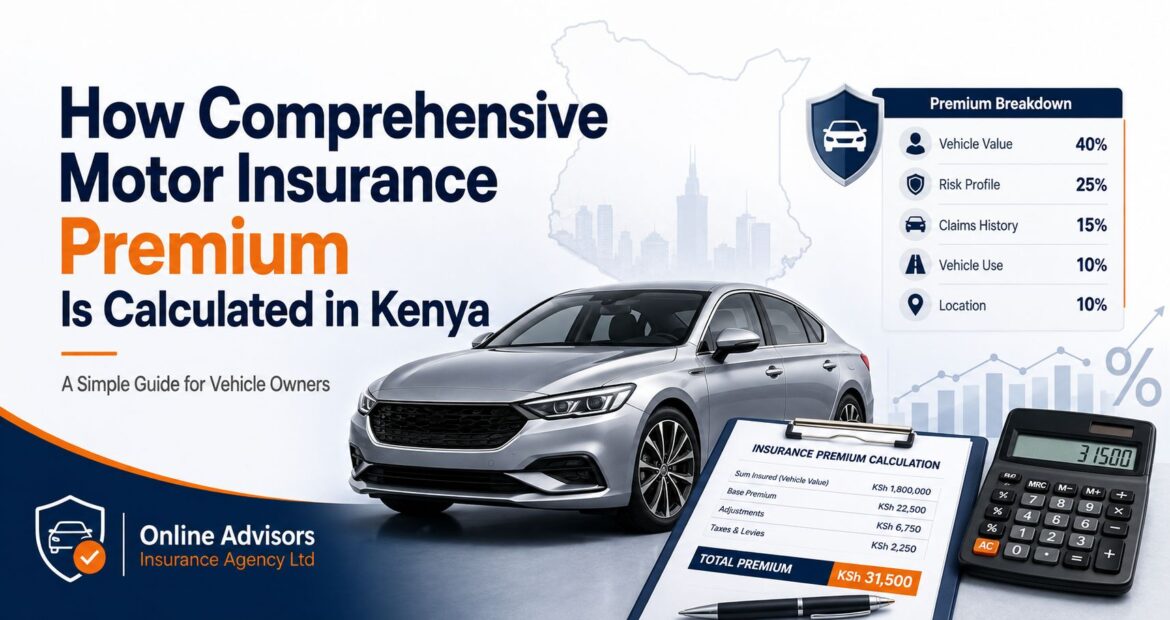
If you are shopping for comprehensive motor insurance in Kenya, one of the first questions you are likely to ask is:
“How much will it cost to insure my car?”
Unlike third-party motor insurance, which is often offered at relatively fixed premium bands, comprehensive motor insurance is generally calculated based on the value of the vehicle, the insurer’s applicable premium rate, the type and use of the vehicle, optional benefits selected, and statutory charges.
This means that two vehicles with the same market value may not necessarily receive exactly the same comprehensive insurance premium.
In this guide, we explain how comprehensive motor insurance premiums are calculated in Kenya and the factors that can affect the final amount you pay.
What Is Comprehensive Motor Insurance?
Comprehensive motor insurance provides broader protection than third-party-only insurance.
Depending on the policy terms, comprehensive cover typically provides protection against risks such as:
- Accidental damage to your vehicle
- Theft of the insured vehicle
- Fire damage
- Third-party bodily injury
- Third-party property damage
- Malicious damage
- Certain natural perils, subject to policy terms
Additional benefits may also be purchased or included depending on the insurer.
Kenyan law requires vehicles used on public roads to have insurance against applicable third-party risks. Comprehensive insurance goes beyond this minimum requirement by providing cover for damage or loss involving the insured vehicle itself, subject to the terms, limits and exclusions of the policy.
The Basic Comprehensive Motor Insurance Formula
For many private vehicles, the starting point for calculating the premium can be expressed as:
Basic Premium = Vehicle Value × Applicable Insurance Rate
The percentage rate is determined by the insurer.
For example, assume:
Vehicle value: KES 2,500,000
Illustrative comprehensive rate: 4%
The basic premium would be:
KES 2,500,000 × 4% = KES 100,000
Therefore, before optional benefits and statutory charges, the illustrative basic comprehensive premium would be:
KES 100,000
The 4% rate used above is only an example. It should not be interpreted as a universal market rate. Different insurers may apply different rates and minimum premiums depending on the vehicle and the risk presented.
Step 1: Determine the Value of the Vehicle
The vehicle’s insured value is one of the most important factors in calculating a comprehensive motor insurance premium.
For example:
| Vehicle Value | Illustrative Rate | Basic Premium |
|---|---|---|
| KES 1,000,000 | 4% | KES 40,000 |
| KES 1,500,000 | 4% | KES 60,000 |
| KES 2,000,000 | 4% | KES 80,000 |
| KES 2,500,000 | 4% | KES 100,000 |
| KES 3,000,000 | 4% | KES 120,000 |
| KES 5,000,000 | 4% | KES 200,000 |
Again, the 4% rate is used purely for illustration.
An insurer may require a motor vehicle valuation to establish an acceptable insured value, especially when taking out a new comprehensive policy.
It is important that the vehicle is insured at an appropriate value.
Underinsurance
Underinsurance occurs when the vehicle is insured for substantially less than its appropriate value.
This can create problems during a claim because the settlement may be affected by the policy’s terms relating to underinsurance or average.
Overinsurance
Insuring a vehicle for an unrealistically high amount does not necessarily mean that the insurer will pay that amount following a total loss.
Motor insurance is generally intended to compensate for an insured loss in accordance with the policy terms rather than allow the policyholder to profit from the occurrence of a loss.
For this reason, obtaining a realistic valuation is important.
Step 2: Apply the Insurer’s Comprehensive Rate
Once the vehicle’s value has been established, an insurer applies the applicable basic comprehensive insurance rate.
For example:
Vehicle value: KES 3,000,000
If Insurer A offered an illustrative rate of 3.5%:
KES 3,000,000 × 3.5%
= KES 105,000
If Insurer B offered an illustrative rate of 4%:
KES 3,000,000 × 4%
= KES 120,000
If Insurer C offered an illustrative rate of 4.5%:
KES 3,000,000 × 4.5%
= KES 135,000
This demonstrates why comparing insurance quotations can be worthwhile.
However, the cheapest premium should not be the only consideration when choosing an insurer.
A motorist should also consider:
- Scope of cover
- Policy exclusions
- Applicable excesses
- Claims process
- Optional benefits
- Approved repair arrangements
- Limits of liability
- Insurer financial strength
- Customer service
- Policy conditions
Step 3: Add Optional Motor Insurance Benefits
After calculating the basic comprehensive premium, the policyholder may choose additional benefits.
These vary from insurer to insurer.
Common optional benefits may include:
1. Excess Protector
Most comprehensive motor policies contain an excess.
An excess is the portion of an insured loss that the policyholder may be required to bear before the insurer settles the balance of an admissible claim.
An excess protector may reduce or remove certain applicable excesses, subject to the insurer’s terms and conditions.
The cost of excess protector varies between insurers.
2. Political Violence and Terrorism Cover
Standard comprehensive policies may contain limitations or exclusions relating to political violence and terrorism.
A policyholder may therefore have an option to purchase additional Political Violence and Terrorism (PVT) cover.
The premium charged depends on the insurer’s applicable terms and rate.
3. Courtesy Car or Loss-of-Use Benefit
If your insured vehicle is involved in an accident and remains at a garage for repairs, being without transport can be inconvenient.
Some insurers offer a courtesy-car or loss-of-use benefit at an additional premium.
The benefit is normally subject to:
- Maximum number of days
- Daily limits
- Qualifying claims
- Policy conditions
4. Road Rescue and Towing
Some comprehensive policies include emergency towing or roadside assistance within their standard package, while others offer enhanced benefits at an additional premium.
Always check the limit provided.
5. Increased Windscreen Cover
Comprehensive policies frequently provide windscreen cover up to a stated limit.
If your vehicle has an expensive windscreen, particularly where it incorporates sensors, cameras or other technology, you may want a higher windscreen limit where available.
An additional premium may apply.
6. Entertainment System Cover
Vehicles with expensive aftermarket radios, screens, sound systems and other accessories may require additional cover beyond the standard policy limit.
Step 4: Calculate the Premium Before Statutory Charges
Assume the following hypothetical quotation:
Vehicle value: KES 2,500,000
Basic comprehensive premium: KES 100,000
The customer then selects optional benefits quoted by the insurer as:
Political Violence & Terrorism: KES 5,000
Excess Protector: KES 4,000
Enhanced Courtesy Car Benefit: KES 3,000
The premium before statutory charges becomes:
KES 100,000
- KES 5,000
- KES 4,000
- KES 3,000
Premium before statutory charges = KES 112,000
The optional-benefit figures above are illustrative only. Actual rates and benefits vary by insurer.
Step 5: Add the Insurance Training Levy
General insurance policyholders in Kenya are subject to an Insurance Training Levy.
The Insurance Act provides for the training levy to be charged to policyholders and collected by insurers. The applicable regulations prescribe a rate of 0.2% of gross direct premium for general insurance business.
Using our example:
Premium before statutory charges:
KES 112,000
Insurance Training Levy:
KES 112,000 × 0.2% = KES 224
Step 6: Add the Policyholders Compensation Fund Levy
Policyholders also contribute to Kenya’s Policyholders Compensation Fund (PCF).
The Fund states that policyholders contribute 0.25% of the premium payable. Insurers separately make an equivalent contribution to the Fund.
Using our example:
KES 112,000 × 0.25% = KES 280
Therefore:
Insurance Training Levy = KES 224
Policyholder PCF Levy = KES 280
Total policyholder levies:
KES 504
This is equivalent to:
0.45% × KES 112,000 = KES 504
Step 7: Add Stamp Duty
Insurance policies are also subject to the applicable stamp duty.
Under Kenya’s Stamp Duty framework, an insurance policy in the relevant category attracts KES 40 stamp duty.
Therefore:
Premium before statutory charges = KES 112,000
Training Levy = KES 224
PCF Levy = KES 280
Stamp Duty = KES 40
Total Premium = KES 112,544
Comprehensive Motor Insurance Premium Calculation Example
Using the example above:
| Component | Amount |
|---|---|
| Basic Comprehensive Premium | KES 100,000 |
| Political Violence & Terrorism | KES 5,000 |
| Excess Protector | KES 4,000 |
| Courtesy Car Benefit | KES 3,000 |
| Subtotal | KES 112,000 |
| Insurance Training Levy – 0.2% | KES 224 |
| Policyholders Compensation Fund Levy – 0.25% | KES 280 |
| Stamp Duty | KES 40 |
| Illustrative Total Premium | KES 112,544 |
Therefore, in this hypothetical example, the customer would pay:
KES 112,544
for the annual comprehensive motor insurance policy.
Actual premiums will depend on the insurer, vehicle, cover selected and underwriting terms.
A Simple Formula to Understand Your Motor Insurance Quote
For illustration, the calculation can be summarized as:
Vehicle Value × Comprehensive Rate
= Basic Premium
Then:
Basic Premium + Selected Optional Benefits
= Premium Subtotal
Then:
Premium Subtotal + Applicable Policyholder Levies + Stamp Duty
= Total Premium Payable
For the statutory policyholder levies discussed above, the training levy of 0.2% and PCF levy of 0.25% together amount to 0.45% of the applicable premium base.
What Determines the Comprehensive Insurance Rate?
The percentage applied to the vehicle value is not necessarily the same for every customer.
Insurers assess several factors when determining the rate and terms they are prepared to offer.
These may include:
1. Type of Vehicle
A private saloon car may attract different terms from:
- Commercial vehicles
- Trucks
- Pick-ups
- Taxis
- PSVs
- Motorcycles
- Special-purpose vehicles
Kenya’s motor insurance rules themselves distinguish between vehicles used for fare-paying passengers, business vehicles, private cars and motorcycles when categorising certificates of insurance.
2. Vehicle Value
Higher-value vehicles normally result in higher absolute premiums because the insurer faces a larger potential loss.
For example:
A 4% premium on a KES 1 million car is:
KES 40,000
while the same illustrative percentage on a KES 5 million vehicle would be:
KES 200,000.
3. Vehicle Age
Older vehicles may attract different underwriting conditions.
Depending on the insurer, an older vehicle may:
- Attract a higher rate
- Require inspection
- Require valuation
- Carry different excesses
- Be considered only under specific terms
- In some cases, not qualify for the insurer’s standard comprehensive product
It is therefore advisable to obtain quotations rather than assuming every insurer will treat an older vehicle in the same way.
4. Vehicle Make and Model
Insurers may consider:
- Cost of spare parts
- Availability of spare parts
- Repair costs
- Theft exposure
- Vehicle performance
- Historical claims experience
A luxury or high-performance vehicle may therefore attract different terms from a commonly available mass-market vehicle.
5. Use of the Vehicle
How the vehicle is used matters.
For example:
Private use
is different from:
Commercial use
which is different from:
Taxi or PSV use.
A vehicle used commercially may spend more time on the road and may consequently present a different risk profile.
6. Claims History
A poor claims history may affect the terms an insurer is prepared to offer.
Conversely, some insurers may offer favourable consideration or a no-claim-related benefit to qualifying policyholders, subject to their underwriting rules.
7. Driver Profile
Depending on the insurer and product, factors such as the driver’s:
- Age
- Experience
- Driving history
- Intended vehicle use
may affect underwriting.
8. Vehicle Security
Some insurers may consider security measures such as:
- GPS tracking
- Alarm systems
- Immobilisers
- Secure parking
particularly for vehicles considered vulnerable to theft.
For certain risks, installation of an approved tracking device may be a condition of cover.
Why Are Comprehensive Insurance Quotes Different Between Insurers?
Assume you request quotations from three insurance companies for the same vehicle.
You could receive:
Insurer A – KES 95,000
Insurer B – KES 105,000
Insurer C – KES 115,000
This does not automatically mean that the KES 95,000 policy is the best option.
The policies may have different:
- Excesses
- Windscreen limits
- Radio/cassette limits
- Towing limits
- Courtesy-car benefits
- PVT terms
- Excess protector terms
- Territorial limits
- Special conditions
- Exclusions
This is why motorists should compare both price and policy benefits.
What Is a Minimum Premium?
Some insurers apply a minimum premium.
Suppose an insurer’s applicable rate produced a mathematical premium of KES 25,000, but the insurer’s minimum comprehensive premium for that category of business was KES 35,000.
The applicable basic premium could therefore be:
KES 35,000
rather than KES 25,000.
This is one reason why simply multiplying the vehicle value by a percentage does not always reproduce the insurer’s final quotation.
Does a Lower Vehicle Value Always Mean Cheaper Insurance?
Generally, reducing the insured value will reduce the mathematical premium where the premium is calculated as a percentage of value.
However, deliberately undervaluing your vehicle simply to reduce the premium can create problems at claim time.
The insured value should reasonably reflect the vehicle’s appropriate value under the insurer’s valuation and underwriting requirements.
Should You Choose the Cheapest Comprehensive Insurance Quote?
Not necessarily.
Price is important, but insurance is ultimately purchased to protect you when something goes wrong.
Before accepting a quotation, consider asking:
- What is the basic excess?
- Is excess protector available?
- Is political violence and terrorism covered?
- What is the windscreen limit?
- What is the entertainment-system limit?
- Is towing covered?
- Is a courtesy car provided?
- Are theft claims subject to additional conditions?
- Are young or inexperienced drivers subject to additional excesses?
- What documents will be needed if I make a claim?
- Are there authorised repair garages?
- What major exclusions should I understand?
A slightly more expensive policy may sometimes provide significantly better protection.
Example: Comprehensive Insurance for a KES 3 Million Vehicle
Suppose your car has been valued at:
KES 3,000,000
and an insurer offers an illustrative basic rate of:
3.5%
The basic premium is:
KES 3,000,000 × 3.5%
= KES 105,000
Suppose optional benefits selected increase the premium by:
KES 10,000
Subtotal:
KES 105,000 + KES 10,000
= KES 115,000
Training Levy at 0.2%:
KES 115,000 × 0.2%
= KES 230
PCF policyholder levy at 0.25%:
KES 115,000 × 0.25%
= KES 287.50
Stamp Duty:
KES 40
Illustrative total:
KES 115,000
- KES 230
- KES 287.50
- KES 40
KES 115,557.50
The final figure may be presented in accordance with the insurer’s applicable rounding and quotation procedures.
How Can You Reduce Your Comprehensive Motor Insurance Premium?
There are several legitimate ways to seek better value.
Compare More Than One Insurer
Rates and benefits differ between insurers.
An insurance agency can help you compare available quotations rather than approaching insurers individually.
Choose Optional Benefits Carefully
Do not automatically remove valuable benefits simply to reduce the premium.
Instead, understand what each benefit provides and decide whether it is relevant to your risk.
Maintain a Good Claims Record
Avoidable or frequent claims may affect future underwriting terms.
Insure the Vehicle at an Appropriate Value
An accurate valuation helps prevent both overinsurance and underinsurance.
Review Your Policy Every Year
Do not automatically renew without reviewing:
- Vehicle value
- Premium
- Benefits
- Excesses
- Policy limits
- Alternative quotations
The most suitable insurer this year may not necessarily provide the most competitive terms at your next renewal.
Frequently Asked Questions
How much is comprehensive car insurance in Kenya?
There is no single price applicable to every vehicle. The premium generally depends on the vehicle value, applicable insurer rate, vehicle use, age, underwriting factors, optional benefits and statutory charges.
How do I calculate comprehensive insurance?
A simplified starting calculation is:
Vehicle Value × Insurer’s Comprehensive Rate = Basic Premium
You then add applicable optional benefits and statutory charges.
Is 4% the standard comprehensive insurance rate in Kenya?
No.
A 4% rate is frequently useful as an illustrative example, but there is no single comprehensive rate that should be assumed to apply to all Kenyan motorists.
Insurers determine applicable rates and underwriting terms according to the risk and their pricing policies.
What is the 0.45% insurance levy?
For the policyholder charges discussed in this article, the 0.45% represents the combined effect of:
Insurance Training Levy: 0.20%
plus
Policyholders Compensation Fund policyholder levy: 0.25%
The legal framework provides for the training levy to be charged to policyholders, while the Policyholders Compensation Fund confirms a 0.25% policyholder contribution.
Is there stamp duty on motor insurance in Kenya?
Yes. The applicable insurance-policy stamp duty discussed in this guide is KES 40.
Do comprehensive insurance rates differ between companies?
Yes.
Different insurers can quote different premiums and offer different benefits, excesses, limits and policy conditions for the same vehicle.
For this reason, comparing the full quotation is usually more useful than looking at the percentage rate alone.
Get a Comprehensive Motor Insurance Quote in Kenya
Calculating a premium yourself can give you an estimate, but the actual price depends on the rates and underwriting terms available from insurers at the time you request cover.
Online Advisors Insurance Agency Ltd can help you compare comprehensive motor insurance quotations and understand the differences in premiums, excesses, benefits and policy terms before you make a decision.
Whether you are insuring a new vehicle, renewing an existing policy or considering changing insurers, obtaining multiple suitable quotations can help you make a more informed choice.
Request a Comprehensive Motor Insurance Quote Today
Compare available options. Understand what you are buying. Choose cover that meets your needs.
Important Disclaimer
The premium percentages, optional-benefit amounts and calculation examples used in this article are illustrative examples only and should not be treated as quotations or guaranteed market rates. Insurance rates, minimum premiums, benefits, excesses, underwriting criteria and policy terms vary between insurers and may change over time.
Always refer to the actual quotation and policy wording issued by the insurer before purchasing cover.