

Being involved in a road accident can be stressful, even when nobody is seriously injured. Once the immediate safety concerns have been handled, another important question quickly follows:
How do you make a motor insurance claim in Kenya?
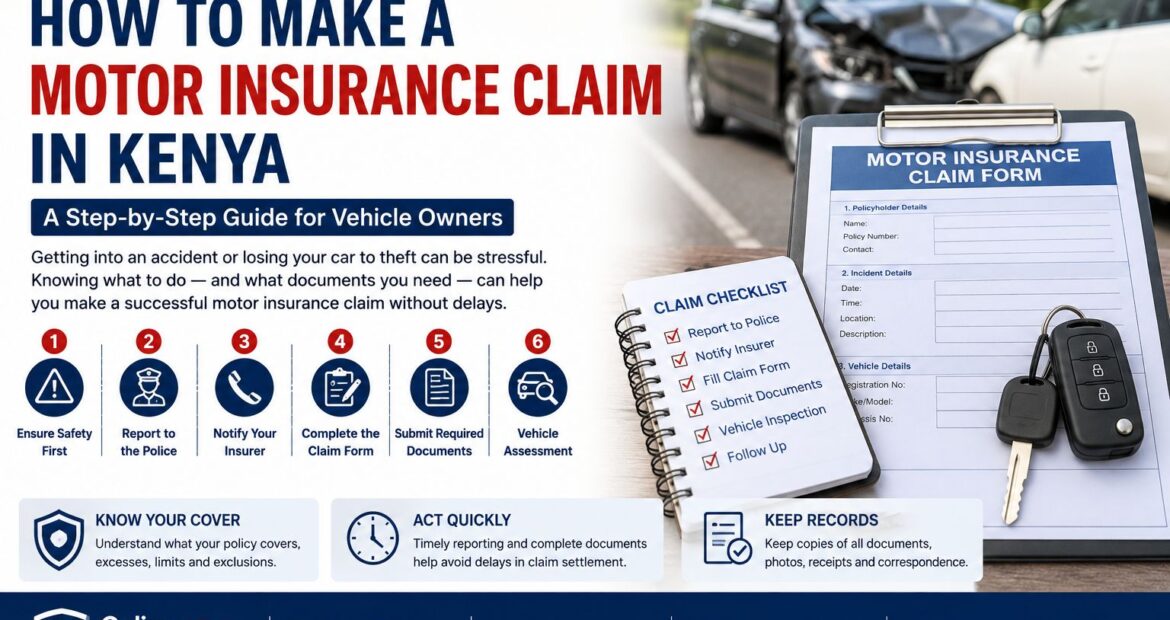
The claims process generally involves notifying your insurer or insurance intermediary, documenting the accident, reporting the incident to the police where required, completing a claim form, submitting supporting documents and allowing the insurer to assess the loss before repairs or settlement are authorised.
A current motor-claims process published by Britam, for example, tells motorists to photograph the accident scene, obtain a police abstract, prepare copies of the driver’s licence, National ID and vehicle logbook, and then submit the claim.
However, the exact process and documentation can differ between insurers and depending on whether the claim involves accidental damage, theft, bodily injury, third-party property damage or a total loss.
This guide explains the motor insurance claims process step by step.
What Should You Do Immediately After a Car Accident?
Your first priority after an accident should be safety, not insurance paperwork.
Where possible:
- Check whether anyone has been injured.
- Move to a safe location where appropriate and lawful.
- Seek emergency medical assistance where necessary.
- Avoid creating further danger to other road users.
- Preserve evidence of the accident scene where it is safe to do so.
Once the immediate emergency has been addressed, begin documenting the incident.
Step 1: Take Clear Photographs and Videos
Before vehicles are moved, where it is safe and practical to do so, take photographs of:
- Your vehicle
- The other vehicle or vehicles involved
- Registration plates
- Damage to all vehicles
- Road position
- Road markings
- Traffic signs
- Junctions
- Skid marks where visible
- Surrounding property damage
- General accident scene
Take both close-up photographs and wider images showing the overall scene.
Britam’s current motor claim process specifically advises policyholders to take clear photographs of the vehicle at the accident scene from multiple angles.
These photographs can help the insurer understand how the accident occurred and document the extent of damage.
Step 2: Exchange Details With the Other Driver
Where another vehicle is involved, obtain relevant information.
This can include:
- Driver’s full name
- Telephone number
- Vehicle registration number
- Vehicle owner’s details where different
- Insurance company
- Insurance certificate details where available
You should also note details of any independent witnesses.
Useful witness information includes:
- Name
- Telephone number
- Contact address where appropriate
Witness evidence can become important where the circumstances of the accident are disputed.
Step 3: Do Not Admit Liability at the Scene
Avoid making statements such as:
“It was completely my fault.”
Determining legal liability can involve evidence, witness statements, police information, road rules and insurer investigations.
You should provide truthful factual information about what happened without unnecessarily accepting legal responsibility.
Britam’s current motor accident claim form expressly advises that neither the owner nor driver should admit fault or liability, and that correspondence relating to the accident should be forwarded to the insurer for consideration.
This does not mean you should provide false information.
Always describe the accident accurately.
Step 4: Report the Accident to the Police
A police report is an important part of many motor insurance claims.
Report the accident to the appropriate police station as soon as reasonably possible and follow the applicable police procedures.
You may subsequently need a:
Police Abstract
The abstract provides an official record that the accident was reported.
Britam’s current motor claims guidance instructs motorists to obtain a police abstract, while its published claims checklist includes the police abstract among the documentation for accident claims.
Keep the police station details and reference information provided when reporting the accident.
Step 5: Notify Your Insurer or Insurance Agency Promptly
Do not wait until the vehicle has already been repaired before informing your insurer.
Notify your:
- Insurance company
- Insurance agent
- Insurance broker
as soon as possible in accordance with your policy conditions.
Provide basic information such as:
- Your name
- Policy number
- Vehicle registration
- Date of accident
- Location
- Brief description of what happened
- Whether anyone was injured
- Whether third-party property was damaged
- Current location of the insured vehicle
Early notification allows the insurer to advise you on the correct next steps.
Step 6: Do Not Authorise Repairs Without Insurer Approval
This is an extremely important claims rule.
After an accident, you may be tempted to immediately tell a garage:
“Start repairing the car.”
That can create problems.
Your insurer normally needs an opportunity to inspect or assess the damage before repairs are authorised.
Britam’s current motor accident report form specifically states that repairs should not be authorised without prior authority from the insurer.
Therefore, unless emergency action is necessary to prevent further damage or comply with safety requirements, obtain guidance from your insurer before authorising permanent repairs.
Step 7: Arrange Towing Where Necessary
If the vehicle cannot be safely driven, it may need to be towed.
Depending on your comprehensive policy, towing or accident recovery costs may be covered up to specified limits.
Britam’s current comprehensive motor product includes protection, recovery and towing after an accident among its listed benefits, while its Nairobi-area motor rescue service includes towing for eligible comprehensive customers.
However, benefits and limits differ between insurers.
Before engaging an expensive recovery service, contact your insurer or intermediary where practical.
Step 8: Complete the Motor Accident Claim Form
Your insurer will usually require a motor accident claim form.
The form may ask for information relating to:
- Policyholder
- Vehicle
- Driver
- Date and time of accident
- Exact location
- Weather conditions
- Road conditions
- Vehicle speed
- Purpose for which the vehicle was being used
- Other vehicles involved
- Third-party property damage
- Persons injured
- Passengers
- Witnesses
- Police station
- Description of the accident
Some forms also request a sketch showing how the accident occurred.
Britam’s current motor accident report form requests detailed information about the driver, vehicle use, accident circumstances, police reporting, third parties and witnesses.
Complete the form accurately.
Do not guess where you genuinely do not know an answer.
What Documents Are Usually Required for a Motor Accident Claim?
A typical accident claim may require documents such as:
- Completed motor accident claim form
- Copy of the insured’s National ID
- Copy of driver’s National ID where applicable
- Copy of vehicle logbook
- Copy of valid driver’s licence
- Police abstract
- Photographs of the accident and damage
- Repair estimate where requested
- Evidence of premium payment where applicable
- Excess payment where applicable
Britam’s published motor claims checklist includes the claim form, copies of identification, logbook, driver’s licence, police abstract, confirmation of premium payment and applicable excess among its listed accident/partial-theft requirements. It also notes that additional documentation may be requested depending on the circumstances.
Your particular insurer may require different or additional documents.
Step 9: The Insurer Assesses the Damage
Once the claim has been reported and sufficient information has been provided, the insurer determines:
- Whether the event is covered by the policy.
- The extent of the damage.
- The reasonable cost of repairs.
- Whether an assessor or investigator is required.
- Whether the vehicle should be repaired or treated as a total loss.
- Whether any excess applies.
An insurance assessor may inspect the vehicle and review the garage’s repair estimate.
The Insurance Regulatory Authority’s Claims Management Guidelines provide that where further assessment is needed to quantify an admissible loss, the insurer should appoint the relevant service provider and advise the claimant or intermediary about the action being taken.
Step 10: The Insurer Determines Whether the Claim Is Admissible
Submitting a claim does not automatically mean that it will be paid.
The insurer must establish whether the event falls within the policy.
The insurer may consider questions such as:
- Was the policy active?
- Was the premium properly paid?
- Was the driver appropriately licensed?
- Was the vehicle being used for the declared purpose?
- Did the accident occur within the territorial limits?
- Does an exclusion apply?
- Was there material non-disclosure?
- Was the loss accidental?
- Are the submitted documents accurate?
This assessment is known as determining claim admissibility.
What Happens If the Insurer Needs to Investigate the Claim?
Some claims require further investigation.
For example, questions may arise regarding:
- How the accident happened
- Identity of the driver
- Vehicle use
- Theft circumstances
- Previous damage
- Fraud concerns
- Liability
- Policy compliance
The IRA Claims Management Guidelines state that where further investigation is necessary to determine admissibility, the insurer should tell the claimant that an investigation is required and explain the need to cooperate. After receiving the investigation report, the insurer should make an offer or communicate a declinature and its reasons within the specified guideline timeframe.
Cooperate with legitimate requests for information.
Step 11: Repair Authority May Be Issued
If the claim is approved for repairs, the insurer may issue a repair authority to an approved or agreed garage.
The garage can then proceed with authorised repairs.
The insurer may:
- Pay the garage directly
- Agree an approved repair amount
- Apply the applicable excess
- Require you to pay certain non-covered items
Do not assume every requested repair will automatically be covered.
For example, pre-existing damage or mechanical wear unrelated to the accident may not form part of the insured accident claim.
What Is the Motor Insurance Excess?
The excess is the portion of an insured loss that you may be required to bear.
For example:
Approved repair cost:
KES 300,000
Applicable excess:
KES 50,000
Policyholder bears:
KES 50,000
Insurer contributes:
KES 250,000
subject to the policy terms.
Additional excesses may apply depending on circumstances.
These can include:
- Basic excess
- Theft excess
- Young driver excess
- Inexperienced driver excess
An excess protector may protect against some applicable excesses where it has been purchased.
For a detailed explanation, see our guide:
Motor Insurance Excess in Kenya Explained
Step 12: Vehicle Repairs Are Completed
Once authorised repairs are completed, inspect the vehicle carefully.
Check:
- Bodywork
- Paint matching
- Lights
- Sensors
- Mechanical operation
- Wheel alignment
- Replaced parts
- Any accident-related functions
Raise legitimate concerns promptly.
You may also be asked to sign relevant repair or discharge documentation.
What Happens If the Car Is a Total Loss?
Not every damaged car is economical to repair.
A vehicle may be treated as a total loss when the damage is sufficiently severe relative to the vehicle’s insured value and the applicable policy criteria.
Britam’s current comprehensive motor insurance information states that it treats a vehicle as a total loss where the repair cost exceeds 50% of the sum insured under that product.
Different policies may use different wording or criteria.
Where a vehicle is treated as a total loss, the insurer may make a settlement offer based on the applicable policy terms, valuation, insured value and other relevant considerations.
Additional Documents for a Total-Loss Claim
Total-loss claims can require additional documentation.
Britam’s motor claims checklist indicates that, after a total-loss offer, documentation or items may include:
- Executed discharge voucher
- Original logbook
- Insurance certificate
- Vehicle spare keys
- Toolkit
- Jack
- Spare wheel
- NTSA transfer documentation in relevant circumstances
depending on whether salvage is retained and the nature of the claim.
Always follow the specific instructions provided by your insurer.
What If the Vehicle Is Stolen?
A theft claim requires a different process from an ordinary accident claim.
If the vehicle is stolen:
- Report the theft to the police immediately.
- Notify your insurer promptly.
- Complete the motor theft claim form.
- Provide the required ownership and identity documentation.
- Cooperate with investigation requirements.
Do not wait several days hoping the vehicle will simply reappear before notifying the relevant parties.
Your policy may also contain specific theft conditions and an applicable theft excess.
What If Another Driver Was Responsible for the Accident?
Even if you believe another motorist caused the accident, still notify your insurer.
Avoid personally negotiating liability before obtaining advice.
The insurer may assess:
- Accident evidence
- Police information
- Witness statements
- Third-party insurer details
- Applicable liability
Where another party is legally responsible, your insurer may attempt to recover amounts from that party or their insurer.
This process is often referred to as subrogation or recovery.
Will You Still Pay an Excess if the Accident Was Not Your Fault?
Possibly, depending on the policy and claims circumstances.
An excess may initially apply to your own-damage claim even where another party appears responsible.
If the insurer successfully recovers its loss from the responsible third party, the treatment of your excess will depend on the policy and recovery arrangements.
Ask your insurer or intermediary specifically:
“If recovery is successful, what happens to the excess I paid?”
What If the Other Driver Makes a Claim Against You?
Do not ignore letters, demands or legal documents received from third parties.
Forward them immediately to your insurer.
Britam’s current motor accident claim form expressly tells policyholders not to answer communications about the accident themselves, but to send them to the insurer for consideration.
Your policy’s third-party liability section exists to deal with covered legal liabilities subject to the policy limits and conditions.
Common Reasons Motor Claims Can Be Delayed
Motor claims can take longer where:
- Documents are missing
- Claim form is incomplete
- Police abstract has not been provided
- Liability is disputed
- Vehicle ownership is unclear
- Premium status is unresolved
- Investigation is required
- Repair estimates are disputed
- Spare parts are unavailable
- Third parties are involved
- Valuation issues arise
- The claimant is slow to respond
The easiest way to reduce avoidable delay is to submit accurate and complete documentation early.
IRA’s Claims Management Guidelines require insurers, once the necessary claim documentation has been received, to acknowledge receipt within the guideline timeframe and then proceed with settlement, assessment or investigation as appropriate.
Common Mistakes to Avoid After an Accident
1. Leaving Without Taking Photographs
Evidence can disappear quickly once vehicles are moved.
2. Admitting Liability
Give factual information without unnecessarily making legal admissions.
3. Repairing the Vehicle Before Insurer Approval
This can interfere with assessment and potentially complicate the claim.
4. Failing to Report the Accident Promptly
Notify the insurer according to the policy requirements.
5. Giving False Information
Insurance fraud can have serious consequences.
Always provide accurate information.
6. Using an Unapproved Garage Without Checking
Your insurer may have approved repair arrangements.
Confirm before committing to repairs.
7. Throwing Away Damaged Parts
Do not dispose of accident-related parts before assessment without approval.
8. Ignoring Third-Party Letters
Forward them to your insurer promptly.
How Long Does a Motor Insurance Claim Take in Kenya?
There is no single settlement period applicable to every claim because claims vary significantly.
A minor accident involving clearly covered damage can be processed much faster than:
- Major collision
- Total loss
- Theft
- Fatal accident
- Multiple third parties
- Disputed liability
- Fraud investigation
Technology is also changing the claims process.
For example, in March 2026 Britam announced an AI-based motor assessment service targeting qualifying minor comprehensive motor claims, with an accelerated assessment and settlement process.
This does not mean every motor claim in Kenya will be settled that quickly.
Complex claims still require appropriate assessment and investigation.
What Should You Do if Your Claim Is Delayed?
Start with your insurer or insurance intermediary.
Ask for:
- Current claim status
- Outstanding documents
- Whether an assessor has been appointed
- Whether investigation is ongoing
- Whether liability is disputed
- What action is required from you
- Expected next procedural step
Keep communication records.
If a dispute cannot be resolved through the insurer’s complaint process, the Insurance Regulatory Authority (IRA) provides a consumer complaints mechanism for matters including disagreements over liability, settlement amounts and delays in settlement of payable claims.
Can an Insurance Agency Help With a Claim?
Yes.
An insurance intermediary can be particularly valuable after a loss.
A good insurance agency can help you:
- Notify the insurer
- Understand claim requirements
- Obtain the correct claim forms
- Review documents before submission
- Communicate with the insurer
- Follow up on assessment
- Understand excesses
- Clarify policy benefits
- Track progress
- Escalate unresolved issues appropriately
This is one reason customers should evaluate an insurance agency based not only on how quickly it sells a policy, but also on the support it provides when a claim occurs.
Motor Accident Claim Checklist
If you are involved in an accident, use this quick checklist:
At the Scene
☐ Check for injuries
☐ Seek emergency help where necessary
☐ Take photographs/videos
☐ Record vehicle registrations
☐ Exchange driver details
☐ Obtain witness details
☐ Do not unnecessarily admit liability
Immediately Afterwards
☐ Report to police where required
☐ Obtain/report toward a police abstract
☐ Notify insurer or insurance agent
☐ Arrange approved towing where needed
☐ Do not authorise permanent repairs without approval
Claim Submission
☐ Complete claim form
☐ National ID copies
☐ Driver’s licence copy
☐ Logbook copy
☐ Police abstract
☐ Accident photographs
☐ Repair estimate where requested
☐ Other documents requested by insurer
During Assessment
☐ Make vehicle available for inspection
☐ Cooperate with assessor/investigator
☐ Confirm applicable excess
☐ Obtain repair authority before repairs
Frequently Asked Questions
What documents do I need to make a motor insurance claim in Kenya?
Common documents include a completed claim form, National ID, driver’s licence, vehicle logbook and police abstract. The insurer may request additional documentation depending on the claim.
Do I need a police abstract for a motor insurance claim?
A police abstract is commonly required for accident claims. Current Britam motor-claim guidance specifically instructs motorists to obtain one.
Can I repair my vehicle before the insurance company inspects it?
You should generally obtain insurer approval first. Britam’s current motor accident form explicitly states that repairs should not be authorised without prior insurer authority.
Should I admit fault after an accident?
Avoid making unnecessary admissions of legal liability. Provide truthful factual information and allow the circumstances to be assessed. Current insurer claim documentation also advises owners and drivers not to admit liability.
Will comprehensive insurance pay for all accident repairs?
Not necessarily.
Payment is subject to:
- Policy coverage
- Excess
- Exclusions
- Limits
- Claim admissibility
- Approved repair costs
- Policy conditions
Who pays the garage after an insurance claim?
Depending on the settlement arrangement, the insurer may issue repair authority and settle approved costs directly with the repairer, while the policyholder bears applicable excesses or non-covered costs.
Can my insurance claim be rejected?
Yes.
Claims can be declined where the event is outside policy coverage or where relevant terms and conditions have not been satisfied.
Where an insurer declines a claim after necessary investigation, IRA’s Claims Management Guidelines require communication of the declinature and reasons in the applicable process.
Conclusion
A successful motor insurance claim starts long before your vehicle reaches the garage.
After an accident:
Protect people first.
Then:
Document the accident.
Report it appropriately.
Notify your insurer promptly.
Submit complete documents.
Do not authorise repairs without insurer approval.
Understand your excess.
Cooperate with the assessor or investigator.
The smoother your documentation and communication, the easier it is for the insurer to assess the claim efficiently.
Most importantly, understand your insurance policy before an accident occurs.
Knowing the claims process, excess, exclusions and available benefits can save considerable confusion when you actually need your insurance.
Need Help With Motor Insurance or a Claim?
At Online Advisors Insurance Agency Ltd, we help customers not only obtain motor insurance but also understand the cover they are purchasing and the claims process that follows.
We can assist with:
- Comprehensive motor insurance
- Third-party motor insurance
- Commercial vehicle insurance
- Motor policy renewals
- Claims guidance
- Motor insurance comparisons
Talk to Online Advisors Insurance Agency
Tel: 0723 645 810
Website: www.onsure.co.ke
Office: Vision Plaza, 1st Floor, Office 2, Mombasa Road, Nairobi
Insurance matters most when you need to claim. Choose cover — and an advisor — that will be there when it matters.
Important Disclaimer
This article provides general educational information and does not replace the terms of your insurance policy or specific claims instructions from your insurer. Claim requirements, reporting periods, excesses, assessment procedures and settlement methods vary between insurers and policies. Always notify your insurer or insurance intermediary promptly and follow the applicable policy wording and current claims procedures.