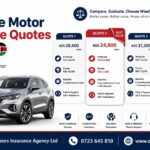


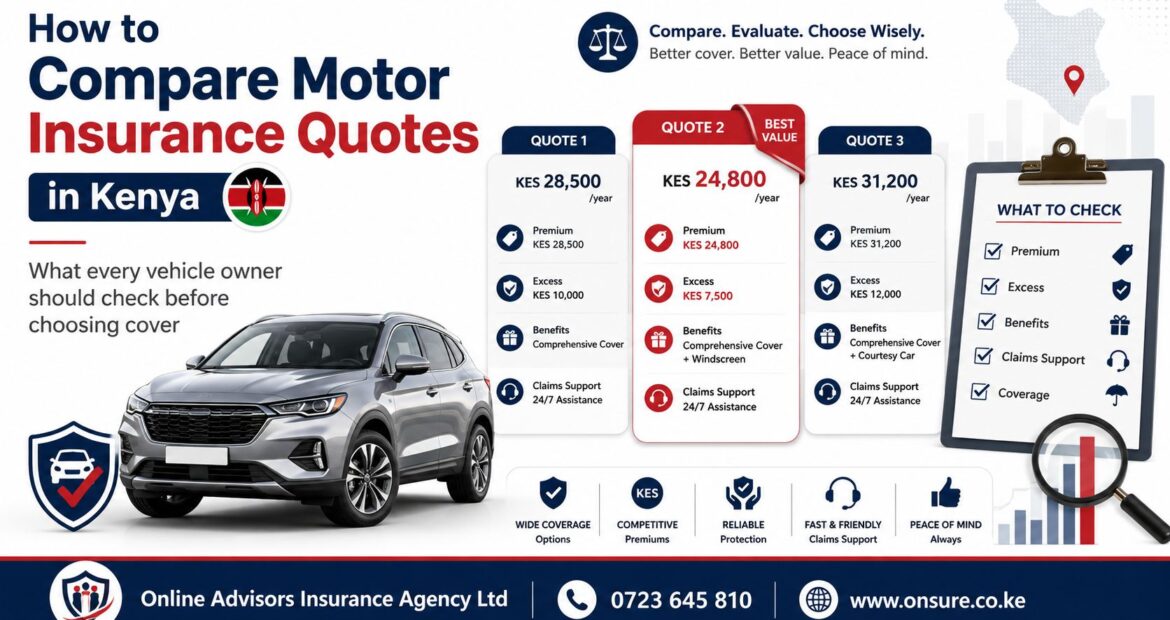
When shopping for motor insurance in Kenya, it is tempting to compare quotations using only one figure:
the premium.
If Insurer A quotes KES 65,000 and Insurer B quotes KES 78,000, the cheaper option may immediately look like the better deal.
But motor insurance quotations are rarely identical.
A lower premium can come with a higher excess, lower windscreen limits, fewer benefits, stricter conditions or more limited optional protection. A slightly more expensive policy may provide significantly better value when you eventually need to make a claim.
The right way to compare motor insurance quotations is therefore to ask:
What am I getting for the premium I am paying?
This guide explains how Kenyan motorists can compare comprehensive and third-party motor insurance quotations properly before choosing a policy.
Start by Comparing the Same Type of Insurance
Before comparing prices, make sure the quotations provide the same basic type of cover.
The main categories include:
Third-Party Only Insurance
This mainly protects you against insured liabilities to third parties.
It generally does not cover accidental damage to your own vehicle.
Third-Party Fire and Theft
Where available, this provides third-party protection together with specified fire and theft protection for your vehicle.
Comprehensive Motor Insurance
Comprehensive insurance provides broader protection and can include accidental damage to your own vehicle, fire, theft and third-party liabilities, subject to the policy terms.
For example, Britam’s current comprehensive motor product lists accidental damage, fire, theft and third-party liabilities among its core protections. It also includes benefits such as windscreen cover, towing and recovery, depending on applicable terms.
You cannot meaningfully compare a third-party quotation with a comprehensive quotation simply because both relate to the same vehicle.
1. Compare the Total Premium
The premium is still important.
Ask each insurer or intermediary for the total amount payable, not merely the basic rate.
For comprehensive insurance, the total cost can include:
- Basic comprehensive premium
- Optional benefits
- Applicable policyholder levies
- Stamp duty
- Other applicable charges
For example:
Quote A
Basic premium: KES 70,000
Optional benefits: KES 5,000
Statutory charges: KES 377.50
Stamp duty: KES 40
Total: KES 75,417.50
Quote B
Basic premium: KES 74,000
Optional benefits included: KES 2,000
Statutory charges: KES 342
Stamp duty: KES 40
Total: KES 76,382
The headline rate alone does not tell you which policy offers better value.
2. Compare the Vehicle Value Used
Comprehensive premiums are closely connected to the value of the vehicle.
Suppose two insurers quote the same car.
Insurer A
Vehicle value: KES 2,000,000
Insurer B
Vehicle value: KES 2,400,000
Even if Insurer A’s premium is lower, the quotations are not being calculated on the same insured value.
Before comparing them, ask:
What value has each insurer used for my vehicle?
Where required, obtain a professional valuation.
A low premium based on an unrealistically low insured value may not be in your best interests.
3. Compare the Basic Comprehensive Rate
Where the premium is calculated as a percentage of the vehicle’s insured value, compare the rate being applied.
For example:
Vehicle value:
KES 2,000,000
Insurer A
Rate: 3.5%
Basic premium:
KES 70,000
Insurer B
Rate: 4%
Basic premium:
KES 80,000
Insurer C
Rate: 4.5%
Basic premium:
KES 90,000
At first glance, Insurer A is cheapest.
But the comparison should not end there.
You now need to compare the excesses, benefits, limits and exclusions.
4. Compare the Basic Excess
The motor insurance excess is the amount of an insured loss you may be required to bear.
This is one of the most important parts of a motor insurance comparison.
Suppose:
Insurer A
Annual premium: KES 70,000
Basic excess: KES 80,000
Insurer B
Annual premium: KES 76,000
Basic excess: KES 40,000
Insurer A saves you:
KES 6,000
at purchase.
But if you subsequently make an eligible own-damage claim, the difference in potential excess could be:
KES 40,000.
This demonstrates why:
Cheapest premium does not always mean cheapest insurance.
5. Check Whether Excess Protector Is Included
An excess protector can protect you against certain excesses that would otherwise become payable after a covered loss.
When comparing quotations, ask:
- Is excess protector included?
- Is it optional?
- How much does it cost?
- Which excesses does it protect?
- Does it protect theft excess?
- Does it cover young-driver excess?
- Are any excesses excluded?
Do not simply compare:
With excess protector
against:
Without excess protector
as though they are equivalent quotations.
They are not.
6. Compare the Theft Excess
A theft claim can involve the entire value of the vehicle.
You therefore need to know what contribution you might have to make if your vehicle is stolen.
Britam’s current comprehensive motor information, for example, explicitly states that theft compensation is subject to an excess.
Ask every insurer:
What is the theft excess?
A cheap quotation with an unusually high theft excess may not offer the value you expect, particularly for a vehicle with significant theft exposure.
7. Compare Windscreen Cover
Windscreens can be expensive, particularly on modern cars equipped with:
- Cameras
- Rain sensors
- Driver-assistance systems
- Heating elements
- Heads-up displays
Check:
What windscreen limit is included?
For example:
Insurer A
Windscreen limit:
KES 30,000
Insurer B
Windscreen limit:
KES 100,000
If your replacement windscreen costs KES 120,000, the difference matters.
Britam currently lists free windscreen cover as one of the benefits of its comprehensive motor product, illustrating why benefit limits should be considered alongside the headline premium.
Always confirm the actual monetary limit applicable to your quotation.
8. Compare Audio and Entertainment System Cover
Many comprehensive policies provide some protection for factory-fitted or approved entertainment equipment.
But the limits differ.
Check whether your quotation covers:
- Radio
- Infotainment screen
- Speakers
- Amplifiers
- Navigation equipment
- Other declared accessories
A policy offering only a small standard limit may not adequately protect an expensive aftermarket system.
9. Compare Towing and Roadside Assistance
After a major accident, towing costs can be significant.
Ask:
- Is towing included?
- What is the maximum amount?
- Is roadside assistance included?
- Is assistance available countrywide?
- Is there a specific approved provider?
Britam currently includes accident protection, recovery and towing among the listed benefits under its comprehensive motor product.
Other insurers may provide different limits and arrangements.
10. Compare Courtesy Car or Loss-of-Use Benefits
A vehicle can remain at a garage for days or weeks following an accident.
If you depend on your car for work or daily activities, a courtesy-car benefit can be valuable.
Check:
- Whether it is included
- Whether it is optional
- Maximum number of days
- Daily monetary limit
- Waiting period
- Eligible claims
A quotation that costs KES 5,000 more but provides useful mobility after an accident may represent better value for some motorists.
11. Compare Political Violence and Terrorism Cover
Political Violence and Terrorism cover, commonly referred to as PVT, may be offered separately or included under particular arrangements.
Ask:
- Is PVT included?
- Is it optional?
- What additional premium applies?
- What events are covered?
- What exclusions apply?
Do not assume every comprehensive quotation contains exactly the same PVT protection.
12. Compare Geographical Limits
Where can you drive the vehicle and remain covered?
Some motorists regularly travel into:
- Uganda
- Tanzania
- Rwanda
- Other East African countries
Britam’s current comprehensive product states that its normal geographical scope is Kenya but that cover can be extended to other East African countries on request.
If you travel across borders regularly, ask about:
- Territorial extension
- Additional premium
- Documentation required
- COMESA Yellow Card where applicable
- Claims procedures outside Kenya
13. Compare Total-Loss Terms
A badly damaged vehicle may be declared a total loss rather than repaired.
Ask each insurer:
At what point is my vehicle considered a total loss?
Britam’s current comprehensive motor product states that it considers a vehicle a total loss where repair costs exceed 50% of the sum insured.
Other insurers may use different policy wording or assessment criteria.
This is another reason policy terms matter.
14. Check the Repair-Garage Arrangements
Ask:
- Does the insurer have approved garages?
- Can I choose my preferred garage?
- Are dealer garages allowed?
- Are genuine parts used?
- Are alternative parts permitted?
- What happens if the insurer and garage disagree on repair costs?
Owners of premium or specialised vehicles should pay particular attention to this issue.
15. Compare the Insurer’s Claims Process
Insurance becomes most important when you make a claim.
Before purchasing cover, find out:
- How claims are reported
- Whether claims can be submitted online
- Required documentation
- How assessment is arranged
- How garages are authorised
- How total-loss claims are handled
- How complaints are escalated
The Insurance Regulatory Authority publishes claims settlement statistics as part of its consumer-protection and market-information resources. Its current website also provides access to licensed entities and claims statistics, which can help consumers conduct additional due diligence.
Do not treat one statistic as the sole measure of insurer quality, but use available regulatory information as part of your assessment.
16. Confirm That the Insurer Is Licensed
Before purchasing insurance, confirm that the insurance company is currently licensed to conduct the relevant class of business in Kenya.
The Insurance Regulatory Authority maintains a current Licensed Entities 2026 registry and a licensed-insurers directory.
This is particularly important if you receive unusually cheap insurance offers through:
- Social media
- Unknown websites
- Unfamiliar intermediaries
Do not choose an insurance policy solely because someone promises a very low price.
Verify who is actually underwriting the cover.
17. Compare the Policy Exclusions
Every motor insurance policy has exclusions.
Ask for or review the actual policy wording.
Important issues can include:
- Unlicensed drivers
- Undisclosed vehicle use
- Mechanical breakdown
- Wear and tear
- Driving under prohibited circumstances
- Undeclared modifications
- Territorial restrictions
- Certain theft circumstances
- Particular types of accessories
A quotation tells you what the insurance costs.
The policy wording tells you what you have actually purchased.
18. Compare Special Conditions
Your particular quotation may include special requirements.
Examples might include:
- GPS tracker installation
- Alarm or immobiliser
- Specific authorised drivers
- Valuation
- Inspection
- Additional excess
- Secure overnight parking
- Restricted vehicle use
Read these conditions carefully.
A benefit is only valuable if you can comply with the policy conditions.
19. Consider the No-Claim Discount
Some insurers reward customers who remain claim-free.
Britam’s current comprehensive motor product, for example, lists a non-claim discount that can build up depending on the number of years without a claim.
Ask:
- Is a no-claim discount available?
- How is it calculated?
- Can an existing discount be transferred?
- What happens after a claim?
This can affect the long-term cost of insurance.
20. Compare Payment Options Carefully
Some insurers or intermediaries may allow premium-financing or instalment arrangements.
If you are offered instalments, establish:
- Total cost
- Deposit required
- Financing charges
- Payment schedule
- What happens after missed payments
- When full insurance cover becomes effective
A lower monthly figure does not necessarily mean a lower total cost.
A Practical Motor Insurance Comparison Example
Suppose your car is valued at:
KES 2,500,000
You receive three comprehensive quotations.
| Feature | Insurer A | Insurer B | Insurer C |
|---|---|---|---|
| Annual Premium | KES 85,000 | KES 92,000 | KES 98,000 |
| Basic Excess | KES 75,000 | KES 50,000 | KES 40,000 |
| Excess Protector | Optional | Included | Included |
| Windscreen Limit | KES 30,000 | KES 75,000 | KES 100,000 |
| Towing | Included | Included | Included |
| Courtesy Car | No | Optional | Included |
| PVT | Optional | Included | Included |
| Regional Extension | Optional | Optional | Included |
If you compare only premiums:
Insurer A wins.
But when you compare:
- Excess
- Excess protector
- Windscreen
- PVT
- Courtesy car
- Territorial benefits
the answer becomes less obvious.
The best quotation depends on your needs and risk.
The figures above are illustrative only.
What Should Matter Most?
A useful way to compare quotations is to rank these factors:
1. Essential
- Licensed insurer
- Correct vehicle value
- Required coverage
- Acceptable exclusions
- Affordable excess
2. Important
- Excess protector
- Theft terms
- Windscreen limit
- Towing
- Claims process
3. Lifestyle Dependent
- Courtesy car
- Regional extension
- Entertainment-system cover
- Special accessories
- Optional benefits
Then compare price.
This prevents a small premium difference from distracting you from much larger coverage differences.
Why the Cheapest Motor Insurance Can Cost More Later
Imagine two quotations.
Policy A
Premium:
KES 70,000
Excess:
KES 80,000
Policy B
Premium:
KES 78,000
Excess:
KES 40,000
Policy A saves:
KES 8,000
today.
But after one qualifying accident, the difference in excess could potentially be:
KES 40,000.
Again, this does not automatically make Policy B better.
But it demonstrates why motor insurance should be viewed as a risk-transfer decision, not merely an annual purchase.
Questions to Ask Before Accepting a Motor Insurance Quote
Before paying, ask your insurer or insurance intermediary:
- What is the total premium?
- What vehicle value is being used?
- What is my basic excess?
- What is my theft excess?
- Is excess protector included?
- What excesses does the protector cover?
- What is the windscreen limit?
- What is the entertainment-system limit?
- Is towing included?
- Is a courtesy car included?
- Is PVT included?
- What territorial limits apply?
- What are the major exclusions?
- Are there special security requirements?
- Is valuation required?
- Which garages can repair the vehicle?
- How do I report a claim?
- Is a no-claim discount available?
- What happens in a total loss?
- Is the insurer currently licensed for motor business?
If you can answer these questions, you are no longer comparing prices.
You are comparing insurance value.
Common Mistakes When Comparing Motor Insurance Quotes
Mistake 1: Choosing the Lowest Premium Automatically
Premium is only one component of the policy.
Mistake 2: Ignoring the Excess
A higher excess can significantly increase your contribution after a claim.
Mistake 3: Comparing Different Vehicle Values
Make sure insurers are quoting on comparable sums insured.
Mistake 4: Assuming All Comprehensive Policies Are the Same
They are not.
Benefits, limits, exclusions and conditions vary.
Mistake 5: Ignoring Optional Benefits
A quotation without excess protector should not be directly compared with one including it without adjusting for the difference.
Mistake 6: Not Reading the Policy Wording
The quotation is only a summary.
Mistake 7: Buying From an Unverified Seller
Use the IRA’s current licensed-entity resources to verify insurers and intermediaries where necessary.
Why Use an Insurance Agency to Compare Quotes?
You can approach several insurance companies yourself.
But this may involve:
- Completing multiple requests
- Repeating vehicle information
- Understanding different policy terms
- Comparing different benefit structures
An insurance agency can simplify the comparison by presenting quotations on a more consistent basis.
The agency can help explain:
- Why premiums differ
- Which excess applies
- Which benefits are included
- Which benefits are optional
- What special conditions apply
- What documents are required
This is especially useful where the lowest quotation is not necessarily the most suitable one.
Frequently Asked Questions
Which motor insurance company is cheapest in Kenya?
There is no single insurer that will always be cheapest for every vehicle.
Pricing can vary depending on:
- Vehicle value
- Vehicle type
- Age
- Use
- Claims history
- Insurer underwriting
- Optional benefits
- Minimum premiums
Request quotations for your specific vehicle.
Should I choose the cheapest comprehensive insurance?
Not automatically.
Compare the premium together with excesses, benefits, limits, exclusions and claims terms.
Why do insurance companies quote different premiums for the same car?
Insurers may apply different:
- Rates
- Minimum premiums
- Excesses
- Underwriting criteria
- Benefits
- Discounts
- Risk assessments
Therefore identical vehicles can receive different quotations.
How many motor insurance quotes should I compare?
There is no required number, but obtaining several suitable quotations can help you understand the available range.
The goal is not to collect the largest number possible.
It is to obtain enough comparable and suitable options to make an informed decision.
How do I know whether an insurer is licensed in Kenya?
The Insurance Regulatory Authority maintains current licensed-entity resources, including its 2026 Licensed Entities registry and licensed-insurer directory.
What is the most important thing besides price?
For comprehensive motor insurance, the excess is one of the first things you should examine.
You should also consider:
- Scope of cover
- Exclusions
- Claims support
- Insurer licensing
- Vehicle value
- Important benefit limits
The Bottom Line
When comparing motor insurance quotations in Kenya, do not ask only:
“Which one is cheapest?”
Ask:
“Which quotation gives me the best combination of price, protection and claim-time value?”
Compare:
Premium
Vehicle value
Excess
Excess protector
Theft excess
Windscreen cover
Towing
Courtesy car
PVT
Territorial limits
Claims process
Exclusions
Special conditions
Insurer licensing
A good insurance decision is not necessarily the cheapest policy.
It is the policy whose premium, coverage and financial exposure make sense for your circumstances.
Compare Motor Insurance Quotes With Online Advisors
At Online Advisors Insurance Agency Ltd, we help vehicle owners compare motor insurance options from reputable insurance companies in Kenya.
Instead of looking at premium alone, we can help you compare important differences in:
- Comprehensive rates
- Excesses
- Excess protector
- Windscreen limits
- Optional benefits
- Policy conditions
- Claims requirements
Whether you are purchasing insurance for a new vehicle or renewing your existing policy, comparing available options can help you make a more informed decision.
Request Motor Insurance Quotes
Tel: 0723 645 810
Website: www.onsure.co.ke
Office: Vision Plaza, 1st Floor, Office 2, Mombasa Road, Nairobi
Don’t just compare prices. Compare protection.
Important Disclaimer
This article provides general educational information and does not constitute an insurance quotation or recommendation of a particular insurer. Premiums, benefits, excesses, limits, exclusions and underwriting conditions vary between insurance companies and may change over time. Always review the current quotation, policy schedule and policy wording before purchasing cover.