


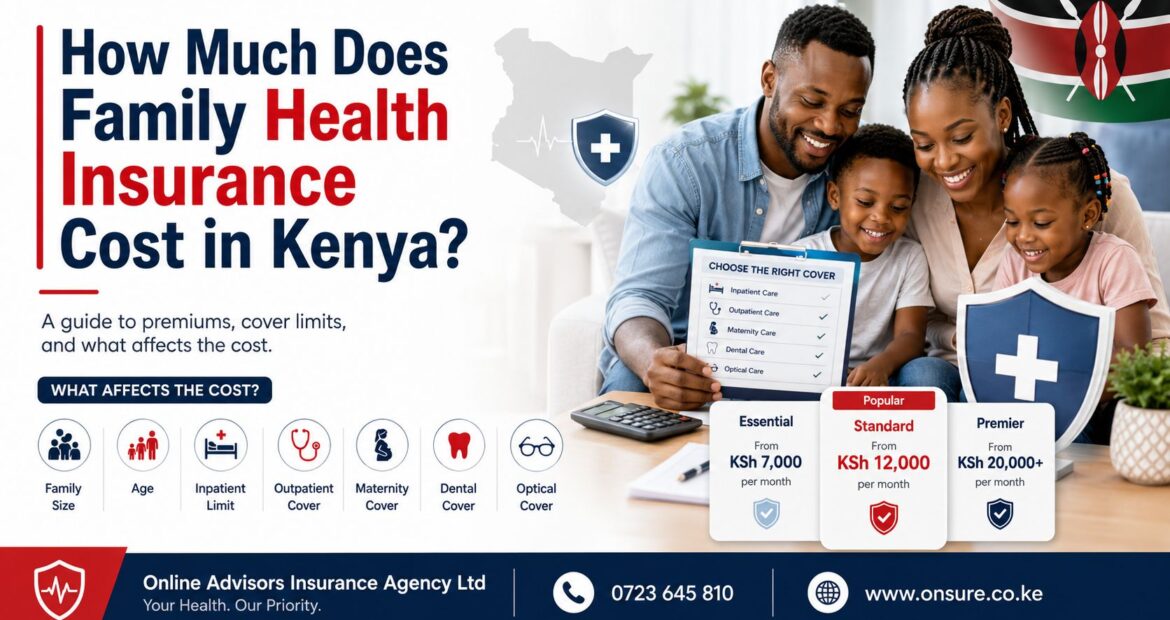
For many Kenyan families, the biggest question when considering private medical insurance is simple:
How much does family health insurance cost in Kenya?
There is no single standard price.
The cost depends on several factors, including the ages of the people being insured, the number of family members, the inpatient limit selected, whether outpatient treatment is included, and additional benefits such as maternity, dental, optical, chronic illness and international treatment.
As a current market example, Jubilee Insurance states that its CoverBora inpatient-only plan starts from KES 11,200 per year for families, while more comprehensive family medical plans can cost considerably more depending on the benefits selected.
This means the better question is not simply:
“What is the cheapest family health insurance?”
Instead, ask:
“What level of medical protection does my family need, and how much will that protection cost?”
This guide explains the major factors that affect family medical insurance premiums in Kenya and what you should compare before buying a policy.
What Is Family Health Insurance?
Family health insurance is a medical insurance policy designed to protect a principal member and eligible dependants against specified healthcare expenses.
Depending on the insurer and product, the people covered may include:
- Principal member
- Spouse
- Children
- Other eligible dependants in certain arrangements
Family medical plans can provide benefits such as:
- Inpatient hospital treatment
- Outpatient treatment
- Maternity
- Dental treatment
- Optical treatment
- Chronic illness care
- Emergency evacuation
- Overseas referral treatment
However, not every family health insurance plan includes all these benefits.
Britam’s current Milele Family plan, for example, provides inpatient and outpatient benefits as well as dental, optical and overseas referral features, illustrating how comprehensive family plans can extend beyond hospital admission alone.
How Much Does Family Health Insurance Cost in Kenya?
Family medical insurance premiums can range from relatively low-cost inpatient-only plans to significantly more expensive comprehensive plans.
For example, Jubilee currently advertises:
CoverBora family cover from KES 11,200 per year
for its inpatient-focused product.
Jubilee’s broader 2026 health-insurance cost guidance notes that premiums vary according to factors such as the policyholder’s age, number of dependants and selected benefits.
A family seeking basic hospitalisation protection may therefore pay substantially less than another family requiring:
- High inpatient limits
- Outpatient cover
- Maternity
- Dental
- Optical
- Chronic-condition benefits
- Wider hospital access
The quoted premium must always be compared with the benefits provided.
Why Do Family Health Insurance Prices Differ So Much?
Consider two hypothetical families.
Family A
They purchase:
- Inpatient-only insurance
- KES 500,000 inpatient limit
- No outpatient cover
- No maternity
- No dental
- No optical
Their premium may be relatively affordable.
Family B
They purchase:
- KES 5 million inpatient limit
- Outpatient cover
- Maternity
- Dental
- Optical
- Chronic illness protection
- Overseas referral benefits
Their premium will normally be considerably higher.
Both policies may be called family health insurance, but they provide very different levels of financial protection.
What Determines the Cost of Family Health Insurance in Kenya?
1. Number of Family Members
The number of people being covered is one of the first factors affecting your premium.
For example:
One adult + one child
will generally cost less than:
Two adults + four children.
Some insurers offer family packages covering a specified number of dependants, while others price individual family members according to age or benefit structure.
When requesting a quotation, provide accurate information about:
- Principal member
- Spouse
- Number of children
- Ages of everyone being covered
2. Age of the Adults
Age is a major health-insurance pricing factor.
A family headed by adults in their twenties or thirties may receive different pricing from a family where the principal member or spouse is in their fifties or sixties.
Healthcare risks generally increase with age, which can influence insurer pricing.
Jubilee’s current health-insurance pricing guidance specifically identifies age among the factors affecting medical insurance cost.
Older parents may also require dedicated senior health insurance instead of being added to an ordinary family plan.
3. Inpatient Limit
The inpatient limit is one of the most important factors affecting premium.
Inpatient insurance provides cover for eligible medical costs when the insured person is admitted to hospital.
A family might choose an annual inpatient limit such as:
- KES 250,000
- KES 500,000
- KES 1 million
- KES 2 million
- KES 5 million
- KES 10 million
Generally:
Higher inpatient limit = Higher premium
Jubilee’s J-Care Premium currently offers several plan levels with cover reaching up to KES 10 million, demonstrating the range of protection available in the Kenyan market.
The highest possible limit is not automatically necessary for every family.
Choose a limit that reflects your budget and the level of financial risk you want the insurer to absorb.
4. Outpatient Cover
Outpatient insurance covers eligible treatment where you visit a healthcare provider but are not admitted overnight.
It may include:
- Doctor consultations
- Specialist consultations
- Prescription medicine
- Laboratory tests
- X-rays
- Diagnostic procedures
- Minor treatment
Adding outpatient cover usually increases the premium.
Families with young children or members requiring regular consultations may find outpatient cover particularly useful.
Other families may prefer to pay routine medical bills themselves while using insurance primarily for major hospital admissions.
5. Maternity Cover
Maternity is another major factor affecting family health insurance cost.
Depending on the insurer and policy, maternity benefits can include:
- Antenatal treatment
- Normal delivery
- Caesarean delivery
- Pregnancy complications
- Postnatal treatment
- Newborn-related benefits
Maternity normally comes with a specific annual limit.
It may also be subject to a waiting period.
For this reason, couples planning to have children should investigate medical insurance before pregnancy rather than waiting until maternity treatment is already required.
6. Dental Cover
Dental benefits may cover eligible expenses such as:
- Dental consultation
- Extraction
- Fillings
- Root canal treatment
- Scaling
depending on the policy.
Dental usually has a separate annual sublimit.
For example, having a:
KES 2 million inpatient limit
does not mean you automatically have:
KES 2 million dental cover.
Always check the specific dental benefit.
7. Optical Cover
Optical benefits can include:
- Eye examinations
- Prescription lenses
- Frames
- Other eligible eye-care services
Like dental cover, optical normally operates under its own limit.
Britam’s Milele Family plan currently lists both dental and optical among its family medical benefits.
Adding these benefits can increase the overall premium.
8. Pre-Existing Conditions
A pre-existing condition is generally a medical condition that existed before insurance commenced, subject to the definition used by the particular insurer.
Examples may include existing:
- Hypertension
- Diabetes
- Asthma
- Heart conditions
- Other previously diagnosed illnesses
How these conditions are treated varies considerably.
An insurer may:
- Accept them
- Apply a waiting period
- Apply a sublimit
- Request medical information
- Charge differently
- Exclude specific conditions
Britam’s Milele Family product currently states that it accepts pre-existing conditions, although actual cover remains subject to the terms and limits of the product.
Always ask specifically how an existing condition will be treated before paying your premium.
9. Chronic Illness Cover
Chronic illnesses can require continuous treatment over many years.
Examples include:
- Diabetes
- Hypertension
- Asthma
- Certain heart conditions
A family with members requiring regular chronic medication should pay close attention to:
- Chronic-disease limits
- Medicine benefits
- Specialist visits
- Waiting periods
- Provider network
A plan that looks inexpensive may provide inadequate chronic-condition protection.
10. Hospital Network
Before purchasing family medical insurance, ask:
Which hospitals can I use?
Insurers normally maintain an approved provider network.
The hospital network may include:
- Clinics
- Mission hospitals
- Private hospitals
- Specialist hospitals
- Premium healthcare facilities
Some plans provide broad access while lower-cost options may use a more restricted network.
Britam currently describes its Milele range as providing access to hospitals across its provider network, with plans ranging from budget-friendly to more comprehensive options.
A cheap policy may be less useful if your family’s preferred hospital is not accessible under the plan.
11. Geographical Coverage
Some health insurance policies provide treatment primarily within Kenya.
Others may extend to:
- East Africa
- Africa
- Overseas referral
- Worldwide treatment
International medical insurance usually costs considerably more than Kenya-only insurance.
For families who live and receive medical care primarily in Kenya, international cover may not always be necessary.
However, it can be valuable for people who travel frequently or want access to treatment outside the country.
12. Co-Payments
A co-payment is an amount the insured person contributes when obtaining certain medical services.
For example:
Consultation cost:
KES 3,000
Applicable co-pay:
KES 500
You pay:
KES 500
and the insurer handles the eligible balance according to the policy terms.
A plan with a co-pay may sometimes have a lower premium than an equivalent zero-co-pay plan.
Therefore, when comparing policies ask:
“How much will I pay annually?”
and:
“How much will I still pay when I actually visit the hospital?”
13. Waiting Periods
Waiting periods are extremely important when comparing medical insurance.
A waiting period is the period after the policy starts during which particular illnesses or benefits are not yet covered.
Waiting periods may apply to:
- General illness
- Maternity
- Surgery
- Chronic illness
- Pre-existing conditions
- Certain specialised procedures
Two medical policies with similar premiums can therefore provide very different value during the first year.
Always ask for the waiting-period schedule before buying.
Inpatient Only vs Inpatient and Outpatient: Which Is Cheaper?
Generally, inpatient-only insurance is cheaper because the insurer is covering fewer types of medical expenses.
This can be a good starting point for families with limited budgets.
Suppose your primary concern is:
“What happens if one of us requires surgery or several days in hospital?”
Inpatient insurance addresses that large financial risk.
You could then self-fund ordinary:
- Doctor consultations
- Minor illnesses
- Medicine
- Basic laboratory tests
where affordable.
On the other hand, a family that visits healthcare providers frequently may obtain better value from inpatient plus outpatient insurance.
Example 1: Budget Family Health Insurance
Consider a young family seeking mainly protection against major hospitalisation.
They choose:
- Inpatient-only cover
- Moderate inpatient limit
- Local provider network
- No maternity
- No dental
- No optical
Their annual premium may be relatively low.
Jubilee’s current CoverBora product demonstrates this lower-cost approach, with family pricing advertised from KES 11,200 annually.
This does not mean every family can obtain cover at KES 11,200.
Eligibility and benefits matter.
Example 2: Mid-Level Family Medical Insurance
Another family wants:
- Inpatient cover
- Outpatient treatment
- Higher hospital limit
- Dental
- Optical
Their annual premium will generally be higher.
However, they also receive broader support for everyday medical expenses.
Example 3: Comprehensive Family Health Insurance
A third family wants:
- High inpatient limit
- Outpatient
- Maternity
- Dental
- Optical
- Chronic-condition benefits
- Wider hospital network
- Overseas referral
This is likely to cost considerably more.
Jubilee’s current J-Care Premium provides six flexible levels and limits reaching up to KES 10 million, illustrating the type of broader protection available at the comprehensive end of the market.
Is the Cheapest Family Health Insurance the Best?
Not necessarily.
Imagine two hypothetical plans.
Plan A
Annual premium:
KES 35,000
Benefits:
- Inpatient only
- KES 500,000 annual limit
Plan B
Annual premium:
KES 80,000
Benefits:
- KES 2 million inpatient
- Outpatient
- Dental
- Optical
- Maternity
Plan A is cheaper.
But that does not automatically make it better.
Likewise, Plan B is more comprehensive, but it may contain benefits your family does not currently need.
The best policy is the one that provides appropriate protection at a premium you can continue paying sustainably.
What Should You Compare Before Buying?
Use this checklist when comparing family medical insurance.
| Feature | What to Check |
|---|---|
| Annual premium | Total cost |
| Inpatient limit | Maximum hospital cover |
| Outpatient | Included or optional |
| Maternity | Limit and waiting period |
| Dental | Annual sublimit |
| Optical | Annual sublimit |
| Chronic illness | Limits and conditions |
| Pre-existing conditions | Waiting period/terms |
| Hospital network | Hospitals you can access |
| Co-pay | Amount payable per visit |
| Emergency evacuation | Included or optional |
| Overseas referral | Availability |
| Waiting periods | When cover becomes usable |
| Exclusions | What is not covered |
Do not compare premiums without comparing these benefits.
How Can You Reduce the Cost of Family Health Insurance?
Prioritise Inpatient Protection
If your budget is limited, start by protecting against major hospital bills.
You can add broader benefits later if necessary.
Choose an Appropriate Limit
Do not automatically choose the highest inpatient limit available.
Choose a level that balances affordability and meaningful financial protection.
Compare Several Insurers
Different insurers price family medical insurance differently.
An insurance agency can help you compare suitable options rather than obtaining only one quotation.
Review Optional Benefits
If maternity is not currently relevant, you may not need to pay additional premium for it.
Likewise, consider whether you want to insure dental and optical expenses or self-fund them.
Buy Before Illness Occurs
Waiting until a serious health problem develops can reduce your available options because waiting periods and pre-existing-condition terms may apply.
Should You Include Your Parents?
Parents and senior citizens often require different health-insurance arrangements.
Age can significantly affect:
- Premium
- Eligibility
- Waiting periods
- Medical underwriting
- Benefit limits
Some insurers therefore provide dedicated senior health plans.
When requesting a family quotation, ask whether your parents should:
- Join the family plan
- Take separate policies
- Use a senior-specific medical plan
What Documents May Be Required?
Requirements vary between insurers, but you may be asked for:
- National ID or passport
- KRA PIN
- Spouse details
- Birth certificates for children
- Dates of birth
- Contact information
- Medical declaration
- Completed proposal/application form
Some cases may require additional medical or underwriting information.
Verify Who You Are Buying Insurance From
Before paying for medical insurance, confirm that the insurer or intermediary is appropriately licensed.
The Insurance Regulatory Authority of Kenya currently publishes lists of licensed insurers and licensed medical insurance providers, including 2026 regulatory listings.
This is particularly important when receiving insurance offers through:
- Social media
- Unknown websites
- Unfamiliar intermediaries
Always know who is actually underwriting your medical cover.
Frequently Asked Questions
How much does family health insurance cost in Kenya?
There is no standard price.
Cost depends on family size, ages, inpatient limit, outpatient cover, maternity, dental, optical, chronic conditions and other benefits.
Current insurer examples show that basic family hospital cover can begin at relatively low annual premiums, while comprehensive plans can cost considerably more.
Can I get family health insurance for under KES 50,000 per year?
Potentially, yes.
Some lower-cost plans and inpatient-focused products can fall within that budget depending on family structure and benefits.
However, compare exactly what is covered.
What is the most important health insurance benefit?
For many households, inpatient insurance is the foundation because major hospital admissions can create large unexpected bills.
Other benefits should then be selected according to your family’s needs.
Does family health insurance cover maternity?
Some plans provide maternity cover, but limits and waiting periods usually apply.
Check the specific terms before buying.
Are pre-existing conditions covered?
Some insurers and products accept certain pre-existing conditions, but the applicable limits, waiting periods and conditions vary.
Never assume all conditions are automatically covered.
Can I include my children?
Family plans commonly allow eligible children to be covered, subject to the insurer’s rules and age limits.
Can I include my parents?
Possibly, but senior parents may require separate medical plans because of age and underwriting requirements.
Is outpatient cover worth paying for?
It depends on how frequently your family uses routine healthcare.
Families with regular consultations and medication needs may benefit considerably from outpatient insurance.
Conclusion
So, how much does family health insurance cost in Kenya?
There is no single answer.
Your premium is determined by:
Family size
Age
Inpatient limit
Outpatient cover
Maternity
Dental
Optical
Chronic conditions
Pre-existing-condition terms
Hospital network
Geographical coverage
Waiting periods
The cheapest plan is therefore not necessarily the best plan.
Instead of choosing insurance solely because of the premium, consider:
What medical expenses could seriously affect our family’s finances?
Then look for a policy that transfers those risks at a price your household can sustainably afford.
Compare Family Health Insurance in Kenya
At Online Advisors Insurance Agency Ltd, we help individuals and families compare health insurance options from reputable insurance companies in Kenya.
We can help you compare:
- Premiums
- Inpatient limits
- Outpatient limits
- Maternity benefits
- Dental and optical cover
- Hospital networks
- Waiting periods
- Chronic-condition benefits
- Pre-existing-condition terms
- Important exclusions
Request a Family Health Insurance Quote
Tel: 0723 645 810
Website: www.onsure.co.ke
Office: Vision Plaza, 1st Floor, Office 2, Mombasa Road, Nairobi
Don’t choose family health insurance by price alone. Compare what your family is actually protected against.
Important Disclaimer
This article provides general educational information and does not constitute an insurance quotation or personalised financial advice. Product examples and prices referenced are based on publicly available insurer information as of August 2026 and may change. Premiums, benefit limits, waiting periods, eligibility requirements, exclusions and hospital networks vary between insurers. Always obtain a current quotation and review the applicable policy wording before purchasing medical insurance.