


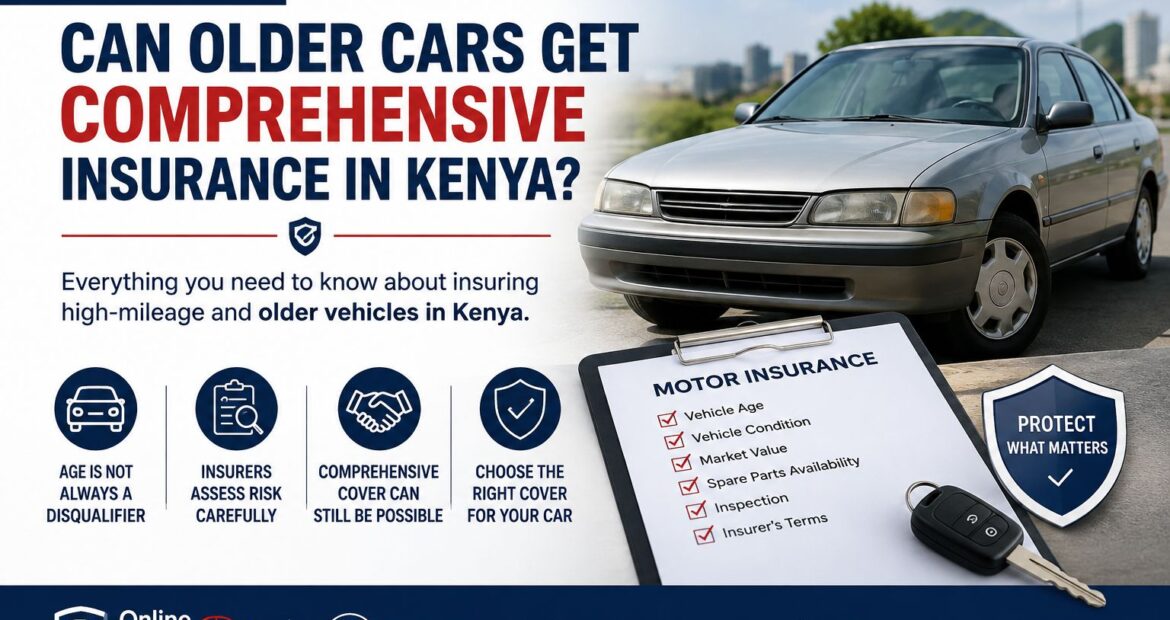
If you own an older vehicle in Kenya, you may have encountered one of the most common motor insurance questions:
Can a car that is more than 10, 15 or even 20 years old still get comprehensive insurance?
The short answer is:
Yes, in some cases — but it depends on the insurer, vehicle age, value, condition, make, model and underwriting requirements.
There is no single rule that guarantees every older vehicle comprehensive insurance simply because it is roadworthy.
At the same time, vehicle owners should not assume that every car above a particular age is automatically prohibited from getting comprehensive cover.
Insurance companies have their own underwriting criteria.
For example, CIC’s current Easy Bima comprehensive product states that a vehicle must be less than 15 years old and have a minimum value of KES 500,000 to qualify under that particular product. It also requires the vehicle to be roadworthy and in good working condition based on valuation.
Other insurers and insurance products may apply different limits or consider older vehicles individually.
This guide explains how vehicle age affects comprehensive motor insurance in Kenya, why insurers sometimes decline older cars, and what options may still be available if your vehicle is over 15 years old.
What Is Considered an Older Vehicle for Insurance Purposes?
There is no universal definition of an “old car” that applies to every Kenyan insurer.
However, vehicle age becomes increasingly important once a car approaches approximately:
10 years
15 years
and beyond.
A commonly encountered underwriting threshold in the Kenyan market is around 15 years from the year of manufacture.
Some insurance products restrict comprehensive cover once a vehicle reaches this age.
For example, CIC’s current Easy Bima eligibility criteria specifically state that vehicles must be less than 15 years old to qualify for its comprehensive cover.
However, this should not be interpreted as a law stating that every vehicle over 15 years must have third-party insurance only.
Other insurers may consider an older vehicle subject to individual underwriting.
Is It Illegal to Comprehensively Insure a Car Over 15 Years Old?
No general rule should be assumed to mean that comprehensive motor insurance becomes legally prohibited once a vehicle reaches 15 years.
The more important issue is insurer eligibility and underwriting appetite.
An insurance company can decide what types of vehicles it is prepared to insure comprehensively, subject to applicable insurance laws and its approved underwriting practices.
Consequently:
Insurer A may decline comprehensive cover for vehicles older than 15 years.
Insurer B may consider the vehicle subject to inspection and valuation.
Insurer C may offer comprehensive cover but apply different rates, excesses or conditions.
This is one of the reasons why using an insurance agency to compare different insurers can be useful for owners of older vehicles.
Why Do Insurers Restrict Comprehensive Cover for Older Cars?
There are several practical reasons.
1. Spare Parts May Be Difficult to Find
As a vehicle becomes older, some original parts may become:
- Scarce
- Discontinued
- Expensive
- Available mainly through used-parts dealers
- Difficult to source locally
This can increase the cost and duration of repairs.
An insurer therefore needs to consider whether it can reasonably repair the vehicle after a serious accident.
2. Repair Costs Can Be High Relative to Vehicle Value
Consider a hypothetical 17-year-old vehicle valued at:
KES 650,000
Suppose a major accident causes:
KES 400,000
in repair costs.
The repair cost represents a large proportion of the vehicle’s value.
That creates a greater possibility of the vehicle becoming an economic total loss rather than being repaired.
The issue becomes even more significant where expensive components such as:
- Gearboxes
- Engines
- Airbags
- Electronic control units
- Headlights
- Body panels
are damaged.
3. Older Vehicles May Have Pre-Existing Damage
An older vehicle may already have:
- Dents
- Scratches
- Rust
- Worn interior components
- Previous accident repairs
- Mechanical defects
- Electrical problems
This creates an important insurance question:
Which damage existed before the policy started?
For this reason, an insurer considering an older car may require a more detailed pre-insurance inspection.
4. Vehicle Condition Varies Significantly
Two vehicles manufactured in the same year can be in completely different condition.
Consider two 2008 vehicles.
Vehicle A
- One careful owner
- Complete service history
- Good paintwork
- Mechanically sound
- Genuine parts
- Well maintained
- No major accident history
Vehicle B
- Multiple previous accidents
- Severe rust
- Poor mechanical condition
- Modified suspension
- Damaged body panels
- Poorly maintained
Both vehicles may be the same age, but they do not present the same risk.
This is why valuation and inspection become increasingly important for older cars.
5. Market Value Becomes Harder to Establish
Comprehensive insurance requires an appropriate insured value.
With relatively new vehicles, market values may be easier to establish because there are many comparable vehicles available for sale.
With older or rare vehicles, valuation becomes more complicated.
Factors such as:
- Condition
- Mileage
- Maintenance
- Modifications
- Scarcity
- Model popularity
- Availability of comparable vehicles
can significantly affect value.
A professional valuation can therefore become particularly important.
Britam’s current online motor insurance process notes that the final premium can change based on the vehicle valuation report, demonstrating the role valuation plays in comprehensive underwriting.
What Happens When Your Car Reaches 15 Years?
Nothing automatically happens to your vehicle simply because it turns 15 years old.
What may change is the number of insurers willing to offer comprehensive cover.
For example:
A vehicle manufactured in:
2011
would be approximately 15 years old in 2026.
At renewal, an insurer may:
- Continue comprehensive cover
- Request a fresh valuation
- Request inspection
- Adjust the comprehensive rate
- Apply different excess terms
- Offer restricted cover
- Move the vehicle to third-party fire and theft
- Offer third-party only
- Decline comprehensive renewal
The outcome depends on the insurer.
This is why motorists with older cars should avoid waiting until the final day of their existing cover before looking for renewal options.
Can a 16-Year-Old Car Get Comprehensive Insurance in Kenya?
Possibly.
However, the number of available insurers may be smaller.
Some insurance products use a 15-year eligibility cut-off.
CIC Easy Bima, for example, currently states that vehicles must be less than 15 years old for comprehensive cover under that product.
However, other Kenyan market sources note that some insurers may still consider older vehicles based on factors such as:
- Valuation
- Roadworthiness
- Make and model
- Claims history
- Vehicle value
- Underwriting approval
Therefore, if one insurer declines your 16-year-old car, it does not automatically mean that every insurer will decline it.
Can a 20-Year-Old Vehicle Get Comprehensive Insurance?
This becomes more difficult.
The older a vehicle becomes, the fewer standard comprehensive options are likely to be available.
A 20-year-old vehicle may require:
- Special underwriting consideration
- Detailed valuation
- Physical inspection
- Proof of good condition
- Individual insurer approval
The insurer may also consider whether the vehicle’s value makes comprehensive insurance economically sensible.
For some older vehicles, third-party fire and theft or third-party only may become the more practical available option.
What Factors Determine Whether an Older Car Can Get Comprehensive Cover?
Vehicle age is only one factor.
Insurers may also consider:
1. Vehicle Value
A well-maintained older vehicle worth KES 3 million may be treated differently from an older vehicle worth KES 350,000.
Some products also have minimum vehicle values.
For example, CIC’s Easy Bima currently specifies a minimum vehicle value of KES 500,000 for comprehensive eligibility.
2. Make and Model
Some older vehicles remain easy to maintain because:
- Spare parts are widely available
- Many mechanics understand them
- Parts are affordable
- The model remains common in Kenya
Other models may have scarce or expensive components.
An insurer may therefore treat two cars of the same age differently.
3. Vehicle Condition
Roadworthiness is extremely important.
CIC’s current Easy Bima criteria state that a vehicle will not qualify for comprehensive cover if it is not roadworthy or in good working condition based on valuation.
A well-maintained older car therefore generally presents a stronger underwriting case than one in poor condition.
4. Claims History
A poor claims history can affect an insurer’s willingness to offer or continue comprehensive cover.
An older vehicle with multiple previous claims may attract more restrictive terms than an equivalent vehicle with a good claims record.
CIC’s published Easy Bima criteria also identify poor claims history as a potential reason for not qualifying for comprehensive cover.
5. Vehicle Use
A privately used older vehicle may present a different risk from an older vehicle being used for:
- Taxi operations
- Ride-hailing
- Commercial deliveries
- PSV operations
- Long-distance transport
Commercial use generally means greater road exposure.
Always disclose the actual use of the vehicle.
6. Availability and Cost of Spare Parts
An older Toyota model with widely available parts may present a different repair situation from a rare luxury vehicle of exactly the same age.
Insurers must consider whether covered repairs can be performed economically.
7. Insured Value Compared With Repair Costs
This is one of the most important considerations.
Suppose:
Vehicle value: KES 700,000
A major accident results in:
KES 500,000 repair estimate
Repairing the vehicle may no longer be economically attractive.
Britam currently states that under its comprehensive motor product, a vehicle can be treated as a total loss when repair costs exceed 50% of the sum insured, illustrating how the relationship between repair cost and insured value can affect claims treatment.
The precise total-loss provisions applicable to your vehicle depend on your insurer and policy wording.
Why Is Valuation Important for Older Vehicles?
A vehicle valuation helps establish:
- Current market value
- Condition
- Vehicle details
- Existing damage
- Accessories
- Roadworthiness indicators
- Appropriate sum insured
For older cars, valuation becomes particularly useful because the original purchase price may have little relationship to today’s market value.
Consider a vehicle purchased for:
KES 3,000,000
ten years ago.
Its current value may now be:
KES 1,200,000.
Comprehensive insurance should be based on an appropriate current insured value rather than simply the historical purchase price.
Can You Insure an Older Car at Its Purchase Price?
Not necessarily.
Insurance is generally intended to compensate you for an insured financial loss, not create a profit.
If you purchased a vehicle many years ago for KES 4 million but its current appropriate value is KES 1.5 million, simply asking for it to be insured at KES 4 million does not mean the insurer will accept that value.
A valuation may be required.
Will Older Cars Pay a Higher Comprehensive Rate?
They can.
Comprehensive insurance pricing is based on underwriting risk.
An insurer considering an older vehicle may apply different:
- Premium rates
- Minimum premiums
- Excesses
- Benefits
- Conditions
than those applied to a newer vehicle.
Therefore:
Older vehicle ≠ automatically cheaper insurance.
Even though the car may have a lower market value, the percentage rate applied could be higher because repair or underwriting risks may be greater.
Example: Comparing a Newer and Older Vehicle
Consider this simplified illustration.
Vehicle A
Year: 2021
Value: KES 2,000,000
Illustrative rate: 3.5%
Basic premium:
KES 70,000
Vehicle B
Year: 2009
Value: KES 1,000,000
Illustrative rate: 5%
Basic premium:
KES 50,000
Vehicle B is worth half as much but is not necessarily charged half the insurance premium because the insurer may apply a different rate.
These rates are purely illustrative.
Actual rates depend on the insurer.
What Happens to the Excess on an Older Vehicle?
The insurer may apply different excess conditions depending on the vehicle and risk.
The excess is the amount of an insured loss that the policyholder may be required to bear.
For example:
Approved repair:
KES 200,000
Applicable excess:
KES 50,000
Policyholder contribution:
KES 50,000
Insurer contribution:
KES 150,000
subject to policy terms.
When comparing comprehensive insurance for an older vehicle, do not look only at the premium.
Ask:
What is the applicable excess?
Is excess protector available?
Is theft excess different?
Are there special endorsements because of the vehicle’s age?
Can You Get Excess Protector on an Older Vehicle?
Possibly, depending on the insurer.
Excess protector is an optional benefit that can protect against certain excesses that would otherwise be payable after a covered claim.
However, availability and scope can differ for older vehicles.
Ask the insurer or insurance intermediary specifically whether:
- Excess protector is available
- There is an additional premium
- All basic excesses are covered
- Theft excess is covered
- Age-related excesses remain applicable
Never assume an excess protector removes every possible excess.
What If No Insurer Will Offer Comprehensive Cover?
You still have alternatives.
Option 1: Third-Party Fire and Theft
Where available, third-party fire and theft provides more protection than ordinary third-party-only insurance.
It generally combines third-party liability protection with specified protection against fire and theft of the insured vehicle.
It does not normally provide the same accidental own-damage protection as comprehensive insurance.
Option 2: Third-Party Only Insurance
Third-party-only insurance protects against insured legal liabilities arising from injury, death or property damage suffered by third parties, subject to policy terms and statutory requirements.
It does not pay for accidental damage to your own vehicle.
For some very old or low-value vehicles, this may be the most practical available option.
Third Party vs Comprehensive for an Older Vehicle
Consider a vehicle worth:
KES 500,000
Suppose hypothetical comprehensive insurance costs:
KES 40,000 per year
You should consider:
- Vehicle value
- Annual premium
- Applicable excess
- Cost of common repairs
- Theft risk
- Personal financial ability to absorb a loss
- How long you intend to keep the vehicle
There is no universal answer.
For some motorists, comprehensive insurance remains worthwhile.
For others, third-party cover plus maintaining an emergency repair fund may make more financial sense.
Is Comprehensive Insurance Worth It for an Older Car?
Ask yourself five questions.
1. Could I Afford to Replace the Car Tomorrow?
If losing the vehicle would create a serious financial problem, comprehensive protection may still be valuable where available.
2. What Is the Vehicle Worth?
Comprehensive insurance becomes less economically attractive where annual premiums and potential excesses represent a substantial proportion of the vehicle’s market value.
3. Is the Vehicle Highly Prone to Theft?
Theft exposure may make broader insurance more attractive.
4. How Expensive Is It to Repair?
A common older vehicle with affordable parts may be relatively inexpensive to repair.
A rare or premium older car can be surprisingly expensive.
5. Is the Vehicle Financed?
This is critical.
A lender may require the financed vehicle to remain comprehensively insured.
If your vehicle is approaching an insurer’s age threshold while finance remains outstanding, discuss this early with:
- Your insurer
- Insurance intermediary
- Financing institution
Do not simply downgrade the vehicle to third-party cover if doing so would breach your financing agreement.
What Should You Do Before Your Car Turns 15 Years Old?
If your vehicle is approaching 15 years, start investigating renewal options early.
Step 1
Check the vehicle’s actual year of manufacture.
Step 2
Obtain an updated valuation.
Step 3
Ensure the vehicle is in good mechanical and physical condition.
Step 4
Request quotations from multiple insurers.
Step 5
Compare eligibility, not just price.
Step 6
Check excesses and optional benefits.
Step 7
If financed, confirm the lender’s insurance requirements.
This reduces the risk of discovering at the last minute that your existing insurance option is no longer available.
Why an Insurance Agency Can Help Owners of Older Cars
This is one situation where approaching only one insurer can limit your options.
Suppose:
Insurer A: declines vehicles above 15 years.
That does not necessarily tell you what:
Insurer B, C or D
might be prepared to consider.
An insurance agency can approach multiple insurers and establish whether comprehensive options remain available for your specific vehicle.
The comparison should look at:
- Eligibility
- Comprehensive rate
- Minimum premium
- Excess
- Excess protector
- Theft terms
- Valuation requirements
- Special conditions
- Optional benefits
rather than asking only:
“Who is cheapest?”
Information to Provide When Requesting Comprehensive Insurance for an Older Car
Have the following ready:
- Vehicle registration number
- Make
- Model
- Year of manufacture
- Current estimated value
- Logbook
- KRA PIN
- ID
- Current insurance details
- Claims history where requested
- Vehicle use
- Existing valuation where available
- Photographs where requested
Providing complete information makes it easier for insurers to determine whether they can offer terms.
Frequently Asked Questions
Can a car over 15 years get comprehensive insurance in Kenya?
Possibly.
Some insurance products impose a 15-year eligibility limit. CIC Easy Bima, for example, currently requires vehicles to be less than 15 years old for its comprehensive product. Other insurers may consider older vehicles subject to valuation, condition and underwriting approval.
Is 15 years a legal maximum age for comprehensive motor insurance?
You should not treat 15 years as a universal legal prohibition.
It is commonly encountered as an insurer underwriting threshold.
Different insurers and products may apply different eligibility rules.
Can a 20-year-old car get comprehensive insurance?
It may be possible in limited cases, but options are generally more restricted.
The insurer may consider vehicle value, make, model, roadworthiness, spare-parts availability, valuation and other underwriting factors.
What happens if my insurer refuses comprehensive insurance because the car is too old?
You can:
- Seek quotations from other insurers.
- Ask an insurance agency to compare available markets.
- Consider third-party fire and theft where available.
- Consider third-party-only cover.
- If the vehicle is financed, speak to the financier before changing the cover.
Does a well-maintained vehicle have a better chance?
Vehicle condition can matter.
Some insurers explicitly consider roadworthiness and valuation when assessing eligibility. CIC’s current Easy Bima comprehensive criteria, for example, state that a vehicle that is not roadworthy or in good working condition based on valuation will not qualify.
Do older cars require valuation?
Where comprehensive insurance is being considered, valuation is commonly important.
The insurer determines whether a fresh valuation or inspection is required.
Is comprehensive insurance worth buying on an old car?
It depends on the vehicle’s value, annual premium, excesses, repair costs, theft exposure, financial circumstances and available policy terms.
Compare the cost of insurance against the financial loss you would experience if the vehicle were stolen or seriously damaged.
The Bottom Line
An older vehicle is not automatically uninsurable.
However, the older the vehicle becomes, the fewer standard comprehensive insurance options you may find.
Around the 15-year mark, some insurers begin applying stricter eligibility rules.
For example, CIC’s Easy Bima currently limits its comprehensive product to vehicles less than 15 years old, while broader Kenyan market evidence indicates that older vehicles may still be considered by some insurers on an individual underwriting basis.
The best approach is therefore:
Do not assume. Compare.
Have the vehicle valued, provide accurate details and ask an insurance intermediary to establish which insurers are willing to offer comprehensive terms.
Need Comprehensive Insurance for an Older Vehicle?
At Online Advisors Insurance Agency Ltd, we can help vehicle owners compare available motor insurance options from reputable insurance companies in Kenya.
If your vehicle is approaching or has exceeded 15 years, we can help you establish what options may be available based on:
- Vehicle age
- Vehicle value
- Make and model
- Condition
- Intended use
- Insurer underwriting requirements
Where comprehensive cover is available, we can also help you compare:
- Premium
- Excess
- Excess protector
- Optional benefits
- Policy conditions
And where comprehensive insurance is unavailable, we can help you understand alternative motor insurance options.
Request a Motor Insurance Quote
Tel: 0723 645 810
Website: www.onsure.co.ke
Office: Vision Plaza, 1st Floor, Office 2, Mombasa Road, Nairobi
Older vehicle? Don’t assume you can’t get comprehensive insurance. Let us compare the available options.
Important Disclaimer
Motor insurance eligibility, age limits, premiums, excesses and underwriting requirements differ between insurers and can change over time. The 15-year references in this article reflect eligibility rules commonly encountered in the market and specific insurer/product examples, not a universal statutory prohibition. Always obtain current terms from the relevant insurer before purchasing or renewing cover.