


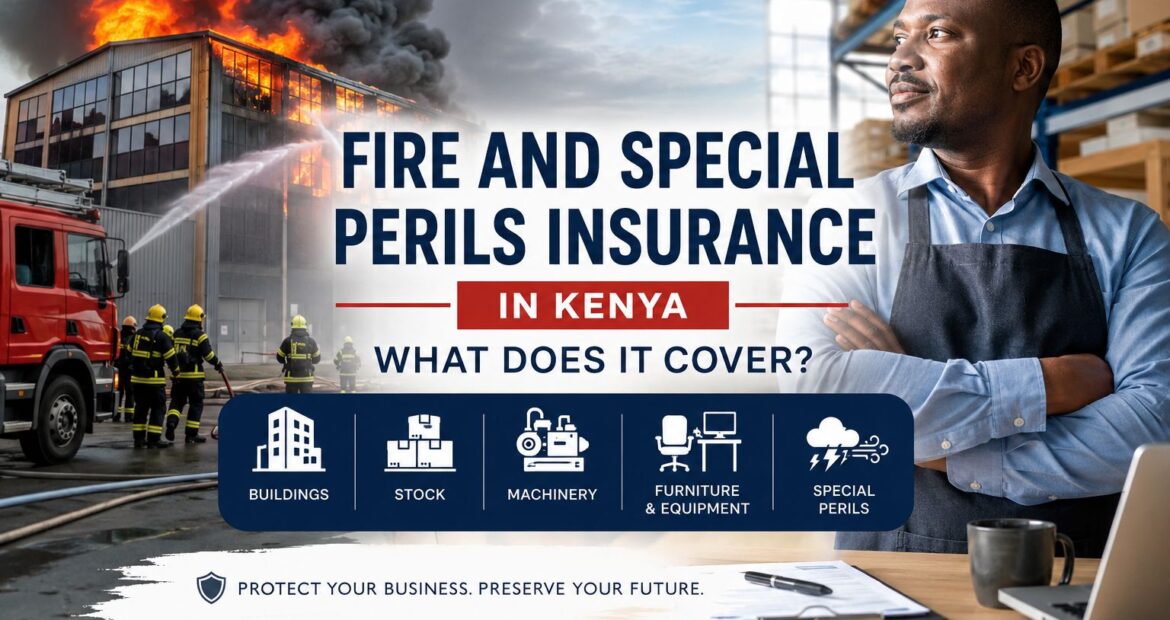
A fire can take years of business investment and destroy it within hours.
Stock accumulated over several months can disappear. Machinery can be damaged beyond repair. Furniture, computers, fittings and important equipment can be lost. Even after the fire is extinguished, the business may remain closed for weeks or months while repairs and replacement work take place.
This is why Fire and Special Perils Insurance is one of the most important forms of property insurance for Kenyan businesses.
Kenya’s Insurance Regulations recognise fire insurance as a distinct class of general insurance. For commercial and industrial risks, the regulations describe fire insurance as protection against loss of or damage to property from fire and other risks customarily included in fire policies, and they separately recognise consequential loss associated with fire.
But buying “fire insurance” does not mean that every possible cause of damage to your property is automatically insured.
The exact protection depends on the perils selected, sums insured, extensions, exclusions, excesses and conditions contained in your policy.
This guide explains what Fire and Special Perils Insurance in Kenya covers, what property can be insured, what may not be covered, how businesses should determine their sums insured and why fire insurance should sometimes be combined with business interruption insurance.
What Is Fire and Special Perils Insurance?
Fire and Special Perils Insurance is property insurance designed to protect insured assets against physical loss or damage caused by specified events.
The fire portion deals primarily with damage caused by fire and related core risks.
The special perils portion extends the policy to other specified events that can damage business property.
According to the Association of Kenya Insurers’ insurance guidebook, basic Fire and Perils Insurance protects property against fire, lightning and explosion, while cover can be extended to include several additional perils depending on the insurance arrangement.
This makes an important distinction:
Fire Insurance is not the same as “everything that can damage my business.”
It protects against the events actually insured by the policy.
What Does Basic Fire Insurance Cover?
At its core, fire insurance deals with loss or damage resulting from fire.
For example, imagine an electrical fault causes a fire inside a shop during the night.
The fire destroys stock, shelves, computers and furniture.
If those items were properly declared under the fire policy and the event falls within the insured terms, the policy can respond to the qualifying physical damage subject to the sum insured, excess and other conditions.
Fire cover can also commonly include lightning and specified explosion risks. The Association of Kenya Insurers identifies fire, lightning and explosion as the fundamental risks under basic Fire and Perils Insurance.
What Are “Special Perils”?
A fire is not the only event that can seriously damage business premises.
Consider a warehouse whose roof is badly damaged by a major storm.
Or a shop whose fittings are damaged during civil disturbance.
Or business premises damaged when a vehicle crashes into the building.
Depending on the policy, these risks can be added as special or allied perils.
The Association of Kenya Insurers notes that Fire and Perils cover may be extended to risks including riot, strike, malicious damage, storm, earthquake, impact by vehicles, aircraft or aerial devices, subterranean fire, spontaneous combustion and overflowing water from tanks or pipes.
The precise wording is important.
Do not assume all of these extensions are automatically included in every quotation.
Your quotation or policy schedule should identify which perils have actually been selected.
Fire Insurance vs Fire and Special Perils
The terminology can sometimes confuse business owners.
A basic policy may primarily cover:
Fire, lightning and specified explosion risks.
A broader Fire and Special Perils arrangement may add other insured events such as:
Storm, earthquake, riot, strike, malicious damage, vehicle impact or water-related damage, depending on the policy.
The Insurance Regulations themselves recognise fire insurance as including fire, explosion, storm and other occurrences customarily included within fire insurance policies.
The safest approach is therefore not to rely only on the name printed at the top of the quotation.
Ask:
“Exactly which perils are insured under this quotation?”
What Business Property Can Be Insured?
Fire and Perils Insurance can be used to protect a wide range of business assets.
The Association of Kenya Insurers identifies property such as buildings, plant and machinery, stock, office equipment, furniture, fixtures and fittings as common assets insured under fire-and-perils arrangements.
For a typical business, this can include the following categories.
Buildings
If the business owns the building from which it operates, the structure itself may be insured.
The sum insured should reflect the appropriate reinstatement or insured value basis required by the policy rather than simply an arbitrary figure chosen to reduce the premium.
Land itself is normally treated differently from the physical structure because fire does not destroy the land.
A business owner should therefore understand exactly what value the insurer expects to be declared for the building.
Stock
Stock can represent one of the largest assets on the balance sheet of a retailer, wholesaler, warehouse or manufacturer.
Examples include:
Merchandise awaiting sale, raw materials, finished products, packaging materials and other declared inventory.
Suppose a wholesale business normally carries:
KES 8 million of stock
but during peak season its stock rises to:
KES 15 million.
If the insurance programme has not been designed to accommodate those fluctuations, the business could potentially find itself inadequately insured at the time of a major loss.
Businesses with fluctuating stock levels should discuss this with their insurance adviser when structuring cover.
Machinery and Plant
Manufacturing and industrial businesses may own expensive machinery.
This can include production machines, generators, processing equipment and other plant.
Fire insurance can protect appropriately declared machinery against insured fire and related property damage.
However, an important distinction exists between:
Damage to a machine caused by an insured fire
and:
The machine simply breaking down mechanically.
Ordinary mechanical breakdown is not the same risk as fire damage and may require Machinery Breakdown Insurance or another engineering policy.
Kenya’s Insurance Regulations treat engineering risks such as machinery breakdown separately from fire insurance.
Furniture, Fixtures and Fittings
Businesses often underestimate the replacement value of everyday items.
Desks, shelves, counters, cabinets, chairs, partitions, fitted equipment and interior improvements can collectively represent a substantial amount.
If a fire destroys the entire interior of an office, replacing these items can become expensive even where no stock is involved.
Include them when assessing the amount of property at risk.
Computers and Office Equipment
Computers, servers, printers, networking equipment and other office assets may also be insured against qualifying fire and special-perils damage.
However, the policy may not automatically cover every type of electrical or electronic failure.
The Association of Kenya Insurers’ guidebook notes exclusions affecting certain electrical or electronic damage arising from events such as short-circuiting, arcing, self-heating or electricity leakage where the circumstances fall within the relevant exclusion.
A business with significant electronic equipment should therefore consider whether it also needs specialised electronic-equipment or all-risks protection.
Example: How Fire Insurance Can Protect a Business
Consider a Nairobi-based retail business.
The business has:
Stock: KES 4,000,000
Furniture and fittings: KES 700,000
Computers and equipment: KES 500,000
Other declared contents: KES 300,000
Total insured property:
KES 5,500,000
A fire starts in neighbouring premises and spreads into the shop.
The resulting qualifying damage is assessed at:
KES 3,200,000
A properly structured Fire and Special Perils policy may respond to the eligible property damage subject to the applicable sum insured, excess, policy conditions and assessment of the claim.
Without insurance, the business may need to raise the entire KES 3.2 million itself.
For many SMEs, that could threaten their ability to reopen.
Does Fire Insurance Cover a Business That Rents Its Premises?
A tenant can still have significant property at risk even though they do not own the building.
For example, a business renting an office may own:
- Computers
- Furniture
- Equipment
- Stock
- Interior fittings
- Machinery
The landlord may insure the building itself, but that does not automatically mean the tenant’s business assets are insured.
If you rent commercial premises, establish:
What does the landlord insure?
and:
What property am I responsible for insuring myself?
Never assume the landlord’s insurance protects your stock or equipment.
What if the Business Owns the Building?
A building owner has additional exposure.
The structure itself may need to be insured in addition to the business contents.
Businesses should also consider how long reconstruction could take following a severe fire.
Protecting the building is one issue.
Protecting the income lost while the building is unusable is another.
That brings us to an important distinction.
Fire Insurance Does Not Automatically Cover Lost Business Income
Suppose an insured fire destroys a restaurant.
The fire policy deals with qualifying physical property damage.
But the restaurant is closed for six months.
During that period, the owners still have financial obligations while sales have largely disappeared.
Ordinary property insurance does not automatically mean all lost income will be reimbursed.
Business Interruption Insurance is specifically designed to address specified financial consequences of an interruption following insured property damage.
The Association of Kenya Insurers explains that Business Interruption Insurance can cover loss of gross profits resulting from reduction or interruption of production following damage caused by fire and allied perils, together with specified continuing costs such as wages and claim-preparation expenses.
For businesses that could not comfortably survive a long closure, this distinction is extremely important.
Fire Insurance vs Business Interruption Insurance
Think of the two covers this way:
Fire and Special Perils
Protects the physical assets.
Business Interruption
Protects specified aspects of the financial consequences of losing the ability to operate following an insured event.
A business may therefore need both.
The Association of Kenya Insurers specifically notes the connection between fire insurance and business interruption insurance when businesses want to protect both assets and the financial effect of interruption.
What Is Not Normally Covered by Fire Insurance?
Every insurance policy has exclusions.
The specific exclusions must be taken from your actual policy wording.
For example, the Association of Kenya Insurers’ guidebook notes that certain valuable or specialised items may not be covered unless specifically declared. Examples can include particular works of art, securities, important documents, money, business books, computer records and other specialised property.
It also identifies certain types of electrical damage, temperature-related deterioration of cold-storage stock and specified boiler or steam-generating equipment losses among risks that can fall outside ordinary fire protection.
The lesson is not to memorise a generic exclusion list.
It is to identify unusual or particularly valuable property in your business and ask whether it is expressly covered.
Fire Does Not Mean Every Cause of Fire Is Automatically Treated the Same
Claims are assessed according to the circumstances and policy wording.
An insurer may examine:
- How the fire started
- Where it started
- What property was damaged
- Whether the insured property existed
- Whether sums insured were adequate
- Whether material information was properly disclosed
- Whether policy warranties were followed
- Whether the loss falls within an exclusion
This is why businesses should provide accurate risk information before taking cover.
What Are Policy Warranties?
A commercial fire policy may contain risk-management requirements.
Depending on the business, these could relate to matters such as:
- Fire extinguishers
- Electrical systems
- Storage methods
- Fire-fighting equipment
- Occupancy
- Hazardous materials
- Housekeeping
- Security
The precise warranties vary according to the risk and insurer.
If a quotation contains a warranty, understand what it requires before accepting the policy.
Insurance should work alongside sensible fire-prevention measures.
Why the Nature of Your Business Matters
Not all businesses have the same probability or severity of fire loss.
Compare:
Accounting Office
Mainly computers, desks and ordinary office equipment.
with:
Furniture Factory
Timber, machinery, electrical equipment and combustible materials.
and:
Petrol-Related Business
Potentially significant flammable-material exposure.
These are fundamentally different insurance risks.
An insurer therefore considers what activities actually take place at the premises.
Accurately describe your business.
Do not describe a manufacturing operation as an ordinary office simply to obtain a lower premium.
How Is the Fire Insurance Premium Determined?
There is no one standard price for Fire and Special Perils Insurance in Kenya.
The premium depends on the characteristics of the risk.
Factors can include the value of property insured, nature of business, construction of the premises, location, fire protections, claims history, selected perils and any additional extensions.
Kenya’s insurance regulatory framework recognises Fire—Industrial and Commercial as a distinct class of general insurance, reflecting the specialised underwriting associated with commercial property risks.
This is why a warehouse, restaurant, office and factory should not necessarily expect identical rates.
How Much Should You Insure Your Property For?
This is one of the most important decisions in property insurance.
Suppose a business owns assets that would require:
KES 10 million
to appropriately reinstate or replace according to the policy’s valuation basis.
The business should not simply choose:
KES 4 million
because the premium will be cheaper.
Insuring property for substantially less than its appropriate value can leave the business exposed.
Where the policy contains an average or underinsurance provision, inadequate sums insured can reduce the settlement following a partial loss.
The precise valuation basis and any average clause should therefore be confirmed from the quotation and policy rather than assumed.
Example of the Underinsurance Problem
Consider an illustrative scenario.
Actual appropriate insured value of property:
KES 10 million
Declared sum insured:
KES 5 million
The business has effectively insured only part of its exposure.
A fire subsequently causes:
KES 2 million
of damage.
The business owner might assume:
“My policy limit is KES 5 million, so the KES 2 million claim must be paid in full.”
That may not necessarily be the outcome if the policy contains an underinsurance or average condition.
This is why correct valuation matters even where the loss is smaller than the stated policy limit.
Review Your Sums Insured Regularly
Asset values change.
Businesses purchase more machinery.
Stock levels grow.
Replacement costs increase.
New offices are fitted out.
A Fire and Special Perils policy that was adequate three years ago may now be seriously outdated.
Review your sums insured when:
- Purchasing major new equipment
- Expanding the business
- Opening another branch
- Increasing stock significantly
- Renovating premises
- Renewing the insurance
Do not simply renew last year’s figures automatically.
Seasonal Stock Can Create a Hidden Risk
Retailers and wholesalers can experience dramatic variations in stock.
Imagine a shop that normally holds:
KES 3 million
in stock.
In November and December it increases stock to:
KES 7 million.
If a fire occurs during the high-stock period, the difference can become significant.
Businesses with seasonal stock fluctuations should discuss the correct structure with their insurance adviser.
Should You Insure Stock at Cost or Selling Price?
Do not guess.
The valuation basis depends on the insurance terms and the nature of the property.
Ask exactly how the insurer wants stock valued.
Insurance is intended to indemnify qualifying loss according to the policy, not create a profit from the insured event.
Accurate stock records are therefore extremely important.
Why Stock Records Matter After a Fire
After a severe fire, much of the physical evidence can be destroyed.
Suppose you claim that:
KES 8 million
of stock was lost.
The assessor may require records supporting the quantity and value of the stock before the loss.
Useful records can include:
- Supplier invoices
- Purchases
- Sales records
- Inventory reports
- Accounting records
- Stock counts
Businesses should maintain appropriate backups, ideally including records stored away from the physical premises or securely online.
What Should You Do Immediately After a Fire?
Human safety comes first.
Contact emergency services and ensure people are moved away from danger.
Once the immediate emergency has been addressed, notify your insurer or insurance intermediary as soon as reasonably possible.
Preserve evidence and take photographs where it is safe to do so.
Avoid unnecessarily disposing of damaged property before the insurer has had an opportunity to inspect it.
Take reasonable steps to prevent further damage.
For example, temporary measures may be required to secure the premises after firefighters leave.
Follow the claims instructions contained in your policy.
What Documents May Be Required for a Fire Claim?
Requirements depend on the circumstances.
A commercial fire claim may involve evidence relating to:
- Ownership of property
- Stock
- Asset values
- Repairs
- Replacement costs
- Incident circumstances
- Business records
For a substantial loss, the insurer may appoint:
- Loss assessors
- Investigators
- Other specialists
to establish the cause, extent and value of the loss.
Complete and accurate business records can significantly improve the claims process.
Can the Insurer Investigate the Cause of the Fire?
Yes.
A major property loss may require investigation to establish what happened and whether the event falls within the policy.
This should not automatically be interpreted as an accusation against the policyholder.
The insurer has to establish:
- What caused the loss
- What was damaged
- Whether it was insured
- How much the loss is worth
- Whether any policy conditions affect the claim
Cooperate with legitimate requests for information.
What Happens if a Fire Starts in a Neighbouring Business?
A fire does not have to start inside your own premises to damage your property.
Imagine a fire starts in the shop next door and spreads through the building.
Your own Fire and Special Perils Insurance can still be relevant to the physical damage to your insured property, subject to the policy terms.
Questions of responsibility between the businesses can subsequently involve separate legal and recovery issues.
The immediate priority for your own insurance claim is whether your loss falls within your cover.
What if Firefighters Damage Property While Extinguishing the Fire?
Fire claims can involve more than items directly burned by flames.
Water, smoke and reasonable fire-fighting activity can also damage property.
The treatment of these losses depends on the policy terms and circumstances.
Do not automatically discard water-damaged or smoke-damaged items before assessment.
Fire Insurance and Loans
Banks and other lenders sometimes require property being used as security to remain insured.
If a business has financed:
- A commercial building
- Machinery
- Other significant assets
the financing agreement may specify insurance requirements.
The lender may also have an interest noted on the policy.
Always understand the financier’s requirements when insuring financed commercial assets.
Fire Insurance for SMEs
Fire insurance is not only for large factories.
A small business can be financially more vulnerable to fire because it may have limited reserves.
Consider a small salon containing:
KES 700,000 of equipment and fittings.
A restaurant with:
KES 2 million of kitchen equipment.
A shop carrying:
KES 3 million of stock.
A small printing business with:
KES 4 million of machines.
A severe fire could seriously affect any of them.
The size of the business does not determine whether the risk matters.
The size of the potential loss relative to the business’s ability to absorb it does.
Fire Insurance for Home-Based Businesses
Working from home does not automatically mean business property is fully protected under ordinary household insurance.
If you operate a business from home and own:
- Commercial stock
- Professional equipment
- Machinery
- Business computers
confirm whether those assets are insured under the applicable policy.
Do not assume personal household cover automatically protects commercial property.
Fire Insurance vs Industrial All Risks
Larger or more complex businesses may sometimes consider broader property-insurance structures such as Industrial All Risks rather than a traditional named-perils approach.
The appropriate structure depends on the size and complexity of the risk.
Fire—Industrial and Commercial is recognised as a distinct class within Kenya’s general insurance regulatory framework.
Businesses with substantial property values should seek advice on whether a traditional Fire and Special Perils policy or a broader commercial property programme is appropriate.
Questions to Ask Before Buying Fire and Special Perils Insurance
Before accepting a quotation, establish the answers to the following:
| What to Check | Why It Matters |
|---|---|
| Property insured | Know exactly which assets are protected |
| Sum insured | Avoid inadequate protection |
| Fire cover | Confirm the basic insured peril |
| Special perils | Identify which extensions are included |
| Stock values | Ensure inventory is adequately declared |
| Business interruption | Protect income as well as property |
| Excess | Know your contribution after a claim |
| Warranties | Understand risk-control obligations |
| Exclusions | Know what is outside the policy |
| Valuation basis | Know how insured property should be valued |
| Claims process | Know what to do after a fire |
This comparison is more useful than looking only at the annual premium.
Cheapest Fire Insurance vs Appropriate Fire Insurance
Suppose two insurers provide quotations.
Quote A
Annual premium:
KES 30,000
Quote B
Annual premium:
KES 45,000
It is tempting to immediately choose Quote A.
But suppose Quote B includes important special perils relevant to your location, more suitable policy limits or extensions that Quote A does not provide.
The KES 15,000 saving may be insignificant compared with a multimillion-shilling uninsured loss.
Compare the protection, then compare the premium.
Why Use an Independent Insurance Agency?
Different insurers can apply different:
- Premiums
- Excesses
- Underwriting requirements
- Special-perils structures
- Risk-management conditions
- Policy extensions
An independent insurance agency can help a business compare appropriate market options without assuming that one insurance company is automatically suitable for every risk.
The objective should be to identify the policy whose structure best matches the business’s actual exposure.
Online Advisors therefore approaches commercial insurance by considering:
What property is at risk?
What events could damage it?
How much could the loss be?
How much protection does the business require?
and only then:
Which available insurance option provides suitable terms?
Verify the Insurer
Before purchasing any commercial insurance, confirm that the underwriting insurer is appropriately licensed.
The Insurance Regulatory Authority regulates Kenya’s insurance industry and maintains current resources for licensed insurers and other insurance entities.
This is particularly important where quotations are received through unfamiliar online sellers or intermediaries.
Know who is actually underwriting the risk.
Frequently Asked Questions
What does Fire and Special Perils Insurance cover in Kenya?
Basic Fire and Perils Insurance generally protects insured property against fire, lightning and specified explosion risks. Additional perils can be added depending on the policy, including risks such as riot, strike, malicious damage, storm, earthquake, vehicle impact and specified water damage.
Does fire insurance cover stock?
Stock is among the business assets that can be insured under Fire and Perils Insurance, provided it is properly declared and insured according to the policy.
Does fire insurance cover furniture and computers?
Buildings, office equipment, furniture, fixtures and fittings are among assets commonly capable of being insured under Fire and Perils Insurance.
The treatment of particular electronic damage may depend on exclusions and whether another specialised cover is needed.
Does fire insurance cover loss of income?
Not automatically.
Business Interruption Insurance is specifically designed to address specified loss of profit and continuing financial costs following an interruption caused by insured property damage.
Can a tenant buy fire insurance?
Yes.
Even where the landlord insures the building, the tenant may still need protection for their own stock, furniture, equipment and other business assets.
Is every special peril automatically covered?
No.
The actual policy schedule determines which extensions and perils have been insured.
Always check the quotation and policy wording.
Is fire insurance compulsory for every Kenyan business?
There is no general rule making the same Fire and Special Perils policy compulsory for every business.
However, lenders, landlords, contracts or particular business arrangements may require property insurance.
Businesses should check their own contractual obligations.
The Bottom Line
Fire and Special Perils Insurance protects the physical foundation upon which many businesses operate.
It can protect:
Buildings
Stock
Machinery
Furniture
Fixtures and fittings
Office equipment
against specified insured events.
But the words “fire insurance” on a certificate are not enough.
A business owner needs to understand:
What property is insured.
Which perils are insured.
How the property has been valued.
What excesses apply.
What warranties must be followed.
What is excluded.
Whether business interruption is also needed.
The most important question is therefore not:
“How cheap can I get fire insurance?”
It is:
“If my premises burned down tonight, would this policy provide enough protection to help my business recover?”
That is the question your insurance programme should answer.
Compare Fire and Special Perils Insurance in Kenya
At Online Advisors Insurance Agency Ltd, we help businesses compare commercial property insurance options available from reputable insurers in Kenya.
Our role as an independent insurance intermediary is to help you understand the cover rather than promote one insurance company as suitable for every business.
We can help you assess:
- Buildings
- Stock
- Machinery and equipment
- Furniture and fittings
- Fire and Special Perils
- Business interruption
- Appropriate sums insured
- Policy excesses
- Important exclusions
Request a Business Insurance Quote
Tel: 0723 645 810
Website: www.onsure.co.ke
Office: Vision Plaza, 1st Floor, Office 2, Mombasa Road, Nairobi
A fire can happen in hours. Building the business took years. Protect what you have built.
Important Disclaimer
This article provides general insurance education and does not constitute legal advice, an insurance quotation or a recommendation of a particular insurer. Fire and Special Perils policies vary in their insured perils, sums insured, excesses, warranties, exclusions and extensions. Businesses should obtain current quotations and review the applicable policy schedule and wording before purchasing cover.
Online Advisors Insurance Agency Ltd is an independent insurance intermediary. Product availability and underwriting terms vary between insurance companies.