


You have comprehensive motor insurance. Your vehicle gets involved in an accident, you report the claim, and the insurer approves the repairs. Then you are informed that you need to contribute part of the repair cost because of an insurance excess.
For many vehicle owners, this raises an obvious question:
“Why am I paying anything when I already paid for comprehensive insurance?”
The answer lies in one of the most important — and sometimes misunderstood — provisions in a motor insurance policy: the excess.
A motor insurance excess is the portion of an insured loss that the policyholder is required to bear before or alongside the insurer’s contribution, subject to the terms of the policy.
Understanding your excess before buying comprehensive insurance is important because two policies with similar premiums can expose you to very different out-of-pocket costs when you make a claim.
This guide explains how motor insurance excess works in Kenya, the different types you may encounter, how excess protector works, and what you should check before choosing a comprehensive motor insurance policy.
What Is Motor Insurance Excess?
Motor insurance excess is the amount of an admissible claim that you, as the insured, are required to bear according to your insurance policy.
It is sometimes also referred to as a deductible.
Consider a simple example.
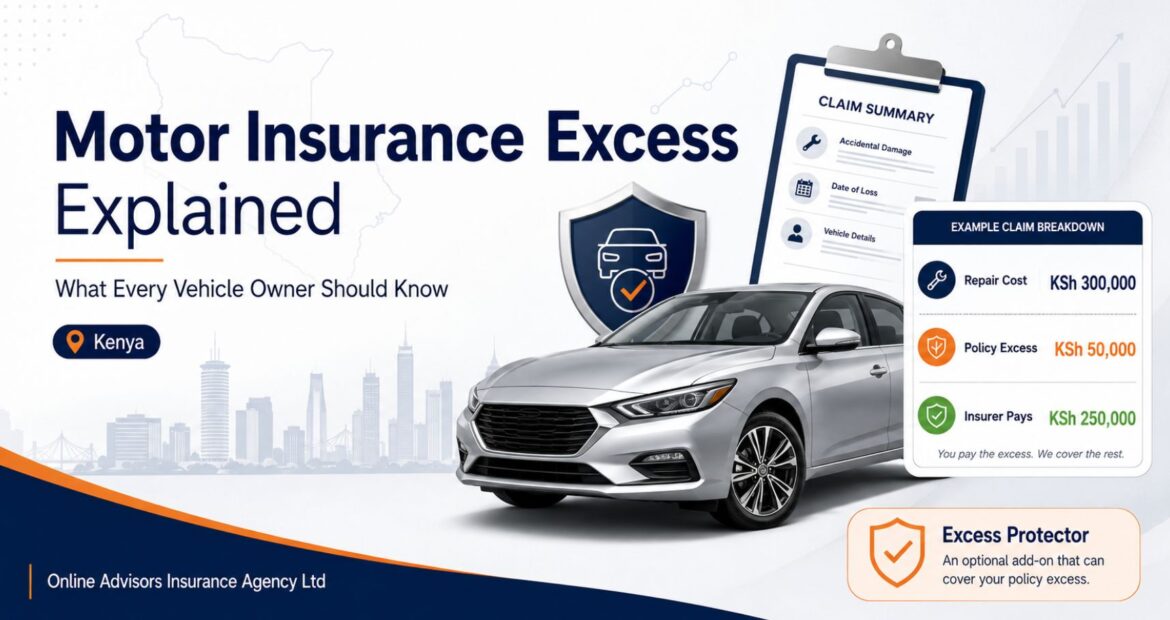
Suppose your vehicle is involved in an accident and the approved repair cost is:
KES 300,000
Your applicable policy excess is:
KES 50,000
Subject to the policy terms, your contribution would be:
KES 50,000
and the insurer would contribute:
KES 250,000
Therefore:
Total repair cost: KES 300,000
Policyholder excess: KES 50,000
Insurer’s contribution: KES 250,000
Being comprehensively insured does not necessarily mean that the insurer pays every shilling of every claim.
Britam, for example, explains in its current comprehensive motor product information that compensation for theft is subject to an excess, illustrating that excess provisions form part of comprehensive motor insurance terms.
The exact excess applicable to your vehicle is determined by the terms, schedule, endorsements and conditions of your particular insurance policy.
Why Do Insurance Companies Apply an Excess?
Excess serves several purposes.
1. It Shares Part of the Risk
Insurance transfers a significant portion of financial risk from the policyholder to the insurer.
An excess means the policyholder retains a defined portion of that risk.
2. It Discourages Very Small Claims
Without an excess, an insurer could receive claims for every small scratch, dent or minor incident.
Processing very small claims can create administrative costs that are disproportionate to the value of the loss.
An excess means some minor losses may remain below the amount worth claiming.
3. It Encourages Risk Management
Because the policyholder retains some financial responsibility, excess provisions can encourage more careful driving and vehicle protection.
4. It Helps Insurers Price Risk
The amount of risk retained by the policyholder can form part of the insurer’s underwriting and pricing considerations.
A policy with more extensive excess protection may therefore cost more than one under which the motorist retains greater financial responsibility.
How Is Motor Insurance Excess Calculated?
There is no single excess amount that applies to every motor insurance policy in Kenya.
An insurer may specify excess as:
- A percentage of the vehicle’s insured value;
- A fixed monetary amount;
- A percentage subject to a minimum amount; or
- Another basis stated in the policy.
For example, suppose the policy states:
Own Damage Excess: 2.5% of the vehicle value, minimum KES 20,000
If the vehicle is valued at:
KES 2,000,000
then:
KES 2,000,000 × 2.5%
= KES 50,000
Because KES 50,000 is above the hypothetical KES 20,000 minimum, the applicable excess in this example would be:
KES 50,000
The percentages and minimum amounts in this example are for illustration only. Actual excesses vary between insurers, vehicle categories and individual policies.
Example: How Excess Affects an Accident Claim
Suppose your vehicle is insured for:
KES 2,000,000
and your policy has an illustrative own-damage excess of:
2.5% of the insured value
Your excess would be:
KES 50,000
Now assume an accident causes:
KES 400,000 in approved repairs.
Without applicable excess protection:
| Claim Component | Amount |
|---|---|
| Approved repair cost | KES 400,000 |
| Policyholder excess | KES 50,000 |
| Insurer contribution | KES 350,000 |
You would therefore need to bear KES 50,000 of the loss, subject to the actual policy terms.
This demonstrates why looking only at the annual insurance premium can be misleading.
One insurer might charge a slightly lower premium but impose a higher excess.
Another insurer could cost slightly more but provide more favourable excess terms.
What Types of Motor Insurance Excess Can Apply?
This is where vehicle owners need to pay close attention.
There can be more than one excess under a motor insurance policy.
Depending on the insurer and policy, you may encounter provisions relating to:
- Basic or own-damage excess
- Theft excess
- Young driver excess
- Inexperienced driver excess
- Unauthorised or unnamed driver provisions
- Additional excesses imposed for particular risks
Not every insurer uses identical terminology or thresholds.
Always refer to your actual policy schedule and wording.
1. Basic or Own-Damage Excess
The basic excess is the amount you may be required to contribute when making an own-damage claim.
For example, your vehicle may hit another vehicle, a wall or another object and sustain damage.
If the loss is covered, your insurer may approve repairs but apply the basic excess stated in the policy.
Example
Approved repairs:
KES 250,000
Applicable basic excess:
KES 40,000
Policyholder contribution:
KES 40,000
Insurer contribution:
KES 210,000
unless an applicable excess protector or other policy provision changes the amount payable.
2. Theft Excess
A policy may impose an excess where the insured vehicle is stolen or suffers an insured theft loss.
This can be particularly important because the value involved in a total theft claim may be substantial.
Britam’s current comprehensive motor insurance information, for example, explicitly states that compensation following theft is subject to an excess.
The theft excess does not necessarily have to be identical to the normal accidental-damage excess.
For that reason, when buying comprehensive insurance, ask:
“What is my theft excess?”
Do not assume that an ordinary excess protector automatically removes every theft-related excess.
3. Young Driver Excess
Some insurers may impose an additional excess when the vehicle is being driven by a person below a specified age.
The insurer’s definition of a young driver must be checked in the policy because age thresholds can differ.
For example, an insurer could define young drivers according to its own underwriting criteria and impose an additional excess where a claim occurs while such a person is driving.
This can be important for families where children or younger relatives occasionally drive the insured vehicle.
If several people will use the vehicle, disclose this when arranging the cover.
4. Inexperienced Driver Excess
A driver can be older but still be considered inexperienced.
An insurer may define an inexperienced driver according to how long the person has held a driving licence or other criteria specified in the policy.
Consequently, a newly licensed driver may be subject to an additional excess even if that person is not particularly young.
The exact definition varies between insurers.
Can More Than One Excess Apply to a Claim?
Potentially, yes, depending on the policy wording.
This is one reason it is dangerous to assume:
“My excess is only KES 20,000.”
You need to establish whether that is:
- The basic excess;
- The minimum excess;
- An additional driver excess;
- The theft excess; or
- Only one of several applicable excess provisions.
Before purchasing comprehensive motor insurance, ask the insurer or insurance intermediary to explain the potential excesses relevant to your circumstances.
What Is an Excess Protector?
An excess protector is an optional motor insurance benefit designed to protect the policyholder against certain excesses that would otherwise be payable following a claim.
Instead of simply buying:
Comprehensive Insurance
you may choose:
Comprehensive Insurance + Excess Protector
The excess protector normally attracts an additional premium.
The purpose is to reduce your potential out-of-pocket contribution when an applicable claim occurs.
Example: Claim Without Excess Protector
Suppose:
Vehicle value: KES 3,000,000
Approved accident repairs: KES 500,000
Applicable basic excess: KES 75,000
Without excess protector:
Policyholder bears: KES 75,000
Insurer contributes: KES 425,000
subject to policy terms.
Example: Claim With Excess Protector
Assume the same vehicle and loss:
Approved repairs: KES 500,000
Basic excess: KES 75,000
If the policyholder purchased an excess protector that specifically covers this basic excess and all its applicable conditions have been satisfied, the policyholder may avoid having to bear that KES 75,000 basic excess.
That is the potential value of buying an excess protector.
Does Excess Protector Cover Every Type of Excess?
Not necessarily.
This is one of the most important points in this article.
An excess protector should not automatically be interpreted as protection against every possible excess in the policy.
Depending on the insurer and policy wording, limitations may apply to areas such as:
- Theft
- Young drivers
- Inexperienced drivers
- Particular vehicle uses
- Specific policy endorsements
- Certain types of losses
- Other compulsory excesses
The scope differs between insurance products.
Before purchasing it, ask:
“Exactly which excesses does this excess protector waive or cover?”
That question is much better than simply asking:
“Does the policy have excess protector?”
Is Excess Protector Worth Paying For?
For many comprehensive motor insurance customers, it can be worth considering.
Suppose an optional excess protector costs you an additional amount when purchasing the policy, but the basic excess applicable after an accident could run into tens of thousands of shillings.
The additional premium could therefore protect you from a considerably larger unexpected expense.
However, whether it represents good value depends on:
- The cost of the excess protector
- Value of your vehicle
- Amount of basic excess
- Scope of the protection
- Excluded excesses
- Your risk tolerance
- Your insurer’s policy terms
The correct approach is therefore not to buy it blindly, but to compare the additional premium against the financial exposure it removes.
Does Excess Apply When an Accident Was Not Your Fault?
This is an important question.
How an excess is handled following a non-fault accident depends on the circumstances of the claim, the policy wording and whether recovery can successfully be made against the responsible third party or their insurer.
Do not automatically assume that because you believe another driver was at fault, no excess will initially be relevant to your own-damage claim.
Your insurer or intermediary should explain:
- How your claim will be handled;
- Whether an excess is initially applicable;
- Whether recovery will be pursued from the responsible party;
- Whether any recoverable amount can subsequently be reimbursed.
Liability also needs to be established rather than simply assumed.
What Happens If the Claim Is Smaller Than the Excess?
Consider this example:
Approved damage:
KES 25,000
Applicable excess:
KES 50,000
The loss is lower than the excess.
In a typical excess structure, there would effectively be no amount for the insurer to contribute toward that particular own-damage loss because the loss falls within the amount retained by the insured.
This is one reason excess provisions discourage very small claims.
Is the Excess Deducted From the Insurance Premium?
No.
The premium and the excess are different.
Premium
The premium is the price you pay to purchase the insurance policy.
Excess
The excess is the portion of an eligible loss you may need to bear when making a claim.
Paying your annual comprehensive premium does not automatically remove your excess.
You need to look at whether the policy includes an appropriate excess protector.
Premium vs Excess: An Example
Suppose you receive two comprehensive motor insurance quotations.
Insurer A
Annual premium:
KES 80,000
Basic excess:
KES 75,000
Insurer B
Annual premium:
KES 88,000
Basic excess:
KES 40,000
At first glance, Insurer A appears cheaper.
But suppose you subsequently have an accident.
The difference in potential claim contribution may be significantly greater than the KES 8,000 difference in annual premiums.
This does not mean Insurer B is automatically better.
It demonstrates why insurance should be compared using:
Premium + Benefits + Excesses + Limits + Exclusions + Claims Terms
rather than price alone.
Why You Should Check Excess Before Buying Motor Insurance
Many customers understandably begin by asking:
“How much is the comprehensive insurance?”
But another equally important question is:
“How much could I have to pay if I make a claim?”
Before choosing a comprehensive motor insurance quotation, ask for clarification on:
- Basic excess
- Minimum excess
- Theft excess
- Young driver excess
- Inexperienced driver excess
- Excess protector
- What the excess protector covers
- Any special excess applicable to your vehicle
- Other important exclusions or endorsements
The Insurance Regulatory Authority continues to emphasize consumer education and understanding of policy coverage, claims processes, and policyholder rights and responsibilities.
Five Questions to Ask Before Buying Excess Protector
Before selecting a policy, ask your insurance advisor:
1. What is my normal own-damage excess?
Ask for the amount or calculation method.
2. What excesses does the excess protector cover?
Do not assume it covers everything.
3. Is theft excess protected?
Get a clear answer based on the policy wording.
4. Are young and inexperienced driver excesses protected?
This is particularly important where several family members use the vehicle.
5. How much does excess protector add to my premium?
You can then evaluate the additional premium against the amount of risk you would otherwise retain.
Common Mistakes Vehicle Owners Make About Excess
Mistake 1: Assuming Comprehensive Means Zero Contribution
Comprehensive insurance provides broad protection, but it remains subject to excesses, exclusions, limits and policy conditions.
Mistake 2: Choosing Insurance Only on Price
The cheapest premium may come with different excesses or benefits.
Compare the entire policy.
Mistake 3: Assuming Excess Protector Covers Everything
Always check its scope.
Mistake 4: Not Declaring Other Drivers
If younger, newly licensed or other people regularly drive your vehicle, discuss this with the insurer or intermediary.
Proper disclosure helps ensure you understand the terms applicable to those drivers.
Mistake 5: Reading the Excess Clause Only After an Accident
The best time to understand your excess is before buying the policy, not when your vehicle is already at the garage.
Frequently Asked Questions About Motor Insurance Excess in Kenya
What is excess in motor insurance?
It is the portion of an eligible insured loss that the policyholder is required to bear under the terms of the insurance policy.
Is excess compulsory on comprehensive motor insurance?
Comprehensive policies commonly contain excess provisions, although the amount, calculation method and circumstances in which they apply vary between insurers and policies.
How much is motor insurance excess in Kenya?
There is no universal amount.
It may be expressed as a percentage, fixed amount or percentage subject to a minimum. The exact figure should appear in your quotation, policy schedule, endorsement or policy wording.
What is excess protector in car insurance?
Excess protector is an additional benefit designed to protect against certain excesses that would otherwise be borne by the policyholder following a covered claim.
Does excess protector cover theft?
Do not assume so.
Whether theft excess is covered depends on the specific insurer’s excess protector terms.
Ask your insurer or insurance intermediary to confirm this before purchasing the policy.
Can I buy comprehensive insurance without excess protector?
Depending on the insurance product, yes.
However, you should understand the amount of excess you could need to bear if you subsequently make a claim.
Do I pay excess every year?
An excess is not the same as your annual premium.
It normally becomes relevant when an applicable claim occurs under circumstances in which the policy requires you to bear an excess.
Is excess calculated on the repair cost or vehicle value?
This depends on the policy.
An insurer may specify an excess using the insured value, a fixed amount, a minimum amount or another basis.
Always check the wording applicable to your particular policy.
The Bottom Line
Motor insurance excess is one of the most important factors to understand when comparing comprehensive insurance policies in Kenya.
A cheap premium does not necessarily mean a cheap claim.
Before purchasing cover, understand:
How much is my basic excess?
What other excesses can apply?
What does my excess protector actually cover?
How much could I need to contribute after an accident or theft?
These questions allow you to compare motor insurance on value rather than premium alone.
Compare Comprehensive Motor Insurance Options
At Online Advisors Insurance Agency Ltd, we help vehicle owners compare comprehensive and third-party motor insurance options from reputable insurance companies in Kenya.
Our role is not simply to show you a premium. We can also help you understand important differences such as:
- Applicable excesses
- Excess protector
- Policy benefits
- Optional covers
- Limits
- Exclusions
- Claims requirements
Need a Comprehensive Motor Insurance Quote?
Call: 0723 645 810
Website: www.onsure.co.ke
Visit us: Vision Plaza, 1st Floor, Office 2, Mombasa Road, Nairobi
Compare the premium. Understand the excess. Choose your cover with confidence.
Important Disclaimer
This article is intended for general insurance education and does not constitute a specific insurance quotation, policy wording or guarantee of claim payment. Excess percentages, minimum amounts, definitions, benefits and exclusions differ between insurers and insurance products. Always review the insurer’s current quotation, policy schedule, endorsements and policy wording before purchasing cover.