

Buying motor insurance in Kenya does not have to be complicated. Whether you are taking out comprehensive insurance, third-party cover, or renewing an existing motor policy, having the correct documents ready can make the process significantly faster.
For most individual motorists, insurers commonly require basic identification details together with documents and information that confirm ownership and identify the vehicle being insured.
For example, Britam’s current digital motor insurance application requests a customer’s KRA PIN, ID number, copy of identification and vehicle logbook, together with vehicle details such as the chassis number, engine number, registration number, make, model, year of manufacture and estimated vehicle value.
This guide explains the documents you may need to insure a vehicle in Kenya, additional requirements for comprehensive motor insurance, and what you should prepare before requesting a quotation.
Quick Answer: Documents Commonly Required for Motor Insurance in Kenya
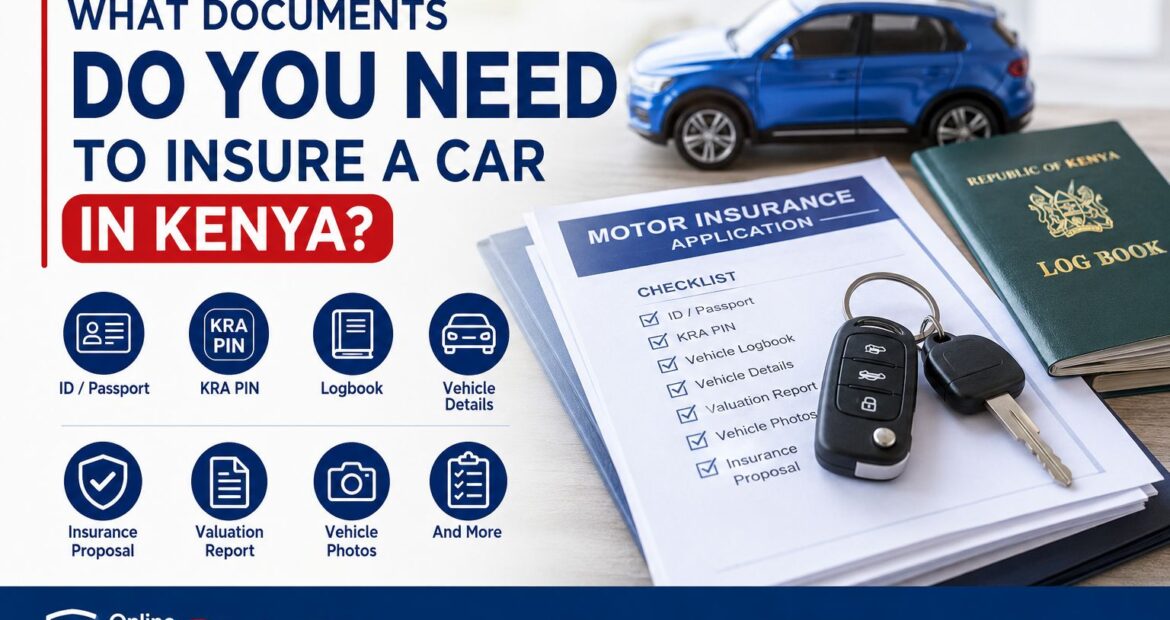
For a privately owned vehicle, you should generally have the following available:
- Copy of National ID or valid passport
- KRA PIN
- Copy of vehicle logbook
- Vehicle registration number
- Chassis number
- Engine number
- Vehicle make and model
- Year of manufacture
- Vehicle use
- Estimated or assessed vehicle value where comprehensive insurance is required
- Completed motor insurance proposal or application details
- Vehicle valuation report where required
- Vehicle inspection or photographs where requested by the insurer
The exact requirements depend on the insurer, type of vehicle and type of cover being purchased.
1. National ID or Passport
The insurer needs to establish the identity of the person taking out the insurance policy.
For individual customers, this will commonly involve providing:
A copy of your Kenyan National ID
or, where applicable:
A valid passport or other acceptable identification document.
The details you provide should be accurate and correspond with the information being used to issue the insurance policy.
Insurers may request this identification during both policy purchase and subsequent claims.
For example, Britam’s motor claims process asks customers to have copies of their National ID ready when submitting a motor claim.
2. KRA PIN
You will normally also be requested to provide your Kenya Revenue Authority PIN.
The KRA PIN helps identify the policyholder for regulatory and administrative purposes.
When applying for motor insurance digitally, insurers may request your KRA PIN as part of the personal information required to generate and issue the policy.
Britam’s current motor insurance application, for example, specifically requires a KRA PIN from the applicant.
It is therefore useful to have a clear electronic copy or your KRA PIN number available when requesting insurance.
3. Vehicle Logbook
The vehicle logbook is one of the most important documents when arranging motor insurance.
It contains important vehicle and ownership information that allows the insurer to correctly identify the vehicle being insured.
Your logbook provides details such as:
- Registered owner
- Registration number
- Vehicle make
- Vehicle model
- Chassis number
- Engine number
- Other registration particulars
Britam’s current online motor insurance process requires customers to upload a copy of the vehicle logbook.
The logbook also becomes important during claims. Britam’s motor claims checklist, for example, includes a copy of the logbook among the documents required when dealing with accident, partial-theft and other motor claims.
What If the Vehicle Is Not Registered in Your Name?
This should be disclosed to the insurer or insurance intermediary before the policy is issued.
There are legitimate situations where the person arranging insurance may not yet appear as the registered owner.
Examples can include:
- Recently purchased vehicles
- Vehicles awaiting ownership transfer
- Financed vehicles
- Company vehicles
- Vehicles registered in another legal entity’s name
The insurer may request additional documentation explaining your legal or financial interest in the vehicle.
Do not simply assume ownership details are irrelevant because you physically possess the vehicle.
Insurance is based partly on the principle that the person arranging cover should have an appropriate insurable interest in the property being insured.
4. Vehicle Registration Number
You will need to provide the vehicle’s correct registration number.
For example:
KXX 123X
The registration number will normally appear on insurance documents and the motor insurance certificate.
Double-check the number before the policy is issued.
A simple typing error can create unnecessary complications when verifying insurance or handling a claim.
5. Chassis Number
The chassis number — often associated with the Vehicle Identification Number or VIN — helps uniquely identify the vehicle.
It is particularly useful because registration plates can change, while the chassis identifier relates to the actual vehicle itself.
Britam’s current motor insurance application requests the vehicle chassis number as part of the quotation process.
Ensure the chassis number provided matches your official vehicle documentation.
6. Engine Number
The insurer may also request the vehicle’s engine number.
Like the chassis number, this provides an additional means of identifying the vehicle being insured.
The engine number should correspond with your vehicle records unless there has been an officially documented engine change.
Britam’s motor insurance application currently requests both the chassis and engine number.
7. Vehicle Make and Model
You will need to identify the vehicle accurately.
For example:
Make: Toyota
Model: Prado
or:
Make: Mazda
Model: CX-5
This information can affect underwriting because different vehicles may present different:
- Repair costs
- Spare-parts costs
- Theft exposures
- Values
- Performance characteristics
- Claims experience
Do not simply describe the vehicle as “Toyota” or “Mercedes.”
Provide the correct make and model.
8. Year of Manufacture
The insurer may ask for the vehicle’s year of manufacture.
Vehicle age can influence whether an insurer is willing to provide comprehensive cover and the terms they offer.
Depending on the insurer, older vehicles may require:
- Additional inspection
- Valuation
- Different comprehensive rates
- Higher excesses
- Special underwriting approval
Britam’s current motor insurance quotation process includes the vehicle’s year of manufacture among the required vehicle details.
This leads directly into our next Week 3 article:
Can Older Cars Get Comprehensive Insurance in Kenya?
9. Vehicle Value for Comprehensive Insurance
If you are buying comprehensive motor insurance, the value of the vehicle becomes particularly important.
Comprehensive insurance premiums are commonly influenced by the vehicle’s insured value.
For example, a vehicle worth:
KES 1,000,000
will generally present a different potential own-damage loss to an insurer than a vehicle worth:
KES 5,000,000.
Britam’s online motor application requests an estimated vehicle value and notes that the full premium may ultimately be determined based on the vehicle’s valuation report.
Therefore, if you are requesting comprehensive insurance, be prepared to provide an approximate current value of your vehicle when obtaining an initial quotation.
10. Vehicle Valuation Report
For comprehensive insurance, an insurer may require the vehicle to be professionally valued.
The purpose of the valuation is to establish an acceptable value for insurance purposes and confirm important details about the vehicle.
A valuation may help verify matters such as:
- Current vehicle value
- Vehicle condition
- Chassis details
- Engine details
- Accessories
- Existing damage
- Vehicle specifications
This reduces disputes about the insured vehicle and its condition.
A valuation is particularly important because the value used for insurance can influence both the premium and how a total-loss or theft claim is assessed.
Do You Need a Valuation Before Getting a Quote?
Not necessarily.
You can often obtain an initial or indicative comprehensive insurance quotation using your estimated vehicle value.
For example:
Vehicle estimated value: KES 2,500,000.
The insurer or intermediary can use this value to prepare an initial quotation.
A formal valuation may then be required as part of finalising the comprehensive cover.
This means you do not necessarily need to delay requesting quotes simply because you have not yet had the car valued.
11. Vehicle Photographs or Inspection
An insurer may require photographs or physical inspection before confirming certain comprehensive motor covers.
The purpose is usually to document the condition of the vehicle when cover starts.
Photographs may include:
- Front of vehicle
- Rear
- Left side
- Right side
- Windscreen
- Dashboard
- Odometer
- Registration plates
- Chassis or other identifying details where appropriate
This is particularly useful in establishing whether damage existed before the insurance policy started.
The exact inspection requirements differ between insurers.
Why Does Pre-Insurance Inspection Matter?
Consider this situation:
A vehicle already has significant damage to the front bumper before comprehensive insurance begins.
Three weeks later, the policyholder submits a claim for front-bumper damage.
Without documentation of the vehicle’s pre-insurance condition, it may be difficult to establish when the damage occurred.
Pre-insurance inspection helps both the policyholder and insurer document the condition of the vehicle when the risk was accepted.
12. Details About How the Vehicle Is Used
Insurance is not based solely on the vehicle itself.
The insurer also needs to understand how the vehicle is used.
You may therefore need to specify whether it is used for:
- Private purposes
- Commercial purposes
- Taxi operations
- PSV operations
- Transport of goods
- Institutional purposes
- Company activities
- Other specialised activities
This is important because a private vehicle and a taxi, for example, do not present identical risks.
Never insure a vehicle as private if it is actually being used commercially simply to obtain a cheaper premium.
Incorrectly describing the use of a vehicle can create serious problems when a claim occurs.
13. Motor Insurance Proposal Form
You may be required to complete a physical or digital motor insurance proposal form.
This is more than an administrative form.
The proposal provides the insurer with information upon which it can assess the risk.
You may be asked questions relating to:
- Policyholder details
- Vehicle details
- Vehicle use
- Drivers
- Previous insurers
- Claims history
- Previous accidents
- Previous insurance cancellations
- Modifications
- Vehicle value
- Required cover
- Optional benefits
Answer these questions accurately.
Material information should not be intentionally concealed simply because you believe it could increase the premium.
Additional Documents for a Company-Owned Vehicle
Where a vehicle belongs to a company rather than an individual, the documentation may differ.
Depending on the insurer and circumstances, you may be requested to provide company details such as:
- Certificate of incorporation or registration details
- Company KRA PIN
- Vehicle logbook
- Contact-person details
- Relevant company identification information
- Completed proposal form
- Other know-your-customer documentation required by the insurer
Fleet insurance applications may require additional schedules showing details of all vehicles being insured.
Additional Information for Financed Vehicles
If your vehicle has been purchased through asset finance, disclose this when arranging comprehensive insurance.
The financier normally has a financial interest in the vehicle.
The insurance documentation may therefore need to reflect that interest appropriately.
You may be required to provide information relating to:
- Financing institution
- Vehicle registration
- Vehicle value
- Financing interest
- Required insurance terms
Financiers commonly require vehicles under asset finance to maintain comprehensive insurance because the vehicle represents security for the outstanding financing.
What Documents Do You Need for Third-Party Motor Insurance?
Third-party insurance usually involves fewer valuation-related requirements because the policy is primarily concerned with liabilities to third parties rather than paying for accidental damage to the insured vehicle.
For a normal private vehicle, you should generally be prepared with:
- National ID or appropriate identification
- KRA PIN
- Vehicle logbook/details
- Registration number
- Vehicle make/model
- Vehicle use
- Required policy period
- Proposal/application details
A formal vehicle valuation will generally be more relevant to comprehensive insurance than ordinary third-party-only cover.
Exact requirements remain subject to the insurer.
What Documents Do You Need for Comprehensive Motor Insurance?
For comprehensive insurance, prepare:
Personal Documents
- ID/passport
- KRA PIN
Vehicle Documents
- Logbook
- Registration number
- Chassis number
- Engine number
- Make/model
- Year of manufacture
Underwriting Information
- Vehicle use
- Estimated value
- Driver/use information where requested
- Claims history where requested
Additional Requirements
- Valuation report where required
- Vehicle photographs or inspection
- Completed proposal/application
- Financier information where applicable
Having these ready can substantially speed up the process.
What Documents Will You Need If You Eventually Make a Claim?
The documents needed to buy insurance should not be confused with the documents required to make a claim.
Following a motor accident, additional documents may be required.
Britam’s current claims process, for example, instructs customers to obtain a police abstract and prepare copies of their driver’s licence, National ID and vehicle logbook.
Its published motor-claims checklist also references documentation such as:
- Completed motor accident/theft claim form
- Identification documents
- Vehicle logbook
- Driver’s licence
- Police abstract
- Evidence relating to the accident
- Applicable excess payment
depending on the nature of the claim.
Therefore, keep your insurance and vehicle documentation organised even after the policy has been issued.
Common Mistakes When Applying for Motor Insurance
1. Giving the Wrong Vehicle Value
Do not intentionally undervalue a vehicle simply to reduce the premium.
Use a reasonable current estimate and obtain the required valuation.
2. Providing an Incorrect Registration Number
Check every letter and number.
3. Failing to Disclose Commercial Use
If the vehicle is being used as a taxi, commercial vehicle or for another business purpose, disclose it.
4. Ignoring Ownership Differences
If the logbook is not in your name, explain the circumstances before the cover is issued.
5. Providing Inconsistent Chassis or Engine Details
Information should correspond with the official vehicle documentation.
6. Waiting Until the Last Day to Renew
Do not wait until the insurance expires before looking for documents, obtaining quotations and arranging valuation.
Starting early gives you time to compare different options properly.
How Long Does It Take to Get Motor Insurance?
The process can be relatively quick when:
- Your documents are ready
- Vehicle details are accurate
- The insurer has accepted the risk
- The required premium has been paid
- Any necessary inspection or valuation has been completed
- There are no underwriting issues requiring additional approval
Third-party cover can generally involve a simpler underwriting process than comprehensive insurance because comprehensive cover may require valuation and other checks.
Motor Insurance Document Checklist
Before requesting your quotation, use this checklist:
Individual Policyholder
☐ National ID/passport
☐ KRA PIN
☐ Vehicle logbook
☐ Registration number
☐ Chassis number
☐ Engine number
☐ Make and model
☐ Year of manufacture
☐ Vehicle-use details
For Comprehensive Insurance
☐ Estimated vehicle value
☐ Valuation report where required
☐ Vehicle photographs/inspection where required
☐ Details of optional benefits required
Where Applicable
☐ Financier information
☐ Company documentation
☐ Additional driver information
☐ Claims history
☐ Completed proposal form
Frequently Asked Questions
Can I get a car insurance quote without a logbook?
You may sometimes obtain an initial indicative quote by providing basic vehicle information, but the insurer will generally require adequate vehicle documentation and details before finalising the policy.
Do I need my KRA PIN to insure a vehicle in Kenya?
Insurers commonly request the policyholder’s KRA PIN as part of the application process. Britam’s current online motor application, for example, requires both a KRA PIN and ID details.
Do I need a valuation for third-party insurance?
Vehicle valuation is primarily relevant to comprehensive cover because comprehensive insurance protects the insured vehicle against covered own-damage and theft risks.
A standard third-party-only policy will not normally depend on the vehicle’s market value in the same way.
Do I need a valuation for comprehensive insurance?
An insurer may require a professional valuation when issuing comprehensive cover. The insurer determines its own valuation and inspection requirements.
Can I insure a vehicle that is not in my name?
There are circumstances in which this may be possible, but you should disclose the ownership situation and demonstrate the appropriate legal or financial interest in the vehicle.
Speak to your insurer or insurance intermediary before purchasing the policy.
Can I insure a newly purchased vehicle before transfer is completed?
This should be discussed with the insurer or intermediary. Additional documentation relating to the purchase and ownership transfer may be required.
Does an insurance company need the original logbook?
Requirements differ between insurers and circumstances. Digital insurance applications frequently allow customers to upload a copy of the logbook; Britam’s current online application, for example, provides for electronic upload of the document.
Get a Motor Insurance Quote in Kenya
Having the right documents ready makes buying motor insurance much easier.
At Online Advisors Insurance Agency Ltd, we can help vehicle owners compare motor insurance options from reputable insurers and understand the requirements before purchasing cover.
Whether you require:
- Comprehensive motor insurance
- Third-party insurance
- Commercial motor insurance
- Private vehicle insurance
- Motorcycle insurance
you can request assistance in identifying an appropriate option for your vehicle.
Request a Motor Insurance Quote
Tel: 0723 645 810
Website: www.onsure.co.ke
Office: Vision Plaza, 1st Floor, Office 2, Mombasa Road, Nairobi
Prepare your documents, compare available insurance options and understand the policy before you buy.
Important Disclaimer
Documentation and underwriting requirements vary between insurers, vehicle types and individual circumstances. This article provides general educational information and should not be interpreted as a complete list of documents required by every insurer. Always confirm the current requirements for the specific insurance product you intend to purchase.